Mac Musings
New Macs Before the Expo? What Is Apple Thinking?
Daniel Knight - 2008.01.09
Did it strike you as kind of odd that Apple would announce new Macs one week before the Macworld Expo? The more I think about it, the more it has me wondering. What is Apple thinking releasing the most powerful Mac and most powerful Xserve ever a week before the Expo?
The last Expo I attended seemed to be dominated by iPods, and last year's Expo was dominated by the iPhone. Even with the big hoopla about the Intel transition, the Mac seems to have taken a back seat at the Macworld Expo.
What about this year?
Digital Video
One possibility is that Apple has something so new and so different that they want to get the new Macs out of the way in advance. The Mac is already growing toward 10% market share in the US. Apple has dominated the digital music market. Apple is already an important player in the mobile phone market.
However, there's one product in the Apple line that's not a huge success, Apple TV. Sure, it's a big player in its market, but at present that's a pretty small market. With more and more video content available through the iTunes Store and rumors of a video rental service, Apple TV could become a bigger part of a much bigger market.
A lot of us would love to see Apple enter the DVR market, and now that the cable industry (Comcast, Time Warner, Cox) has embraced standardized technology that will work with all carriers, the door is open for TVs and DVRs that can work with whatever cable carrier you have thanks to this new open architecture.
That's one possibility, that Apple is going to embrace digital video and make the DVR another component in the digital hub, allowing users to record programs, port them to their computers and iPods, and who knows what else.
Apple has long been a leader in this area. Macs with SuperDrives were the first affordable computers to ship with DVD burners, and iMovie has long allowed Mac users to edit digitized and digital video content.
A Renewed Focus on Macs
That's a possibility - a very real one - but I think the reason Apple unveiled the new Mac Pro and Xserve on Tuesday is so they won't steal the thunder from other new Macintosh computers.
The Next MacBook Pro
The 15.4" and 17" MacBook Pro are wonderful, powerful machines. They already offer speeds up to 2.6 GHz, which is very impressive. And while some think their design is becoming a bit dated, I think they look great. The design is nearly perfect - and after nearly 20 years of making portable computers, you'd expect that from Apple.
At the very least, we can expect a refresh and speed bump for the MacBook Pro. Yesterday Intel announced its new 45nm chip line, which includes a 2.8 GHz Mobile Core 2 Extreme. Expect that to hold portable fans over until the July-Sept. period, which is when Intel expects to ship its first Mobile Core 2 Quad processors. Those should really make the MacBook Pro smoke!
The MacBook Pro line was last updated in June, and the January Macworld Expo has traditionally been the time and place to announce new PowerBook and MacBook Pro models.
The Next iMac
The iMac is a bit more current, just updated in August. But with the Mac Pro going quad-core, I wouldn't be at all surprised to see Apple offering a quad-core iMac - at least as a build-to-order option. And for those who hate the glare of the aluminum iMac's glossy display, maybe Apple will license a really good antiglare coating or make matte an option.
If there's a new iMac, expect 2 GB of RAM standard and support for up to 8 GB of RAM. Also look for the same 320 GB drive in the Mac Pro becoming the iMac's standard drive.
The Mac mini
The original Mac mini was unveiled at the Expo three years ago and the first Intel-based model one year later. The mini finally became a Core 2 Mac in September, and it's at the bottom of the Mac food chain in many respects: even the fastest mini is slower than the slowest MacBook.
There are rumors that the Mac mini will be replaced by an even smaller Mac nano, but you just can't get much smaller without eliminating the optical drive. And who wants a Mac where you can't reinstall the OS or install software from CD or DVD? Besides, people have come to love the Mac mini next to their digital TVs, and without an optical drive, how are you going to watch DVDs?
I think the Mac mini will stick around, and I don't think we'll see any changes in its configuration until March or April.
The MacBook
The latest incarnation of the MacBook is one month younger than the Mac mini, so don't expect any changes here until April or May.
New Macs
There are three holes in the Apple product line: There is no midrange modular desktop Mac between the Mac mini, which has very limited expansion, and the Mac Pro, which has more than almost anyone could need. There is no ultralight, ultracompact, ultraportable MacBook. And there's no tablet Mac, although the Modbook (finally shipping!) fills that niche.
The Macintosh
For lack of a better name, let's call the model between the mini and the Pro the Macintosh. For hobbyists - that is, computer users who love to tinker with hardware, change components, tweak they systems - there's nothing like a modular desktop with several drive bays and expansion slots. It's the kind of computer we've been asking for for years, something much more affordable than the Mac Pro and much more expandable than the Mac mini.
What's the best argument for Apple building it? It's called the "Hackintosh", and it's become the popular way for hobbyists to cobble together their own computer with the drive bays and expansion slots they want for a whole lot less money than Apple wants for the Mac Pro. A whole lot less.
If Apple wants to prevent Mac OS X from running on non-Apple hardware, they need to fill this niche, as these users are discovering the joys of the Mac OS and spreading the gospel of the Hackintosh as a real alternative to "Apple's overpriced hardware". If Apple builds it and sells it at a realistic price, they will come.
What would it take to attract this market? Two or three PCIe expansion slots. Three drive bays: one for a 3.5" hard drive, one for an optical drive, and one for either. A socketed CPU, because these folks just love to upgrade. My recommendation would be a 2.0 GHz Core 2 Duo entry-level model with 2 GB of RAM, a 250 GB 3.5" hard drive, a SuperDrive, and the same Intel X3100 video found on the MacBook. With expansion slots, those who want or need better video performance could easily drop in the video card of their choice. Sell it for US$799 and watch it move out the door!
CPU options should include a 2.4 GHz Core 2 Duo and a 2.8 GHz Core 2 Quad at the very least, and there should be at least two banks of memory supporting up to 8 GB of RAM.
However, as much as we'd love to see Apple fill this hole, believing that the hobbyist's advice will be the key to Apple's continued growth, we're not holding our breath. We want it, but we don't expect it.
The MacBook mini
The ultralight notebook market is not for those with thin pocketbooks, and I'd anticipate that a "MacBook mini" would have an aluminum skin like the MacBook Pro models to keep size and weight down. This is a premium market, so there's no need to go with a plastic case like the MacBook. Considering how users loved and still love the 12" PowerBook G4, expect something no wider than 11", no thicker than 1", and with a widescreen display, so probably 7.5" in the third dimension.
This should get the weight under 4 pounds, possibly as light as 3.5 lb. while retaining the built-in optical drive that's been the norm since the first G4 PowerBook was unveiled in 2001. We definitely expect a smaller, lighter MacBook at the Expo.
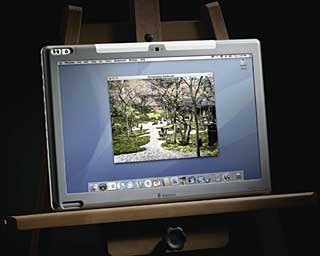 The MacTablet
We would have called this the iTablet, but Steve Jobs has stated that he wants every Mac to have "Mac" in its name. So MacTablet it is. Again, it's a model we would love to see but do not expect to see at the Expo.
The most popular type of Tablet PC has a screen hinged so that it can work as a standard notebook computer or as a tablet. Were Apple to produce a MacTablet, this is the configuration we would expect. The Modbook already exists for those who want a tablet-only design.
The Mac nano
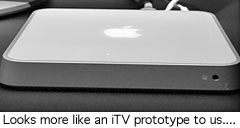 We're not convinced that there's a market for a Mac without a
built-in optical drive, and many of the supposed photos of a Mac nano
turned out to be pictures of Apple TV prototypes. That said, there's no
reason in the world Apple couldn't build a mini server using the Apple
TV enclosure. With remote control (built right into Leopard), it could
be the perfect home and small office server.
We're not convinced that there's a market for a Mac without a
built-in optical drive, and many of the supposed photos of a Mac nano
turned out to be pictures of Apple TV prototypes. That said, there's no
reason in the world Apple couldn't build a mini server using the Apple
TV enclosure. With remote control (built right into Leopard), it could
be the perfect home and small office server.
Newton Redux
There's a spot between the size of a Palm or iPod and the 10" and larger Tablet PCs that was once filled by the Newton and where the Amazon Kindle is trying to carve out its existence. It's not a big market, as people prefer something pocketable or with a keyboard, but it could become a big market. Just look at the success of the PS Portable!
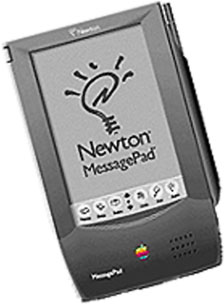 This isn't anything we expect Apple
to do, as it took a bath on the Newton, but it does have the technology
to create and own a market midway between the iPod touch/iPhone/Palm
and 10" Tablet PCs. It would be far better for watching video and using
the Web than the minuscule screen on the iPhone. Add-ons could include
a keyboard and a DVD drive (keep the cost down by making it an
option).
This isn't anything we expect Apple
to do, as it took a bath on the Newton, but it does have the technology
to create and own a market midway between the iPod touch/iPhone/Palm
and 10" Tablet PCs. It would be far better for watching video and using
the Web than the minuscule screen on the iPhone. Add-ons could include
a keyboard and a DVD drive (keep the cost down by making it an
option).
Such a device, perhaps 4" x 7" x 1", would have room for a full-size notebook drive, not the expensive 1.8" hard drives or flash drives found in the iPod classic and touch respectively. And it could use all of the wonderful technology created for the iPhone and iPod touch while running the full Mac OS X Leopard.
We can dream....
One More Thing
Apple hasn't done anything with Network Attached Storage (NAS), and one real possibility for expanding its presence would be a MacServer about the same size as the Mac mini that includes a hard drive, a 4-port gigabit ethernet hub, and 802.11n WiFi along with some USB 2.0 ports for adding one or more printers (it would act as a print server) and additional hard drives. Give it "vampire video" to keep costs down and set it up for remote control from a Mac running Leopard - and make it 100% Windows friendly.
Of course, our dream "One More Thing" announcement would be that Apple has decided how to invest some of its $15 billion - by buying Dell. Dell is in sorry shape. It's market value has dropped from $72 billion six months ago (when Apple passed them) to $45 billion today.
Dell's problem is that what they do best is sell commodity computers and peripherals, and that's a market where price is the bottom line. You'll find Dell notebooks, desktops, and servers everywhere. You'll even find Dell displays connected to Macs (like mine). But you won't find the kind of brand loyalty Apple engenders: Dell users are easily enticed to HP or some other brand because under the skin they're all the same thing - x86 processors running Windows.
Were Apple to acquire Dell, they wouldn't "shut it down and give the money back to the shareholders," as Michael Dell once suggested Apple do. Instead, they'd cut out all of the unprofitable and unnecessary product lines (Dell printers? What were they thinking?) and focus on Dell-branded computers that would ship with Windows, Linux, and/or Mac OS X.
Imagine the impact of all of those Dell kiosks in shopping malls demonstrating Leopard. Imagine the way being able to offer Mac OS X would distinguish Dell from all the other PC brands that only sell Windows computers. Imagine the money Apple could make by letting Dell fill niches, such as a midrange desktop Mac, that Apple really isn't interested in.
Beyond that, imagine what it would do for the Mac's market share and Apple's bottom line.