
2008: This one boggles the mind: The iPod and iTunes Music Store were essentially invented in 1979. That’s more than 20 years before the first iPod shipped – and three years before the first CD players came to market!
Kane Kramer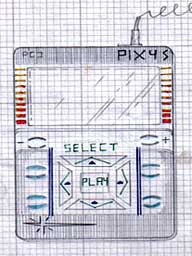 has been identified as the man behind the iPod. More precisely, as the man who came up with the idea that is at the heart of the iPod.
What Kramer conceived in 1979 was a solid state digital music player with a display, a control pad (eerily like Apple’s control wheel), and a supporting system whereby people could buy and download their music in digital form to solid state cards. (The images accompanying this article are cleaned up from faded, discolored images on Kramer’s website.)
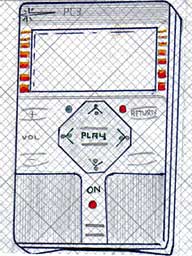 There aren’t a lot of technical details on Kramer’s website or in the prospectus that he sent out to potential investors (downloadable as a PDF from his website). Kramer’s idea was that consumers would be able to go into a music store, pay a fee, and have a track downloaded via phone to a card of some sort, probably one with an EPROM (a type of write-once memory module). These cards, which could each store up to 3.5 minutes of music, which could be played in an iPod-like player.
This was before flash memory and EEPROM, before IBM got into the personal computer business, before people had heard of the Internet. It was the same year the first Sony Walkman came to market and created a tidal wave of personal portable cassette players.
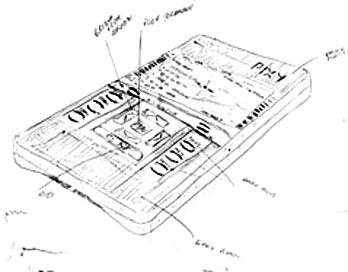
Kramer really thought things through – working with the record companies, a central bank of servers that stored the digitized music, how retailers would be billed and copyright holders and artists paid, and much more. Reading it, you’d almost think someone familiar with the iPod and iTunes Store had gone back in time to 1979.
Kramer’s IXI system had huge technological hurdles in 1979, and cassette tape held a lot more than 3.5 minutes of music, so IXI never went anywhere. To add insult to injury, Kramer ran out of money to renew his patents in 1988, so he has never seen a dime from all of the iPods sold.
So What?
The reason this obscure bit of history was dug up was a lawsuit against Apple. In 2006, Burst.com filed a patent infringement suit against Apple. It had already won a $60 million settlement with Microsoft in 2005 over Windows Media Player. In 2007, Apple agreed to settle with Burst for $10 million – and in return Burst seemingly promised not to sue Apple again.
The problem is, people can patent the silliest or most obvious things, so there’s the potential for Apple to be sued over any aspect of the iPod, iTunes, and the iTunes store – the iPod’s controller, the iPod’s menu system, storing digitized music on a hard drive or flash drive, storing tracks on a central server, serving tracks from a remote server, synchronizing libraries between iTunes and your iPod, how payments to record companies and artists and copyright holders are processed – you name it.
Thanks to Kane Kramer’s groundbreaking work in 1979, Apple now has the answer to most of those potential lawsuits: prior art. If someone else invented it first and you can prove it, that’s sufficient grounds to invalidate a patent. Kramer’s model covers centralized servers with digitized music, paying royalties, electronic distribution (over phone lines in 1979), etc.
At present, Apple has presented Kramer with an iPod, flown him in to testify in court, and paid for his time as a witness. Considering all the ways knowing about Kramer’s IXI system will benefit Apple, let’s hope it compensates Kramer handsomely.
keywords: #kanekramer #itunesstore #ipod #itunesmusicstore
short link: https://wp.me/p51SSp-dde
