
2008 – The G3 range of iMacs had propelled Apple into the public eye, had sometimes been the best selling personal computer on the market, and had helped Apple come back from the brink. Between the iMac and the iPod, the whole world was watching Apple.
When would Apple put a G4 in the iMac? And how would Apple update its best seller?
The iMac Goes G4
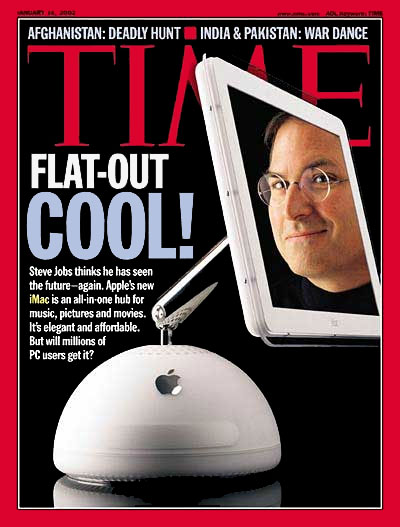 The world learned the answer from Time magazine before Apple announced the new computer. Steve Jobs and the iMac G4 were the cover story for the January 14, 2002 issue, which went on sale before Apple’s Jan. 7 announcement of the new model.
Such is the world of publishing, but it took Jobs by surprise – along with the rest of the world.
The G4 iMac not only adopted the G4 CPU that had previously been reserved for Apple’s pro models (the Power Mac and PowerBook), but it used a radical new design as well. The CPU, hard drive, and tray loading optical drive were in a 10″ hemisphere, and the 15″ flat panel display seemed to float above it, held in place by a chrome arm.
It’s not just a work of art; the technology makes it very easy to move the display and have it stay in place. Unusual as the design is, it’s also very utilitarian. Time called it “the most fabulous desktop machine that you or anyone anywhere has ever seen.”
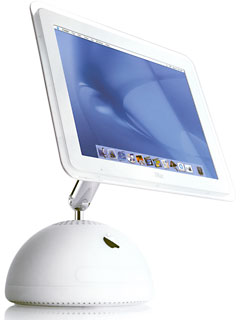 The G3 iMacs had topped out at 700 MHz, and that was exactly where the G4 iMac line began. The entry-level model had a 700 MHz G4 CPU, which added the power of the AltiVec velocity engine to the power of the G3 CPU – and coupled that with Nvidia GeForce 2MX graphics and a 15″ 1024 x 768 flat panel display. Like the G3 iMac before it, the base 700 MHz model included a CD-RW drive, but the next step up replaced that with a CD-RW/DVD-ROM Combo drive, something never offered for the G3 range.
At the top of the line was the first 800 MHz iMac – and the first iMac with a SuperDrive.
On the down side, G4 iMacs weren’t nearly as affordable as the G3 models they replaced. Where Apple had dipped below US$1,000 for some G3 models and never went over US$1,499 for a top-of-the-line G3 iMac, the new G4 model ranged in price from $1,299 to $1,799. It was worth it for the extra processing power, improved graphics engine, and beautiful display, but the iMac no longer appeared affordable to Mom and Pop Consumer.
Bigger Is Better
Apple simplified the iMac line in February 2003 by eliminating the 700 MHz models along with CD-RW and SuperDrive options. There was a single 800 MHz 15″ iMac with a Combo drive that retailed for US$1,299. You can’t get much simpler than that!
Rather than offer two iMacs with the same size screen and different CPU speeds, Apple introduced a new top-end iMac with a 1 GHz G4 CPU, a SuperDrive, a 7200 rpm hard drive and a 17″ 1440 x 900 pixel display. This replaced the 15″ 800 MHz SuperDrive model with the same US$1,799 price tag. 25% more power, 65% more pixels, and a widescreen display made it a great value, and for the first time the iMac was coming close to offering pro level performance.
Apple next improved the iMac in September 2003, adopting USB 2.0 ports while boosting the 15″ iMac to 1 GHz and the 17″ model to 1.25 GHz without raising prices.
Bigger Yet
The ultimate G4 iMac came to market two months later. With a whopping 20″ 1680 x 1050 display and GeForce 5200 Ultra graphics, the US$2,199 20″ iMac G4 was a realistic alternative to the Power Mac for many users. (The 20″ display was so heavy that Apple had to add weight to the base to counterbalance it.)
Speaking of the Power Mac, this was the year Apple moved from a top-end 1.42 GHz dual processor Power Mac G4 to IBM’s new G5 CPU. While the iMac had nearly half the power of the 1.42 GHz dual G4, the G5 had allowed Apple to move beyond that level, with models ranging from a single 1.6 GHz processor G5 to dual 2.0 GHz CPUs.
Flatter and Faster
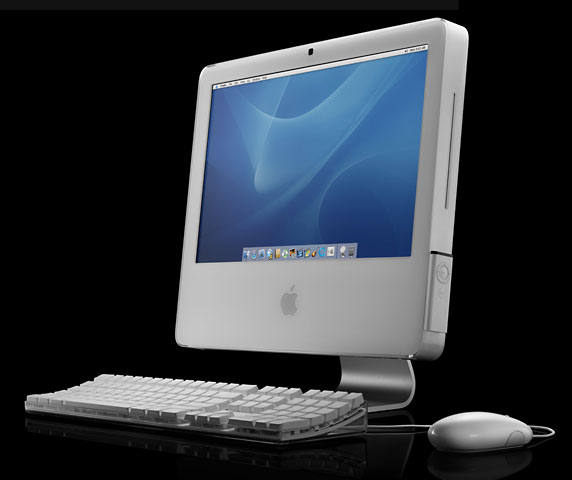 The next step in iMac evolution introduced a whole new design that hid the computer behind its display. The white iMac G5 was introduced in 17″ and 20″ versions in August 2004. A 17″ 1.6 GHz model with a Combo drive went for US$1,299, a 1.8 GHz version with a SuperDrive for US$1,499, and a 20″ iMac G5 for US$1,899.
The vertical design was supposed to improve ventilation and cooling, and Apple has continued to use this configuration of packing the entire computer behind the display ever since.
Apple bumped speeds by 200 MHz in May 2005, also cutting $100 from the price of the 20″ iMac.
iSee You
The final version of the G5 iMac was introduced in October 2005. The 17″ model came in just one speed, 1.9 GHz, and the 20″ was a bit faster at 2.1 GHz. But the big new feature was a built-in iSight webcam. The third version of the G5 iMac was also thinner than earlier models, supported more memory, and the top-end model was brought down to a US$1,699 price point.
The Intel Transition
Apple shocked the computer world when it announced in June 2005 that Macs would be abandoning the PowerPC family of processors for Intel CPUs “next year”. The iMac made the switch in January 2006, months before we expected Apple to begin the transition to Intel.
The Intel Core Duo iMac shared the same design as the last generation G5 iMac. The entry-level 17″ iMac had a 1.83 GHz dual-core processor, while the 20″ ran its dual-core CPU at 2 GHz. In terms of raw processing power, these offered at least twice what the G5 had.
In May these were joined by a less expensive 17″ Core Duo iMac with a Combo drive and integrated graphics that was designed for the education market.
Intel introduced a more powerful CPU family, Core 2 Duo, and the iMac adopted the Core 2 Duo in September 2006. There were four models: 17″ 1.83 GHz with integrated graphics, 17″ 2.0 GHz with dedicated graphics, 20″ 2.16 GHz, and a new supersized 24″ 2.16 GHz iMac with a 1920 x 1280 display.
Aluminum
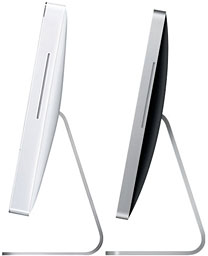 Apple refreshed the iMac’s design in August 2007. The new iMacs had the same configuration as recent models, but they were clad in aluminum with a glass faceplate over the screen. The matte display was gone; from here on, iMacs would have glossy displays.
Apple eliminated the 17″ model from the line, and the new iMacs were even slimmer than the previous ones, and speeds ranged from 2.0 GHz to 2.8 GHz.
The most recent update to the iMac line came in April of this year, when Apple began using Intel’s next generation Penryn Core 2 Duo CPU in the iMac. Speeds now range from 2.4 GHz to 3.06 GHz.
We’ve come a long ways since the 233 MHz G3 iMac first went on sale ten years ago.
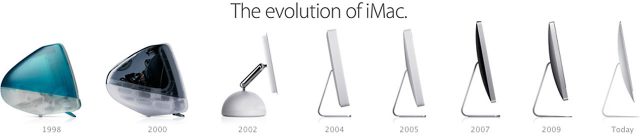
This image did not accompany the original version of this article, which only covers the first six of the eight designs shown here.
Keywords: #imac #imaclegacy #imacg4 #imacg5
Short link: http://goo.gl/jFOiWY
searchword: imaclegacy
