
2008: The iPod very much dominates the MP3 player market, the iTunes Store dominates the digital music market (and probably video as well), the iPhone has redefined the smartphone market, and the Macintosh is the #3 personal computer brand in the US – and the #2 personal computer operating system, growing at an impressive rate that’s mostly at the expense of Windows (see The Windows Death Spiral).
Apple has been very profitable for a very long time and has $19.5 billion cash on hand. Apple continues to innovate, as seen in relatively recent products including the iPhone, iPod touch, Apple TV 2.0, and MacBook Air. Although OS X 10.5 Leopard had some teething pains, they are pretty much a thing of the past, and we can be confident that MobileMe will soon settle down the the level of quality and reliability that we expect from Apple.
Apple has always played an important role in the personal computer industry, although it has never been a dominant player. Despite its seemingly small market share, Apple innovation has shaped the industry, just as it now shapes the MP3 player and mobile phone industries. And just as Apple came to dominance in the MP3 player market and could soon be the #2 player in the smartphone market, Apple has grown the Mac to the #3 PC hardware brand in the US. (Only HP and Dell have a higher market share.)
The Mac OS has long been the #2 operating system for personal computers, a distant second to Microsoft Windows but well ahead of Linux (which has a very strong server presence). Thanks to dissatisfaction with the world of Windows, where PCs often come preloaded with “unnecessary crapware” (a bundle of useful freeware and lots of trialware), Vista is more widely maligned than embraced, and malware is a fact of life (not to mention the cost and processing overhead of running anti-malware programs), Mac sales are growing at an impressive rate.
The Broader PC Market
Mac sales are growing at a 30% annual rate, and Apple recently passed Acer (which owns Gateway, eMachines, and Packard Bell, which in conjunction with NEC acquired Zenith Data Systems in 1996*) for the #3 spot in the US market. (Acer remains the #3 brand worldwide.)
Started as PC’s Limited in 1984 while Michael Dell was a student at the University of Texas at Austin, Dell grew by avoiding retail sales and selling customized (build-to-order) computers to its customers. Dell became the largest PC maker in the US in 1999, passing Compaq (now part of HP), a position it retained through mid 2006, when HP overtook it to become the top dog in the PC market.
Unlike Acer, which grew by acquiring existing brands, Dell has only acquired one PC maker, the high-end Alienware brand, much beloved of gamers.
Dell was sold through Best Buy, Costco, and Sam’s Club stores in the early 1990s, but Dell left that market in 1994. Dell returned to the retail market in 2003 through Sears, but that didn’t last long. After it was overtaken by HP, Dell decided to reenter the retail market; now you can buy Dell computers from Staples, Best Buy, Sam’s Club, and Walmart.
Despite acquiring Alienware in 2006 and adding these additional channels in 2007, Dell has not overtaken HP worldwide, although it is #1 in the US, where it has 31.9% of the market (HP follows at 25.3%).
Since acquiring Compaq in 2002, Hewlett-Packard (HP) has grown the become the biggest player in the worldwide personal computer market with 18.1% of the market (Dell is at 15.6% worldwide). HP got its start making lab equipment and was an early player in the handheld calculator market. (HP could have entered the personal computer market in 1976, when Steve Wozniak offered the company rights to the Apple 1 design.) HP became a standard in the workplace with its workhorse LaserJet printers, and its later DeskJet inkjet printers brought near laser quality to the masses.
Between them, HP and Dell account for 33.7% of the worldwide computer market and 57.2% of the US market. Apple owns 8.5% of the US market and is just a blip worldwide (less than 4.5%).
Apple Computers
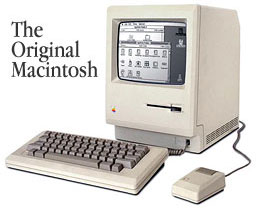
Original Macintosh
Like HP, which was making personal computers before IBM entered the market in 1981, Apple was one of the earliest players in the personal computing revolution. Its first computer, the Apple 1, was a kit, and its second, the Apple II, was the first personal computer with color graphics. Apple’s Lisa was the first personal computer with a graphical user interface and a mouse, and the original Macintosh brought that $10,000 technology to a more accessible $2,500 price point.
1984 was the high water mark for 8-bit personal computers, such as the Apple II series and the Commodore 64, and in 1985 over half of all personal computers sold were 16-bit machines (the Macintosh, the Amiga, the Atari ST, and the IBM compatibles). The 8-bit market died in 1993, the same year that NeXT got out of the hardware business (after selling about 60 thousand computers over a five-year period).
Apple has not been in the business of growing its market by buying other brands. However, it has acquired two competitors over the years: NeXT Computers and Power Computing. The NeXT acquisition was primarily for its operating system, which became the basis for Mac OS X. (It also brought Steve Jobs back to Apple.)
Power Computing was a competitor of Apple’s own making. It was the one of the first Mac OS licensees when Apple launched its authorized clone program in 1994, and it ruthlessly attacked Apple with faster models and lower-priced models. Like Dell, Power only sold directly to end users, while Apple and other clone makers used retail channels.
It’s impossible to know the full extent of the clone market, but a conservative estimate is that it cost Apple 10% of its sales during much of 1995, all of 1996, and most of 1997. Even more sales were lost to Windows 95, which was widely perceived as equivalent to the Mac OS. Between competition from Windows and authorized clones, Apple was bleeding badly.
Jobs realized this, and Apple acquired Power Computing in September 1997, putting an end to the most successful cloner. Apple also phased out the authorized clone program, and Umax discontinued its SuperMac line (the last of the authorized clones) in June 1998.
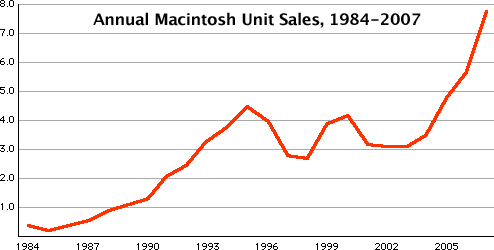
Thanks to the iMac, iBook, and Power Mac G4, Mac sales rose for a time, then fell below the 4 million unit per year mark. Apple has seen sustained annual growth since 2004, and if it continues growing at the present pace, unit sales will reach 10.5 million in 2008, 14 million in 2009, and 18 million in 2010.
The Broader Picture
The iPod is a success worldwide, and the recent expansion of the iPhone to numerous additional markets around the world will further grow the iPhone and Apple’s brand presence. While iPod sales growth may level off, I suspect Apple will simplify the line by eliminating the iPod classic, reducing the price of the iPod touch while boosting capacity, and possibly adding a version of the iPod touch with a 160 GB hard drive for those who find SSD capacity insufficient or cost prohibitive.
The Mac should have a growing worldwide presence as it rides the coattails of iPod and iPhone success. If people are happy with one Apple product and unhappy with Windows, they are more likely to consider switching to the Mac, so Mac sales could grow even faster than they already are.
On top of that, there’s speculation that Apple may be prepared to reduce Mac prices, as its formula for success is to provide “state of the art new products at prices their competitors can’t match”. Time will tell what they mean by that….
* My first MS-DOS computer was a Zenith Z-151, purchased refurbished when I worked for the Heath/Zenith store in Virginia Beach, VA, in the late 1980s. This 4.77 MHz machine was upgraded with Z-158 components to become an 8 MHz “turbo” PC, and its 8088 CPU replaced with the slightly more efficient NEC V-20 CPU. Other upgrades included a 20 MB hard drive, an Everex EGA video card, an EMS expanded memory card, a Northgate OmniKey keyboard, a Logitech 3-button mouse, an 8087 FPU, and a 3.5″ floppy drive. To this day, I still love upgrading computers.
keywords: #marketshare #applecomputer
short link: https://wp.me/p51SSp-dcH
