
2007: When Steve Jobs left Apple in 1985, there were only two Macintosh computers: the original 128K and the 512K “Fat Mac”.
When he returned in 1997, there were PowerBooks, Power Macs, and Performas – each model name followed by a four-digit number. Jobs decided to simplify and focus the product line with four quadrants: a pro desktop, a pro notebook, a consumer desktop, and a consumer notebook.
Quadrants
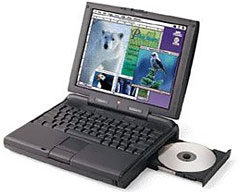
‘Kanga’ PowerBook G3
Apple dropped the four-digit numbers with the release of the 1997 PowerBook G3 (Kanga) and Power Mac G3 in November 1997. These filled the pro notebook and pro desktop quadrants, but Apple’s consumer desktop was still months off.
Jobs introduced the iMac in May 1998, garnering incredible amounts of free publicity for a computer that wouldn’t even ship for three months. This was the first completely new Mac under the Jobs regime; he launched the project immediately upon returning to Apple at the end of 1996.
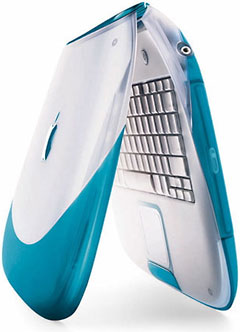 The final quadrant remained empty until July 1999, when Jobs unveiled the iBook, which shipped in September.
Too Simple?
For better or worse, Apple stuck with this naming convention: The pro desktops were all called Power Macs; the pro notebooks, PowerBooks; the consumer desktops, iMacs; and the consumer notebooks, iBooks.
There were two very different models named Power Mac G3 (the 1997 and 1998 beige versions followed by the Blue and White), and far more bearing the Power Mac G4 name. The number of Power Mac G5 models fell between those extremes.
There were four different PowerBook G3 models (Kanga, WallStreet/PDQ, Lombard, and Pismo), with two revisions of the WallStreet, followed by four generations of titanium PowerBooks G4s – and several generations of 12″, 15″, and 17″ aluminum PowerBook G4s.
On the consumer front, there were four tray-loading G3 iMacs (two of them available in five different colors), four generations of slot-loading G3 iMacs (with three or more models per generation), three generations of G4 iMacs, and three generations of G5 iMacs. And Apple simply called all of them iMacs.
Likewise, the clamshell iBook (4 models) gave way to the Dual USB iBook (five generations and two screen sizes), which in turn were replaced by several generations of 12″ and 14″ G4 iBooks.
The only model that threw a wrench into the works was the Power Mac Cube, which Jobs envisioned as something of an executive workstation. Everything else fit into the four-quadrant model.
The New Paradigm
One of Jobs’ goals was to have every Mac include Mac in its name – the iBook was the only exception during Jobs’ tenure as iCEO. Thus, the Performa 6400 begat the Power Mac 6500, the new education model was called the eMac, and the smallest, least expensive Mac ever was named the Mac mini.
With the transition to Intel in 2006, Apple abandoned two of the best-known brands in personal computing. The first PowerBooks had been introduced in 1991, and they established the design of all future notebook computers. It was perhaps the best-known brand of notebooks (with the IBM ThinkPad probably #2) when the last PowerBooks were discontinued in 2006.
The other was the Power Mac, which was introduced with the PowerPC 601 CPU in 1994. For 12 years, the Power Mac was Apple’s flagship model. This was the one name Steve Jobs didn’t have to change; it already had Mac in it.
They’re All Macs Now
Apple broke its quadrant model with the introduction of the eMac, which gave Apple pro, consumer, and education desktops. It shattered the quadrant model with the Mac mini, which gave Apple two completely different consumer desktop lines.
But the important change was the name: Every current Mac has Mac in its name – Mac Pro, iMac, Mac mini, MacBook, and MacBook Pro.
Just as every Mac was called a Mac when Jobs left Apple in 1985, every Mac was called a Mac by the end of 2006. And for those who doubt the Mac’s future, this should erase all doubt. Apple has gone out of its way – even to the point of killing off a very successful notebook brand – to pull all of its desktop and notebook computers clearly under the “Mac” umbrella.
keywords: #powerbook #ibook #powermac #macbook #macmini #imac #emac
short link: https://goo.gl/4zKhyZ
