Mac Musings
Leopard Delayed to October. And the Bad Thing Is?
Daniel Knight - 2007.04.13
Several Mac websites are already bemoaning Apple's announced delay of Leopard (Mac OS X 10.5) until October. At Low End Mac, we're not at all disappointed.
Apple claims the delay is because they reassigned some of the OS X staff to make sure the iPhone is ready for release in June - a worthy goal, as this is yet another new market for Apple.
OS X Prehistory
Mac OS X has its roots in NeXT Computers, a company founded by Steve Jobs after leaving Apple in 1985. NeXTstep, the NeXT operating system, in turn was rooted in the Mach kernel and BSD Unix, so its roots go back to the early 1970 when Bell Labs had Berkeley students help build and tweak Unix.
NeXTstep was quite revolutionary, as it combined a Unix operating system with a Postscript-based display engine and object oriented programming on a personal computer. This was a huge step away from the single-user operating systems with bitmapped displays that everyone else was using in the mid-80s.
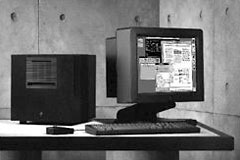 NeXTstep
first ran on the NeXT Cube, a 25 MHz
68030-based computer with a 4-shade grayscale display. This made it
comparable in power to the Macintosh
IIci, Apple's most powerful computer in 1989.
NeXTstep
first ran on the NeXT Cube, a 25 MHz
68030-based computer with a 4-shade grayscale display. This made it
comparable in power to the Macintosh
IIci, Apple's most powerful computer in 1989.
NeXTstep evolved and was eventually ported to Intel x86 architecture, and at the end of the NeXT era, there was a project underway to port it to the PowerPC as well.
Looking to replace the aging "classic" Mac OS and running into all sorts of problems with its in-house projects, Apple acquired NeXT in 1996, bringing Steve Jobs back to the company he cofounded and making NeXTstep the core upon which the new Mac OS would be built.
The OS X Timeline
There were two primary projects that had to be undertaken before OS X could be launched. First, it had to be compiled for the PowerPC CPUs used in Apple's Macintosh computers. Second, there had to be a way to run programs written for the classic Mac OS.
By late 2000 (less than four years after Apple absorbed NeXT), Apple was ready to release a preview of OS X. The US$30 public beta showed off new technologies such as the Quartz rendering engine (rather than NeXT's display Postscript), the Aqua interface, the Dock, and Classic Mode, which allowed OS X users to run pre-X applications.
The beta had some rough edges, and Apple paid attention to user feedback. The first release version of OS X, 10.0 (a.k.a. Cheetah) came to market on March 24, 2001. Cheetah was robust, showed OS X's potential, and wasn't quite ready for prime time. It was slow, incomplete, and there were few apps available for it.
Six months later, Apple released Puma (OS X 10.1), which was far more responsive, added features such as DVD playback, and was available as a free upgrade to those using 10.0. Puma was the first really usable version of OS X, and Apple acknowledged this by making it the default OS on Macs beginning in January 2002.
The OS X Era
We can consider that the beginning of the OS X era, as until then Mac users had to choose to boot their new Macs into the new OS. In 2002, users had to choose to boot Mac OS 9; OS X was the default.
In August 2002, Apple released Jaguar (OS X 10.2), which made several improvements. Quartz Extreme improved graphics rendering on Macs with at least 16 MB of dedicated video memory and AGP graphics. Address Book and iChat were new features, and the first version of Safari was designed to run on 10.2.
Although some people still use Puma, for the most part it has been replaced by Panther as the low-end version of choice for OS X users.
It was 14 months later that Apple released the next major update. Panther (Mac OS X 10.3), unleashed in October 2003, further improved system performance, toned down some of the Aqua graphics, and included Safari as the default browser. iChat gained video support, Fast User Switching allowed multiple user sessions to be open concurrently, and Exposé made it easier to find buried windows.
Panther is generally considered the most efficient version of OS X, as 10.4 added some resource hungry features. Panther was also the first version of OS X to drop support for some older Macs: the beige Power Mac G3 and WallStreet PowerBooks.
Tiger Today
From 10.0 to 10.1 took six months. From 10.1 to 10.2 required 11. From 10.2 to 10.3 spanned 14 months. And Tiger (OS X 10.4) replaced Panther in April 2005, 18 months after Panther had been released.
Tiger added a lot of new features: Spotlight to index your files, the Dashboard with its widgets, smart folders, Automator, Core Image, and Core Video among them.
Apple dropped support for Macs without built-in FireWire ports and only provided Tiger in DVD form. This meant that the tray-loading iMacs, Lombard PowerBook, and early clamshell iBooks were not officially supported.
A lot of longtime Mac users who migrated to Tiger wondered what the big deal was. Spotlight and Dashboard hogged resources, and several programs were written to disable them. Although Tiger added a lot of powerful new features, in some ways it was a step backwards for performance.
The Intel Transition
In 2006, Apple moved from PowerPC processors - which it had used since 1993 - to Intel Core processors. At the same time, Steve Jobs revealed that Apple had been developing an Intel version of OS X for as long as Apple had owned NeXT.
The new Intel processors, most of them dual-core, provided a lot more power than the PowerPC G4 and G5 processors, and OS X 10.4.4 was the first release version of the Mac OS to support Intel CPUs.
Spotting Leopard
The big question since the Macworld Expo in January (and even before that) was when Apple would release Leopard (Mac OS X 10.5). Many speculated that it would come out in May - or perhaps in June or July to coincide with Apple's Worldwide Developer Conference.
Today we finally know when Leopard will be released: October 2007. That's 30 months after Tiger. Two-and-a-half years. That's the longest time between major OS updates in Apple history.
The benefit of this is that Tiger has become the dominant version of OS X, and by sticking with the same version through the Intel transition, Apple has made it that much easier for developers to port existing apps to the new hardware.
The benefit to longtime OS X users is that we'll have avoided Apple's US$129 "OS X tax" for 2-1/2 years.
Then there's the six of one, half dozen of the other reality that we're seeing more and more apps and utilities that require a version of Tiger, which has forced many Panther users to make the switch (or else be left behind with older versions of their software).
Leopard will introduce some big changes and some new features that developers are already very excited about. Just as we now have many apps that require Tiger, there will be Leopard-only apps as soon as 10.5 ships.
We're looking forward to that, but we're also wondering what hardware Apple will leave behind. This is Low End Mac, after all, and we'd hate to see the blue & white G3, slot-loading iMacs, and PowerBook Pismo left behind. (Along the the FireWire iBook, these are the models most likely to lose support.)
Time will tell.
But the best thing is that Tiger will still work on the Macs it works on today, and all the apps being used on Tiger will still work on Tiger in the years ahead, so if your hardware isn't supported with Leopard, you've lost nothing.
And then there's Ryan Rempel, who has been developing XPostFacto for years as the best tool for letting older Macs run versions of OS X that Apple no longer support. Keep up the good work, Ryan!
Parallels
I hate to say this, but this parallels Microsoft's development cycle for Windows. Windows 1.0 shipped in 1985, 2.0 in 1987, and 3.0 in 1990. Windows 3.1 came out in 1992, and Windows 95 arrived in August 1995. Then came Windows 98 in 1998, followed by a Second Edition in 1999. The final version in this family tree was Windows Me (Millennium Edition), an incremental improvement to Win98SE that was released in 2000 and adopted parts of the Windows 2000 interface.
Microsoft also developed a pro/server version of Windows, and Windows NT 3.1 was released in 1993. NT 3.5 arrived in 1994, and 4.0 in 1996. The next product in this line was Windows 2000 shipped in February 2000.
Win2K was superseded by Windows XP in October 2001, and it remained the shipping version of Windows until this winter, when Windows Vista was released (Nov. 2006 to manufacturers, Jan. 2007 to consumers). There was only one significant improvement to XP during its five years on the market; Service Pack 2 was released in August 2004.
Microsoft moved from a short development cycle to increasingly long ones. 2-3 years between major upgrades turned into 5 years as Vista development dragged out longer and longer. And Apple's OS X development cycle has lengthened in the same way, although not to the same extent. Instead of 5 years between versions, Apple will have only 2-1/2 between Tiger and Leopard.
Still, it shows how much work it is to create a major OS update as operating systems grow more complex and feature-laden. Will it be 3-4 years beyond Leopard before OS X 10.6 arrives? And will Vista be the default version of Windows for 7-10 years?
Whatever, we're happy with what we have. Panther was wonderful, and Tiger is doing just fine by us. As nice as it will be to see Leopard ship in October, we're content with the status quo. Our hardware, software, and OS are all working just fine, thank you very much.
Sure, we'll buy a copy of Leopard - maybe even another family pack - and we'll have a lot of fun exploring the new features, but our old Macs are nice and productive with what we already have.