Mac Musings
Growing the Mac Market by Reaching the Computer Hobbyist
Daniel Knight - 2007.02.08
Apple makes a great operating system, great software, and great computers, but it's missing some very important markets with its current product line.
Apple seems to target three audiences: regular users, business people, and graphics professionals. For the latter, there's the Mac Pro with four processing cores, 2-3 GHz of raw horsepower, up to 16 GB of RAM, and room for lots of SATA hard drives.
For consumers - students, home users, teachers, etc. - there are the Mac mini, the iMac, and the MacBook. And for business users, the MacBook Pro is awesome.
But there are some important markets that Apple hasn't addressed. There is no MacBook Lite. There is no rugged 15" MacBook. There is no rugged MacBook with an ExpressCard slot. There is no Mac Tablet (although there is the Axiotron Modbook). And there is no expandable Mac priced below US$2,100.
Apple is one of the five biggest computer companies on the planet, and it seems to be consistently the most profitable. While HP and Dell battle for the Windows market, Mac OS X has its own growing market.
What that means is that Apple not only knows how to make a profit in what is generally a dog-eat-dog field, but it has deep enough pockets to expand its computer line strategically.
Which Market First?
I'd love to see a 10" widescreen ultralight MacBook Pro, something just wide enough for a full-sized keyboard, under 1" thin, and with great battery life. I imagine something this compact could cut into the Pocket PC market by offering a much higher screen resolution. And it would turn heads, as do the Sony Vaio laptops in this size range.
I'd love to see a 12" Mac Tablet, something as rugged as the MacBook with a screen that can be used in either notebook or tablet orientation. I don't think it would attract as much attention as a MacBook Lite, but I'd love to be able to use my next notebook computer as a tablet when necessary (such as live coverage of a Macworld keynote address).
I sympathize with those who find the 15" MacBook Pro a bit delicate and the 13" MacBook too small and unexpandable. I think Apple would be well served with a 15" black-only MacBook with a ExpressCard slot.
But I think the most important market for Apple to target is the computer hobbyist. You know, the guy (we tend to be male) who has fiddled with Linux, knows how to configure a network in his sleep, and upgrades his computer 15 different ways before finally buying something newer to replace it.
Why Target the Hobbyist?
You know, the guy people go to when they're ready to replace their iMac, their PowerBook, or their aging Windows PCs. The guy people trust to give knowledgeable advice. The guy most likely to be running Parallels on an Intel Mac and running both Linux and Windows concurrently with Mac OS X.
These power users love to fiddle with their hardware, putting in a faster hard drive, dropping in more RAM, and installing a better video card, among other things. None of these are easy to do in a Mac mini, and upgrading video simply isn't possible. As for the iMac, it's not hard to upgrade RAM, but the hard drive is hard to get to, and again video is not upgradeable. The same probably goes for the MacBook Pro.
Apple's second most easily expanded computer is the MacBook, which makes it very easy to replace both the hard drive and memory. But it, like the mini, suffers from "vampire video" that can't be replaced.
In Apple's entire product line, which ranges in price from US$600 to well over $3,000, the only model that allows you to upgrade video is the Mac Pro. It starts at $2,000, and that's not a friendly price for hobbyists.
How to Reach the Hobbyist
The people who people are going to for computer advice are not likely to be using Macs because Macs are either not expandable enough or overly expensive for their needs. And they are a key market if Apple wants to really grow market share.
Strategy 1: Hardware
My favorite suggestion is that Apple build a Macintosh more expandable than the mini and less costly and less expandable than the Mac Pro. Looking at the Windows world, where even $300 PCs have expansion slots, I'm convinced Apple could do it at the same price point as the Mac mini.
Of course, we are talking Apple, so it would have to be something stylish. Apple could make it look like an overgrown Mac mini, but I don't think that would be especially attractive. Or they could make it look like a stunted Mac Pro, but that might be an expensive solution that's not suitable for this price point.
Apple would never go with a boring beige, brushed aluminum, or matte silver box that could be mistaken for a Windows PC. The Power Mac 4400, Apple's lone attempt at a boring beige box, was a market disaster.
Apple should never attempt to market something cheap.
In my previous article, Dreaming Up a Mac More Expandable than the Mac mini, More Affordable than the Mac Pro, I looked at one possibility - a dwarf Mac Pro. But several readers suggested Apple look back a bit further. Specifically, to the summer of 2000.
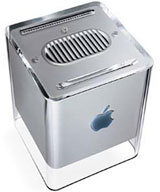 The
Power Mac G4 Cube was
probably the most elegant computer Apple ever released, and while the
media extolled it good looks and clever design, from a value standpoint
it took a back seat to the far more expandable, similarly priced
Power Mac G4.
The
Power Mac G4 Cube was
probably the most elegant computer Apple ever released, and while the
media extolled it good looks and clever design, from a value standpoint
it took a back seat to the far more expandable, similarly priced
Power Mac G4.
It might be time to reconsider the Cube design with a few changes. For one, instead of a single expansion slot that only supports a video card, give it two PCI Express slots. For another, make the ports accessible (on the Cube, they were on the bottom of the computer, which meant you had to turn it off and pick it up to add or remove a USB or FireWire device).
The Cube's other design flaw was the power switch, which was simply too sensitive. Just brushing it would shut down your computer.
But the shape and size are just about right, even if there's no room for full-length expansion cards. Use a 3.5" hard drive and a tray-loading optical drive to keep costs down, and put at least two USB ports on or near the front. And add an eSATA port on the back for good measure.
Steve Jobs seems to like simple geometric shapes, and a 7.5" or 8" cube might be just perfect for one or two hard drives, a SuperDrive, and two PCIe expansion slots. Paint it NeXT black and let it vent heat out the top, as the Cube did.
Finally, price it at US$999 with 1 GB of RAM, a SuperDrive, a 250 MB hard drive, and a single Core 2 Duo CPU running at 2.33 GHz. The hobbyist will beat a path to your door.
Solution 2: Software
The other option would be for Apple to continue to ignore this market from a hardware standpoint and instead offer Mac OS X (with the usual suite of free iApps) for their computers. Even if Apple limits that to newer hardware (say 2005 and later), it could increase the OS X installed base overnight.
Better yet, Apple should buy Parallels, complete their Desktop for Windows, and sell a bundle that makes it easy to install OS X and have it running concurrently with Windows on regular PCs with CPUs that support virtualization - the kind of computers hobbyists are likely to already own.
Give Windows and Linux users an option, at least if their hardware is of recent vintage. Boot directly into OS X or run it virtualized alongside Windows and/or Linux.
The goal is to let hobbyists experience the Macintosh difference, whether that's one a new Macintosh computer (the ideal) or on their own hardware.
Extrapolation
The hardware solution might sell 700,000 units a year, and each of these users is likely to get at least one Windows user to go Mac. Figure this could add 1.5 million sales to Apple's bottom line within a year.
The software solution might sell 2 million copies of OS X for PCs. Most of this will be to hobbyists, since consumers rarely change their operating system. And when Windows users ask the hobbyist's advice, he'll recommend a Mac, because the OS is great and it can also run Windows. And the consumer will probably buy a new Mac rather than adding OS X for Intel to a Dell or HP.
The software solution might sell 2 million additional copies of OS X and at least a million Macintosh computers, significantly increasing the installed base and Apple market share.
The ideal would be a two-pronged solution. Offer OS X for Intel and introduce a new Cube or Mac Pro mini. Sell maybe a million copies of the OS and a million new computers the first year.
And subsequent years would only increase those numbers, perhaps bringing Apple to the point of competing with HP and Dell for top market share in a few years.
Join us on Facebook, follow us on Twitter or Google+, or subscribe to our RSS news feed
Dan Knight has been using Macs since 1986, sold Macs for several years, supported them for many more years, and has been publishing Low End Mac since April 1997. If you find Dan's articles helpful, please consider making a donation to his tip jar.
Links for the Day
- Mac of the Day: PowerBook 500 Series, introduced 1994.05.16. 'Blackbird' includes a 25 to 33 MHz 68040 along with smart batteries and grayscale or color displays.
- Support Low End Mac