Mac Musings
Apple Inc. Intros iPhone and Apple TV
Daniel Knight - 2007.01.10
"We're going to make some history together today...."
- Steve Jobs, 2007.01.09
Apple has been "making history" since 1977, when the Apple II became the first preassembled personal computer that could work with a regular video monitor and supported color. (Before that, personal computers were the domain of electronic hobbyists willing to assemble a kit, add their own keyboard and power supply, and live with text-only monochrome screens.)
Including color on the Apple II motherboard was a stroke of genius, one of those clever Steve Wozniak hacks that typified his ability to think outside the box and find an easier (and generally less costly) way of doing things. Woz's floppy drive controller, introduced in 1978, was another such device, and it was almost single-handedly responsible for floppy drives becoming a popular, affordable feature of PCs.
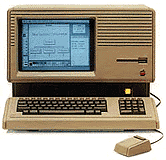
Apple's Lisa (1983)
Apple made history again with Lisa, the first personal computer with a mouse and a graphical user interface (GUI). It was the first machine to move the GUI from the lab and some very expensive Xerox workstation hardware to the office. (At $9,995 with a 5 MB hard drive, it was anything but a home computer.) It was one of the first computers to ship with a megabyte of RAM.
Then came the Macintosh in 1984, which improved on the Lisa GUI by using square pixels, adopted the 3.5" floppy drive instead of Lisa's less reliable Twiggy drive, sold for one-quarter of Lisa's price, and lost the hard drive. It also had as little RAM as possible to keep prices down; in early 1984, including 128 KB of memory was expensive.
Apple made history when the Mac Plus became the first Mac to support SCSI devices in 1986 - up to seven hard drives and other SCSI peripherals could be daisy-chained to the $2,600 computer. It was also the first Mac with expandable memory: RAM could be boosted from 1 MB to 4 MB.
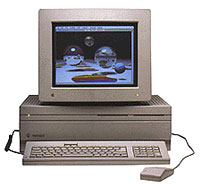 Apple made history in 1987 when
the Mac II added high resolution
color, monitor spanning, and NuBus expansion. And again in 1991 when
System 7 made multitasking, scalable fonts, and 32-bit color support
standard features.
Apple made history in 1987 when
the Mac II added high resolution
color, monitor spanning, and NuBus expansion. And again in 1991 when
System 7 made multitasking, scalable fonts, and 32-bit color support
standard features.
The same year Apple introduced the PowerBook, which became the de facto standard for notebook design in short order. Almost every notebook computer designed since then has put the keyboard near the screen and included a palm rest with a trackball or trackpad.
1993 saw the introduction of Mac TV (a black LC 550 with an integrated TV tuner) and the end of the Apple II line. And in 1994, Apple became the first personal computer brand to adopt RISC architecture with the PowerPC CPUs.
With the acquisition of NeXT in 1987, Apple saw the return of Steve Jobs and paved the way for the first successful personal computer line with a Unix-based operating system - although it wasn't until Sept. 2000 that Apple had a beta available for public preview.
The list goes on with the 2001 introduction of the iPod and the 2006 transition from PowerPC to Intel Core CPUs.
 For the first time this century, in
2006 over half of all Macintosh sales in the US were to people who had
never owned a Mac. Also in 2006, the iPod became the most popular video
player on the market "by a large margin".
For the first time this century, in
2006 over half of all Macintosh sales in the US were to people who had
never owned a Mac. Also in 2006, the iPod became the most popular video
player on the market "by a large margin".
Apple has grown the iTunes Store past Amazon.com to become the #4 music retailer in the US market. Apple has sold over 2 billions songs! Walmart, Best Buy, and Target, which only sell CDs, are next in line.
Apple has sold 1.3 million Disney movies through the iTunes Store, and Paramount is now offering movies through Apple's service as well.
In November, the month Microsoft launched Zune, it accounted for 2% of the market - and the iPod line for 62%. December figures aren't yet available.
Making History Again
Apple TV
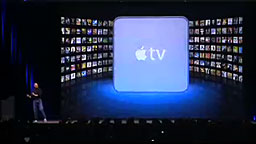 Apple previewed "iTV"
last year, and Jobs unveiled the final product as "Apple TV" at the
keynote. This is the first product to highlight the Apple brand in
years, as almost everything else Apple makes is either a Mac or an
iPod.
Apple previewed "iTV"
last year, and Jobs unveiled the final product as "Apple TV" at the
keynote. This is the first product to highlight the Apple brand in
years, as almost everything else Apple makes is either a Mac or an
iPod.
Apple TV includes USB 2.0, ethernet, and 802.11b/g/n networking and
supports the following video outputs: HDMI, component video,
composite video with an RCA jack [UPDATE: Oops, there
is not composite video output. The RCA jacks are for stereo sound
output, not vido], and 720p high definition video. There's also an
optical audio connection. Inside Apple TV is an Intel CPU and a 40 GB
hard drive capable of storing up to 50 hours of video.
Apple TV automatically synchs to your iTunes library on one computer - whether you're using a Mac or a Windows PC. (That explains why it's not Mac TV!) It can also access photo and music libraries on up to five computers. And you can connect it to your home stereo (which should go without saying).
Apple TV can stream content from up to five computers at once - and access content such as theatrical trailers over the Internet. The remote is that same as on current Macs. It has a 7.7" square footprint, making it a bit larger than the 6.5" square Mac mini. It will be available in February at US$299.
Based on the footprint of the device, I'm speculating that Apple TV may include a slim 3.5" hard drive rather than the 2.5" notebook drive inside the Mac mini. Either way, expect to see an industry arise supporting hard drive upgrades for Apple TV.
The iPhone
 "This
is a day I've been looking forward to for two-and-a-half years."
"This
is a day I've been looking forward to for two-and-a-half years."
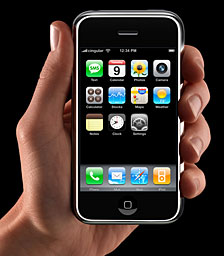
Combining an iPod, a cell phone, and an Internet communicator in a single device, the iPhone has a screen-based interface that doesn't require use of a stylus. It runs OS X, includes a 3.5" 320 x 240 pixel display with 160 pixel-per-inch resolution, is under 3/4" thick (thinner than any smart phone on the market), and has the expected iPod connectors. The battery supports up to five hours of talk, video, and Internet use - and up to 16 hours of audio playback.
There are also the requisite built-in camera (sporting 2 MB resolution, which is 50% better than most camera phones offer and sufficient for a decent 5" x 7" print) and SIM card slot. The iPhone includes a motion sensor and an orientation sensor, which will detect whether you're using it vertically or horizontally. There's also a proximity sensor that can detect when you're using it as a phone. This will turn off the display and touchscreen while you're holding the iPhone to your ear.
 You can
toggle your movies and HD TV shows between full screen and widescreen
modes on the fly.
You can
toggle your movies and HD TV shows between full screen and widescreen
modes on the fly.
In addition to cell phone and iPod dock connectivity, iPhone includes Bluetooth 2.0 and WiFi, and the interface is similar to Front Row on Macs. The iPhone supports "visual voicemail" (finally, someone offers random access to voicemail!), has full email support for POP3 and IMAP accounts, and includes the Safari browser. It also connects to Google Maps and has widgets.
Apple has worked closely with Yahoo Mail, the largest provider of free email in the world with a quarter billion users. Yahoo will provide free "push" email to all iPhoto users using Yahoo IMAP email.
For those who love text messaging, the iPhone supports multiple sessions so you can carry on conversations with more than one person at a time. The interface is similar to iChat and other messaging clients.
The photo library seems like a simplified version of iPhoto, and when you rotate the camera, any photo you're viewing rotates as well - a great way to look at your horizontal photos without being limited to the 240 pixel width of the iPhone's screen.
 I'd hoped
for handwriting recognition using Inkwell (adapted
from Newton), but it doesn't appear to be a feature of the iPhone as
Steve Jobs spent some time dissing the stylus. (Not to say that it
won't work with a stylus, but the entire interface is designed to work
well with just your finger.) So when you want to enter data into the
browser or reply to an email, the iPhone displays a virtual keyboard
(Apple calls it a "soft keyboard") that you can "type" on with a finger
or stylus.
I'd hoped
for handwriting recognition using Inkwell (adapted
from Newton), but it doesn't appear to be a feature of the iPhone as
Steve Jobs spent some time dissing the stylus. (Not to say that it
won't work with a stylus, but the entire interface is designed to work
well with just your finger.) So when you want to enter data into the
browser or reply to an email, the iPhone displays a virtual keyboard
(Apple calls it a "soft keyboard") that you can "type" on with a finger
or stylus.
The software includes error prevention via text prediction, which can help make up for the large size of a finger relative to the virtual keys on the screen.
There will be two versions of the iPhone initially - a 4 GB version retailing for US$499 and and 8 GB model at US$599. The iPhone will be available in June exclusively through Cingular.
I'm guessing that the iPhone isn't based on Intel Core architecture. It's more likely based on Intel's XScale processor, which is found in Palms and Windows Mobile devices. Apple considers iPhone a "closed architecture", so developers will have to work with Apple if they want to create apps for the iPhone.
As an iPod owner, a cell phone user, a Palm user, former Newton user, and a Mac user, I think the iPhone is going to be a runaway success. I think it represents a lot of value - the Motorola KRZR (a RAZR with iTunes support) plus an iPod nano plus a smart phone all in one device should mean a sellout for the first few months on the market.
I'll probably wait for a second revision, which should fix any unanticipated bugs in the original design - and just might include the same kind of hard drive found in full-sized iPods. That would be perfect! And if the iPhone won't support carriers other than Cingular, now part of the new AT&T, a version without phone capabilities would be fine. (I'm happy with Alltel and locked in for two more years)
Apple and Cingular are working closely to have everything in place before the iPhone launches in June, including special pricing plans for phone and data services.
Maybe that will be the next generation of "regular" iPod.
Apple Inc.
Apple Computer incorporated on April 1, 1976. Due to the success of the iPod and the anticipated success of the iPhone, Apple has dropped "Computer" from its name and will henceforth simply be known as Apple Inc.
Mac Stuff
Apple's newest version of the AirPort Extreme Base Station supports the 802.11n draft specification, a five-times-faster wireless networking standard that will eclipse 802.11g as surely as it replaced 802.11b. Apple also announced that the Core 2 iMac (except for the 1.83 GHz version), MacBook, and MacBook Pro models already include 802.11n support using an enabler included with the new AirPort Extreme Base Station.
Apple also offers an AirPort Extreme card option with 802.11n support for the Mac Pro. We expect it to be included in the next revision of the Mac mini. Apple will begin shipping the new 802.11n base station, which has the same 6.5" square footprint as the Mac mini, in February.
The new US$179 hub includes three ethernet ports and a USB 2.0 port for connecting a share printer or hard drive.