
The truth is out there. Or perhaps in there is a better way of putting it, at least as far as batteries for laptop computers are concerned. The truth is that those expensive (and sometimes exploding) batteries are little more than repackaged Li-Ion* AA cells. And generally not the high capacity ones at that.
As those who follow rechargeables know, 2,200 mAh AA Li-Ion cells are far from rare, 2,000 mAh is pretty pedestrian, and 1,800 mAh and below are scraping the bottom of the barrel.
So guess what’s inside the battery running your PowerBook, iBook, eMate, and those zillions of Windows laptops out there? If it’s fairly recent, probably 1,800 mAh Li-Ion cells.
You know how much those notebook batteries cost on the open market: Apple’s prices are prohibitive, and companies like Newer Tech make replacement batteries with both higher capacity and lower prices. Still, they cost well over US$100.
A set of six high capacity Li-Ion cells? Under US$30.
The value of notebook computer that could take low cost AA Li-Ion cells instead of expensive, proprietary enclosures for those same cells? Priceless.
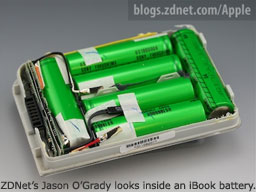 There’s got to be more to those $100+ batteries than a fancy enclosure and $10-15 worth of AA cells. And there is. These batteries have solder tabs on them, so there are soldered bits of wire running between the cells. And a small circuit board with circuitry that could be built into a notebook computers – if it were designed to accept ordinary AA cells.
The industry is talking about safer batteries and standard form factors – but a standard already exists. It’s called the AA Li-Ion cell. It’s been a standard size for decades, and if you eliminate the need to solder wire to the cells or enclose them in fancy cases, you eliminate a lot of potential for heat damage. Not to mention the cost of that fancy battery enclosure.
Here’s a crazy idea for the computer industry: Just use the AA cells that we can buy anywhere. Build the charge level indicators into the computer instead of a battery enclosure, eliminate the enclosure completely, and put in a bay for AA cells.
Possible Drawbacks
It’s a simple solution to a stupid problem, a problem created by corporate greed.
There are only a few problems I can see with using plain old AA Li-Ion cells in notebook computers:
- You can put them in backwards, a problem with way too many batteries.
- You can’t leave charged Li-Ion cells loose in a bag, as they can short out and – drum roll – combust.
- Users might not use matched sets of batteries.
Nobody ever went broke underestimating the stupidity of some people, yet the most widely used batteries – excepting the 9V ones – are completely reversible. You can put them in the wrong way in most devices. Someone needs to address that.
Li-Ion cells should be sold with battery holders that will protect the batteries from damage and keep them from being shorted until they’re installed. That would make it easier to safely carry a spare set of batteries.
And it’s important to use a matched set of cells. If you have 4 identical batteries and 2 that are older or have a lower capacity, you’re losing capacity.
Possible Solutions
Someone needs to come up with a new battery design that’s polarized so you can’t put batteries in backwards. This is something that won’t seriously impact battery prices. Maybe something square or rectangular to keep the cells from rolling away.
Until then, someone could probably make a killing producing a simple battery holder for 12″ iBooks and PowerBooks, perhaps Apple’s best selling series of ‘Books ever. And other models if that one sells. “Just add batteries” could be the ad slogan.
And with no need to solder, install, or even include AA Li-Ion cells, there would be a whole lot less cost to mark up in setting the retail price.
Such an adapter should include information on the importance of using a matched set of cells, maybe even a big, bright warning label you’ll see every time you replace the batteries.
The only real expense would be circuitry to communicate charge level and battery temperature to the computer. Other than that, it’s petty simple stuff. Eventually this circuitry could be built right into portable computers that run from AA Li-Ion cells.
Finally, Li-Ion batteries should be clearly marked with their capacity, month of production, and have room for the user to scribble in a code indicating that this cell is part of battery set A or B or 1 or 2 or whatever.
There’s nothing magical about notebook batteries, but as long as the industry keeps us in the dark about what’s really inside them, we’re going to pay exorbitant prices for a sophisticated container holding $5 batteries.
Benefits
Can you imagine how simple a battery recall would be for Apple, Dell, or anyone else if you could just pick up a cheap set of Li-Ion AA cells and use them until the pedestrian Sony replacement batteries came back from Apple?
Can you imagine Apple and others trimming $100 or more from the price of every notebook computer because they no longer need an expensive, over-engineered battery holder full of AA cells?
I think everyone would benefit from a move away from proprietary enclosures for industry standard batteries. How about it, Apple?
Further Reading
- Anatomy of an Apple Battery, Jason O’Grady, ZDNet
- How-To: Rebuild Your Laptop Battery, Engadget
- Inside a Notebook Battery Pack, ZDNet Australia
- Replace the Cells in Your Apple PowerBook G3 (Lombard or Pismo) Battery
* NOTE: This article originally referenced everyday 1.2V NiMH cells rather than 3.7V lithium-ion batteries, used in modern laptops. These are still commodity batteries, although more expensive than NiMH. Li-Ion batteries can be purchased online for under US$5 each. Also, the new MacBook laptops use lithium polymer batteries, so none of this applies to them.
Keywords: #notebookbatteries #aaliioncells
Short link: http://goo.gl/RWbXCZ
searchword: aaliion
