Mac Musings
Seven Years of iMacs: The More Things Change....
Daniel Knight - 2005.05.06
Seven years ago today, Steve Jobs introduced the original iMac to the world. It didn't just look different, it was different. The iMac had no legacy ports for peripherals.
It was a gamble. Apple was hoping that the iMac would stimulate the nascent market for USB peripherals and guarantee drivers for the Mac. It worked, and by the time the iMac shipped (1998.08.15), you could buy printers that would work with it.
But what earned the iMac the most attention was the Bondi blue case. It looked like something out of the Jetsons, not the kind of beige boxes Apple and everyone else sold in those days. A lot of iMac peripherals were even designed to color coordinate with the all-in-one computer.
And what earned the iMac the most derision was Apple's decision to build the first Mac ever that wasn't designed to accept a floppy drive. Even as the iMac went on to become the best selling computer model, as Apple moved millions upon millions of the colorful machines, PC pundits continued to rail against its lack of a floppy.
Not Perfect, but Good Enough
The iMac wasn't perfect, but it was a marvelous compromise of looks, power, and just enough features to become an excellent home computer at an attractive US$1,299 price.
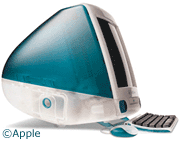 The keyboard was small and lacked a
few keys. The round mouse drove a lot of users crazy - and insured
a big market for USB mice. It was a real bear to get into if you
wanted to upgrade memory, but in the Mac OS 8 era, 32 MB was a
decent amount of memory.
The keyboard was small and lacked a
few keys. The round mouse drove a lot of users crazy - and insured
a big market for USB mice. It was a real bear to get into if you
wanted to upgrade memory, but in the Mac OS 8 era, 32 MB was a
decent amount of memory.
The 233 MHz G3 processor was very comfortable with the classic Mac OS, and the built-in CRT display handled 800 x 600 video crisply, but 1024 x 768 was a bit on the soft side. Still, in that era 800 x 600 was par for the course. Even the 4 GB hard drive - minuscule by today's standards - seemed like a lot of space to people upgrading from older computers.
It Saved Apple
The iMac is probably the most important computer in Apple's history because it drew public attention at a time when Apple was climbing out of a pit. Everyone was explaining why Sony or Disney or someone else needed to gobble up Apple and rescue the Mac, but Steve Jobs and Jonathan Ive designed the iMac, which pulled the company up by its own bootstraps.
By the time the iMac shipped, there were at least a half-dozen iMac websites examining every aspect of the computer and prowling for USB peripherals they could tell their readers about. People waited outside stores for the midnight release in some areas.
iMac Evolution
 The iMac improved. It got
faster, came in new colors, went with a slot-loading drive, got a
full-sized keyboard and lozenge-shaped mouse, added wireless
networking, and eventually reached 700 MHz before the G3 iMac gave way
to a G4 model.
The iMac improved. It got
faster, came in new colors, went with a slot-loading drive, got a
full-sized keyboard and lozenge-shaped mouse, added wireless
networking, and eventually reached 700 MHz before the G3 iMac gave way
to a G4 model.
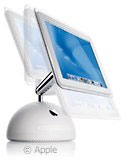
The iMac G4 left the CRT behind in favor of a flat panel display. The design was unique with a hemispherical base, a shiny chrome support bar, and a screen that could be repositioned quickly. Reaction to the visual appearance was mixed, but it was a clever design.
The entry-level model sold for US$1,299, but the G3 iMacs it replaced has sold for US$799-999.
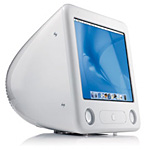 Unfortunately, the iMac G4 never caught
on like the CRT iMac, and Apple created the eMac to maintain a presence in the
education market. The big white eMac has a 17" display that handles
1280 x 960 comfortably, built in stereo speakers (the iMac G4 had
external stereo speakers), and was heavy. It was such a big hit
that Apple eventually released it to the general market, where it
remains a popular choice.
Unfortunately, the iMac G4 never caught
on like the CRT iMac, and Apple created the eMac to maintain a presence in the
education market. The big white eMac has a 17" display that handles
1280 x 960 comfortably, built in stereo speakers (the iMac G4 had
external stereo speakers), and was heavy. It was such a big hit
that Apple eventually released it to the general market, where it
remains a popular choice.
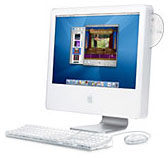 The next step in iMac evolution was
the iMac G5, which has been
around for a year. It dispenses with the big bulbous base of the
iMac G4 and puts the whole computer behind a 17" or 20" flat panel
display. The whole computer is just 2" deep and sits above the
desktop on a metal base.
The next step in iMac evolution was
the iMac G5, which has been
around for a year. It dispenses with the big bulbous base of the
iMac G4 and puts the whole computer behind a 17" or 20" flat panel
display. The whole computer is just 2" deep and sits above the
desktop on a metal base. 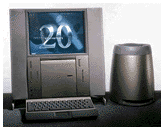 It's a clever solution that isn't unique to Apple - and in
some ways the 20th Anniversary
Macintosh of 1997 anticipated this design.
It's a clever solution that isn't unique to Apple - and in
some ways the 20th Anniversary
Macintosh of 1997 anticipated this design.
Change
The biggest change is the iMac's place in the Apple product line. It used to be the entry-level model, but it went upscale with the move to a G4 CPU. After the introduction of the eMac, the iMac was definitely Apple's midrange machine.
With the move to a G5 processor, the iMac moved a step closer to the Power Mac, and the latest iteration even has gigabit ethernet, making it a better choice than ever for people who need to move big files over a network.
In the Apple hierarchy, the Mac mini has become the entry-level model and the eMac the entry-level all-in-one Mac, putting the iMac two steps up from the bottom, one step below the Power Mac.
Of course, one step below the Power Mac is exactly where it was seven years ago. I guess that hasn't changed. What has changed is that Apple is now targeting the low-end computer market with machines even less expensive than iMacs.