Mac Musings
The April 2005 eMac: Where Do We Go From Here?
Daniel Knight - 2005.03.02
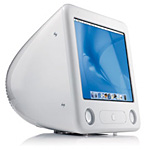
According to AppleInsider, several Apple stores are replacing display eMacs with iMacs, hinting that the current eMac is on the way out.
Well, that's to be expected. Apple has released three versions of the eMac, each one about a year after the other, starting with a 700/800 MHz model unveiled in April 2002 and initially sold only to education customers.
When Apple realized that the flat panel iMac was only selling at a fraction of the rate of the old CRT iMac, they decided that the future wouldn't be 100% flat panel displays - and the eMac has been a hot seller ever since.
The April 2003 eMac moved to 800 MHz and 1 GHz on a 133 MHz system bus (vs. 100 MHz in the original). The 4x SuperDrive was twice as fast as the one in the 2002 model, and Radeon 7500 graphics replaced the Nvidia graphics used in the original eMac.
Prices also dropped. The entry-level 700 MHz CD-ROM eMac had sold for US$999, but the new 800 MHz CD-ROM model was just US$799. The original Combo drive eMac was US$1,199, but the faster 2002 replacement sold for US$999.
And the SuperDrive eMac, launched at US$1,499, was replaced by a faster US$1,299 model. (In October 2003, the Combo eMac was reduced to US$799 and the SuperDrive model to US$1,099.)
Improving a good thing, the April 2004 eMac is available in 1 GHz models aimed at the education market and 1.25 GHz models available to anyone. The 2004 eMac replaced USB 1.1 with USB 2.0, adopted a 167 MHz system bus, moved to Radeon 9200 graphics, and went with an even faster SuperDrive - 8x.
 The 1.25 GHz Combo model retails for
US$799, and the SuperDrive model is just US$999.
The 1.25 GHz Combo model retails for
US$799, and the SuperDrive model is just US$999.
April is just around the corner, so it stands to reason that Apple would be moving out the 2004 models to make room for the 2005s, as AppleInsider speculates.
We can expect a faster eMac with still better graphics. We may even see a 16x SuperDrive, although I wouldn't expect to see that on a consumer Mac until it's offered on the Power Mac G5 (next revision probably due in June, the same month the first and second revisions were released).
The big question is, will Apple stick with the tried-and-true 50 pound white beasty or head in a different direction?
Let's think about that.
CRT technology is cheap. You can pick up a decent 17" CRT display for about US$100. LCD technology, on the other hand, isn't nearly as cheap. The lowest cost 15" LCD I can find is a US$200 model from KDS, and the 17" flat panel displays start at US$240.
Then again, we're dealing with Apple, the same company that uses 12", 15", 17", and 20" LCDs in iBooks, PowerBooks, and iMacs. They're undoubtedly buying at a good price. Let's see where they could go.
Mini Me
One route would be to discontinue the CRT eMac and create a line of smaller, low-cost LCDs to complement the Mac mini. Using the same 12" 1024 x 768 screen found in the 12" iBook and PowerBook, Apple could probably sell a US$250-300 display. Going with the 15" 1280 x 854 LCD used in 15" PowerBooks, maybe they'd have a US$350-400 display.
 For those who need more space, the 17"
1440 x 900 LCD used in the iMac
G5 and 17" PowerBook would
be nice at maybe US$450-500.
For those who need more space, the 17"
1440 x 900 LCD used in the iMac
G5 and 17" PowerBook would
be nice at maybe US$450-500.
No point in pushing anything larger. Who wants to pay more for their display than they pay for the computer?
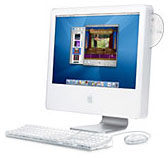
Design the displays to look like the iMac G5 with a foot designed to hold the Mac mini while keeping the ports accessible.
More than Mini
A second option would be to create a lower-cost version of the Mac mini that isn't quite so mini. Make the new model 2.5" to 3" high so there's room for a low-cost 3.5" hard drive, room on the back for a few more ports, and maybe Apple could trim $50-100 from the mini's price.
Go with the same kind of displays suggested above, and maybe offer two or three different models - 1.25 GHz at the bottom, 1.42 or 1.5 GHz and more VRAM in the middle, and 1.67 GHz with still more VRAM at the top.
The Flat eMac
The third route - and the one I think Apple is most likely to follow if they drop the CRT eMac - would be an eMac that looks like an iMac G5. Put the whole computer behind a 15" 1280 x 854 display, but power it with lower-cost G4 processors. I'm thinking a 1.5 GHz G4 sounds about right, and with the smaller display and slightly slower clock speed, it probably wouldn't cannibalize iMac sales.
I'd guess that Apple could sell a flat panel eMac for about the same price as the current CRT model, but even if they had to bump the price US$100, I think they'd have no problem selling it - especially with the Mac mini taking over the low-end of the market.
Which route is Apple going to take? From a design standpoint, I lean toward leveraging the iMac G5 design with a smaller display and a G4 processor, but from a marketing standpoint, maybe it's time to phase out the eMac and make the Mac mini Apple's only entry-level desktop computer.