Mac Musings
Apple and the $100 Laptop
Daniel Knight - 2005.02.09
"Nicholas Negroponte, chairman and founder of MIT's Media Labs, says he is developing a laptop PC that will go on sale for less than $100."
How's that for an attention getting lead?
BBC News reported on Monday that Negroponte is hoping to create such a computer for use by school children and in developing nations. But what exactly can we expect from a US$100 laptop?
One thing we shouldn't expect is a real laptop with a big screen, hard drive, powerful CPU, lots of RAM, and a long-life battery. Two possible models are current pocketable PCs, often based on Windows or the Palm OS, or the AlphaSmart 3000, which is pretty much a keyboard with a multiline b&w screen.
Pocketable PCs have the advantage of being very portable but using keyboards so small that touch typing is impossible. (Still, they are a step above entering text on a cell phone.) The AlphaSmart has a full-sized keyboard, which makes it rather bulky.
If you're going to use a full-sized keyboard, perhaps scaled down just a bit, you're looking at a 10-11" wide computer at least 4" deep (for five rows of keys). I'd suggest a laptop-like design where the screen folds over the keyboard to protect the keyboard and screen.
With no hard drive or CD-ROM, this computer could be well under 1" thin.
To keep costs down, go with a lower resolution b&w display. Assuming a 10" wide x 5" high display and a bit over 100 pixels per inch, lets call it a 1024 x 512 pixel screen. That's about two-thirds of the 12" iBook's screen - very usable.
It's also about 3x the screen space of the original Macintosh (512
x 342 pixels), and we know that we a pretty useful computer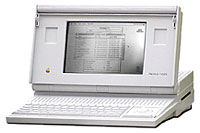 .
.
If you've ever used a Mac Portable (640 x 400 active matrix display), you know that a 16 MHz 68000 CPU can be pretty snappy with a highly optimized operating system (System 6.0.x) and 1-bit video.
If we stick with a non-color display, ignore the lure of gaming, and just want a useful screen for writing, number crunching, and the like, we could have a graphical user interface with a relatively low-powered CPU (by today's standards).
The Catch
The problem with a $100 computer is the operating system. Mac OS X and Windows sell for more than that. A Palm OS license would probably push such a computer well beyond the $100 price point. So we're looking at Linux or something developed specifically for the new PC.
But it doesn't have to be that way. Let's think different and come up with ways Apple could leverage its technology to create a $100 handheld computer because it has already paid the cost to develop so much of the technology.
Two possible paths are a resurrected Portable and a resurrected Newton.
Mini Mac
Apple amortized its development costs for System 6 and System 7 a long time ago. The classic Mac OS was designed for a low resolution 512 x 342 pixel display and 1-bit video, although it scaled very nicely to larger screens and greater bit-depths.
Most of all, it was very efficient, since it had to run on 8 MHz computers with limited amounts of memory.
If Apple wanted to enter the handheld market, it could do a lot worse than update the classic Mac OS a bit and build a folding handheld around a low-power Motorola 680x0 CPU - or even the PowerPC 603e used in early PowerPC PowerBooks. They've got to be downright cheap today.
I've often wished I had something like the Mac Portable in a handheld configuration just so I could play old games like Bard's Tale when I have a few spare minutes....
Ten years ago, Apple could still sell computers with 8-16 MB of RAM and sub-GB hard drives. They sold for a lot, and people found them very usable.
Apple is buying flash RAM by the boatload for the iPod shuffle, and that's exactly what you'd want to use instead of a hard drive on a handheld Mac. For a student computer, we could have something like this:
- 100 MHz PowerPC 603e
- 32 MB RAM
- 256 MB flash memory for file storage
- 4-bit (16 shades of gray) 960 x 480 display
- reduced size keyboard about 8" wide
- 8" wide, 4" deep, 0.8" thick laptop-like case
Give it USB for connectivity, a connection for a VGA and/or S-video adapter (with color support on an external display), and the ability to run for 6 hours on a set of 2000 mAh NiMH AA batteries. I think Apple could sell it for US$100 in bulk quantities (schools ordering 1000+).
Newton Redux
The other option is to skip the keyboard and go with pen input, exactly what the Newton MessagePad PDAs (1993-98) did. They were bulky, which was the main reason Palm was able to dominate the market, but they did a very respectable job with handwriting recognition. (Educators can also think of this as a way of promoting good penmanship.)
Early MessagePads were underpowered, but the StrongARM 110 CPU solved that problem.
Apple still owns the Newton technology, and while some of it has worked its way into OS X, most of it remains unused. This would be wonderful technology to build into a $100 handheld computer, and there's already a decent amount of software available for it.
Apple would have to make the Newton a bit smaller and lighter than the 8.3" height, 4.7" width, 1.1" thickness, and 1.4 lbs. of the MessagePad 2100. Nice as it was to have a big screen, the Newton was chunky. Perhaps a modern version would be 7" tall, 4.5" wide, and 0.8" thick with a weight under one pound.
The MessagePad made very efficient use of power, and a set of AA batteries could last 2-3 months of average us. A modern MessagePad designed to use 2000 mAh NiMH batteries could triple that (alkaline AA batteries are about 700 mAh).
Some changes would have to be made. Use USB for data transfer, attaching a keyboard, wireless networking with Bluetooth or 802.11g. Use SD or xD memory cards instead of the much larger PCMCIA cards of the past. Have an S-video and/or VGA port for use with an external display.
To bring the Newton into the 21st century, it would be nice to see a cursor control and some input buttons - think Gameboy.
Here are some possible specs:
- 200-300 MHz StrongARM or ARM Xscale CPU
- 32 MB static RAM
- 256 MB flash memory for file storage
- 4-bit 480 x 720 display
- reduced-size Newton form factor
Again, I think we have something Apple could sell in bulk at US$100 each.
Above and Beyond
What I'd love to see is something that goes above and beyond both concepts, something Apple can sell profitably for well over US$100 that would extend the Apple brand, fill a niche, and could become the next iPod or Mac mini.
Start with the updated Newton form factor, about the size of a mass market paperback book. Give is a full color 24-bit 480 x 720 pixel display. Use a slow, low power consumption G4 - maybe 700 MHz. Include decent graphics support, a pair of USB ports, a FireWire port, and room for Bluetooth and AirPort Extreme.
Run OS X with a tweaked version of Aqua that works well on a smaller display. Include 256 MB of RAM (expandable) and the same 1.8" hard drives found in iPods (lower power consumption, although 2.5" laptop drives would offer greater storage - everything is a tradeoff).
Standard input would be via stylus, and Apple could offer a keyboard that clips over the screen to protect the MessagePad in transit. And give it video out for an external display.
In terms of function and portability, it's a Newton. In terms of power and graphics, it's a 700 MHz eMac. And with a headphone jack, it's an iPod for listening to your iTunes and carrying around all your important files.
Coincidentally, it could also make a very adequate "video iPod" for those who want movies on the go. (It's no coincidence that I specified this screen size - DVD video is 720 x 480 pixels.)
This is far from the US$100 models we've considered above. At a guess, I'd say it might cost Apple almost as much to produce as the iBook G4. Maybe consider it a tablet iBook. Or a Mac mini with a screen and touch input. Or a super iPod photo that does your pictures justice and can do video as well.
It wouldn't be cheap, but it would extend our ability to use Macs in the field. There are times when I'd love to be able to jot a quick note, work on an article, or just play a game but I don't have my PowerBook - it's too big and expensive to keep at hand.
Something a bit smaller than a Newton that could run my OS X apps and let me jot notes and carry all my files - I think a lot of people would gladly pay US$800 for such a device. This could steal sales from the Mac mini and iPod photo.
And it could help Apple amortize the cost of developing a $100 handheld for the education and developing nation market.