Mac Musings
Apple's Future Is with the Consumer Market, not Just Pros
Daniel Knight - 2005.02.03
Things are changing at Apple. Although Apple has always been an important player in the personal computer business, they've always competed in the higher end of the market.
Nothing they made in the Apple II era came close to the price or success of Commodore or Atari 8-bit computers, and few Macs have ever come close to making the top seller lists.
Until the iMac. When Steve Jobs unveiled the iMac in May 1998, the world saw something different. It wasn't just another all-in-one computer - it was a colorful computer shaped like nothing before it. And Apple had three months to pique the public interest before the iMac went on sale.
The iMac actually made top seller lists for most of its first year on the market. Month after month, the iMac was in the top ten - and often #1. It took the "fruit flavored" iMacs having sales reported by color to knock Apple off the list, but the combines sales of all five colors told a different story.
Apple's next big consumer success was the iBook, which often topped the best selling laptop lists for the first month or two after a new model was released.
Pro vs. Consumer
Compared with the iMacs and iBooks, the Power Macs and PowerBooks were more powerful and significantly more expensive. In fact, Apple had a very clear strategy in the late 1990s of a four quadrant product matrix - laptop vs. desktop, consumer vs. pro. And pros loved the PowerBooks and Power Macs.
Based on the strength of pro model sales, Apple maintained very healthy margins in an otherwise low-margin industry. Even today PowerBooks and Power Macs earns Apple a better markup than their consumer models.
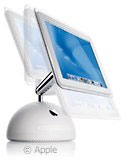 Apple apparently learned
the wrong thing with the iMac brand, turning it from a fairly
price-competitive alternative to Windows PCs (a "cheap" PC setup in
1998 sold for about US$999 - the iMac for US$1,299) to an
over-designed, overpriced oddity.
Apple apparently learned
the wrong thing with the iMac brand, turning it from a fairly
price-competitive alternative to Windows PCs (a "cheap" PC setup in
1998 sold for about US$999 - the iMac for US$1,299) to an
over-designed, overpriced oddity.
Sales plummeted, and a lot of low-end Mac users wouldn't be using newer Macs today if Apple hadn't released the "education only" eMac to the general public. At least the eMac was somewhat price-competitive with low-end Windows systems.
The iPod
The first MP3 players came to market in 1998, the same year the iMac was introduced, and they slowly grew a market for themselves. They weren't easy to use, didn't have much memory, and often required two different pieces of software - one to rip CDs to MP3 format, another to put the tunes on the digital music player.
Seeing the growing market, understanding the pain Windows users were going through (not to mention Mac users, who were often lost in the shuffle), and recognizing an opportunity to grow in a new market, Apple shipped the first iPod in November 2001.
The new hard drive-based music player worked with iTunes, Apple's free program introduced in January 2001 to rip CDs, manage music collections, and burn CDs. With 5 GB of storage, the iPod could hold 1,000 songs.
Apple sold 125,000 iPods by the end of 2001, and independent developers were already creating software to the Mac-only iPod could be used with Windows. In mid-2002, Apple released PC-compatible iPods that shipped with MusicMatch software, the closest thing to iTunes then available for Windows.
In April 2003, Apple unveiled the iTunes Music Store, which was only available to Mac users, since it required iTunes. In June 2003, Apple began to support USB 2.0 on the iPod, since that connection was far more common than FireWire on Windows PCs. They also sold their one millionth iPod that month.
In September, Apple announced that they had sold 10 million songs through the Mac-only iTunes music store, and in October they opened the floodgates by releasing iTunes for Windows and giving Windows users access to iTMS.
Apple has now sold millions and millions of iPods - and hundreds of millions of tracks through the iTunes Music Store.
The iPod Lesson
Apple dominates the digital music player market and the digital music sales market. They've discovered that consumers will pay more for "toys" that work better - and now they've applied that lesson to the Mac with a vengeance.
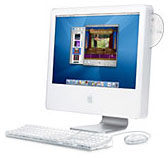 The iMac
G5, still costly, is marketed as being from the people who
created the iPod, and the Mac
mini boldly goes where no Mac has gone before - below US$500.
It's selling like hot cakes, and many vendors are back ordered
three to five weeks right now.
The iMac
G5, still costly, is marketed as being from the people who
created the iPod, and the Mac
mini boldly goes where no Mac has gone before - below US$500.
It's selling like hot cakes, and many vendors are back ordered
three to five weeks right now.
The Problems
Apple is used to lower volume sales (about 4 million Macs a year) and high profit margins (traditionally averaging about 28%), but low-end Macs don't have as high a profit margin as high-end ones. As the mix turns increasingly toward consumer products, Apple expects to see their margins shrink.
The question is whether increased unit sales will lead to more money flowing into Apple, providing good profits despite the lower profit margin. That's what Steve Jobs and Apple stockholders are betting on.
The other problem is that "consumer" Macs are cannibalizing "pro" sales. The iMac G5 is a fantastic alternative to the Power Mac G5 plus a 20" or larger display. The iBook G4 is nearly as powerful as the PowerBook G4 - and maybe more rugged.
In their recent SEC filing, Apple notes this trend. They blame part of the decline in "pro" sales on the Megahertz Myth, but I think they've missed the real sources of their problem.
Macs Just Work
Apple's biggest problem has always been that Mac just work - and keep on working. Where Windows users have traditionally upgraded every two or three years, Mac users tend to keep their machines for three to five years.
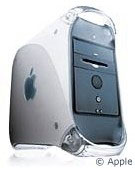 When they do upgrade, things have
advanced so far that compared with their one-time bleeding edge
Power Mac G4 - such as the Digital
Audio models released four years ago - even Apple's slowest
consumer computer would be a huge step up.
When they do upgrade, things have
advanced so far that compared with their one-time bleeding edge
Power Mac G4 - such as the Digital
Audio models released four years ago - even Apple's slowest
consumer computer would be a huge step up.
The fastest Power Mac G4 four years ago ran at 733 MHz. The slowest Mac offered today, the eMac, runs at 1.25 GHz. And the 1.25 GHz Mac mini retails for just $499 and should work with every peripheral a Power Mac G4 owner is likely to have.
If they want to move to a nice flat panel display at the same time, the US$1,899 20" iMac G5/1.8 GHz is a fantastic alternative to the US$1,499 Power Mac G5/1.8 GHz plus Apple's US$999 20" Cinema Display. Same performance, same display, integrated package, $600 savings.
Likewise, someone with a four-year-old PowerBook G4 running at 400 or 500 MHz is going to be blown away by the performance of a 1.2 GHz iBook G4. The "more than good enough" is the enemy of the "still better yet."
Sufficient
How much power do we really need? On the PC side of things, leading edge PCs run with 3+ GHz processors, but most people buy models in the 2.x GHz range - and find them more powerful than they need.
Likewise, a lot of us have discovered that G4 Macs are all the power we can ever anticipate needing. Sure, G5 sounds nice, but we need a compelling reason to upgrade, and a few more MHz or the next generation CPU in and of itself isn't compelling any longer.
With the Mac mini, the eMac, and the iBook, Apple has created solutions that are more than adequate for most users. That's probably the biggest part of the reason "pro" sales are slipping.
Thanks to the iPod and Mac mini, Apple shows that it is learning to cater to the consumer market. That points to a bright future of increasing unit sales and increasing market share - even if gross margin does slip a bit.