Mac Musings
The Overpriced Mac in 1986-87
Daniel Knight - 2005.01.11
We concluded yesterday's article by saying, "Put in perspective, the original Macintosh wasn't the overpriced computer many pundits pretend it to be." That being the case, let's move ahead and try to discover when Macs became "overpriced" in comparison to IBM, Compaq, and other brand name PCs.
Apple shipped the original Macintosh in early 1984 and the "Fat Mac" 512 KB version later in the year. The, for the only time in Apple history, they went for over a year before introducing a new Mac.
There were some big developments in 1985. Microsoft shipped the first version of Windows, Intel announced the 80386 CPU, and Aldus started selling PageMaker, the first desktop publishing program - and it only ran on the Mac.
That was also the year both Steves left Apple. Steve Wozniak ended up going back to school and became a teacher. Steve Jobs was ousted and began laying the groundwork for the next generation personal computer, something that would leapfrog the Mac.
NeXT, Jobs' new venture, officially launched in 1986, the same year Compaq shipped the first 8038-based PC. It would be over three years before the first NeXT computer (announced in 1988) actually shipped, but Apple wasn't standing still.
Macintosh Plus
On the second
anniversary of the Mac's unveiling, Apple announced the Macintosh Plus. Although it looked
like the earlier Macs at first glance, there were a number of
improvements, both internal and external.
The most obvious differences were a keyboard with a numeric keypad and arrow keys, both lacking in the earlier Apple keyboard, and the model name printed on the front next to the Apple logo.
Looking at the back, the older, larger DB-9 serial ports of the original Macs was replaced with a pair of round DIN-8 serial ports, which provided the extra space Apple needed for the Plus' biggest innovation - the SCSI port.
Although Apple had made a hard drive for earlier Macs, it used the slow floppy port to transfer data. SCSI was much faster, and SCSI hard drives could move data four times as fast as the old Apple Hard Drive 20.
Not only that, but SCSI allowed users to chain multiple devices to the computer, so a Mac Plus could have more than one hard drive, a scanner, a tape backup, and still have the potential for more expansion. Introduced with the Mac Plus, SCSI would remain a standard feature of every Mac until the iMac was launched in 1998.
There were changes inside the Mac Plus as well. The most exciting one was 1 MB of standard memory - twice as much as the Fat Mac - and the ability to expand that to a mind boggling 4 MB. (Remember, this was the era of the 640 KB memory ceiling on PCs. A megabyte was a lot of memory.)
The other significant change was adopting a double-sided floppy drive, which allowed 800 KB of data storage - again, twice as much as on earlier Macs. Of course, as the operating system and applications and work files increased in size, even 800 KB floppies would soon become limiting.
The PC World in 1986
This was still the era of the 80286 - Compaq wouldn't ship the first 80386-based PC until September 1986. Most of the AT-class clones were running 8-10 MHz CPUs, with a few 12 MHz models on the cutting edge. Windows was still considered a joke, so DOS PCs offered a lot of raw horsepower, but they didn't have the Mac's GUI.
At $2,599, the 8 MHz Mac Plus could hold its own in terms of price and performance. The Mac's 68000 CPU was pretty equal to the 80286 in terms of performance, and Macintosh System 3 was far more sophisticated than Windows 1.0. When compared with IBM, Compaq, and the like, nobody would have considered the Mac overpriced in 1986.
On the Apple II side of things, Apple introduced the Apple IIgs in late 1986. It offered color, the fastest CPU ever used in a II-series Apple, pretty good backward compatibility, and a graphical user interface. In fact, it acted like a very low resolution color Mac.
1987: Expandable Macs
On March 3, 1987, Apple introduced the third generation of Macintosh hardware. The Mac SE looked a lot like the earlier Macs, but it had room for two internal drives - either a pair of floppies or a floppy drive and a hard one. Although it ran at the same 8 MHz speed, some of the onboard routines were improved, so it was about 15% faster than the Mac Plus.
There were three hardware changes on the SE: ADB ports for the mouse and keyboard, improved SCSI support (much faster than in the Mac Plus), and an expansion slot. With the right card, the SE could emulate a DOS PC, support an external display, or connect to an ethernet network.
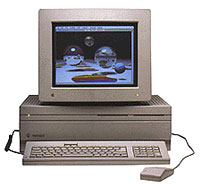 The technology was
improved, but it was still yesterday's news. The real breakthrough
was the Mac II, the first modular
Mac. It had two floppy bays, room for one 5.25" or two 3.5" SCSI
hard drives, 8 SIMM sockets for memory, and 6 NuBus expansion
slots.
The technology was
improved, but it was still yesterday's news. The real breakthrough
was the Mac II, the first modular
Mac. It had two floppy bays, room for one 5.25" or two 3.5" SCSI
hard drives, 8 SIMM sockets for memory, and 6 NuBus expansion
slots.
The 16 MHz 68020 CPU gave it nearly two-and-a-half times the power of the SE. It easily supports up to 8 MB of RAM, which was all the old Mac OS could work with. And, best of all, it supported external displays.
Macs suddenly went from little machines with built-in 9" displays into very flexible tools that could support 8-bit color (or shades of gray) on monitors as large as 21" - and using a second monitor only required plugging in a second video card.
The PC World in 1987
This was the year of the 80386 CPU and Windows/386, the first version of Windows designed to take advantage of some of the 386 CPU's advanced features. Windows was still a hack that didn't hold a candle to the Mac OS (System 4.1 shipped with the Mac II and SE), and the 16 MHz 68020 CPU in the Mac II made it pretty much the equal of the day's 386 hardware.
The Compaq Deskpro 386 had been introduced six months earlier at US$7,900 with 1 MB of RAM, a 40 MB hard drive, and a monitor. The Mac II retailed at US$5,500 with 1 MB of RAM and a 40 MG hard drive. Adding an 8-bit video card, color display, and keyboard (not included with the CPU!) brought the package to around US$7,000.
At this point, there was no reason to consider the Mac overpriced in the face of the PC competition.
- Next in the series: The Overpriced Mac in 1989
Join us on Facebook, follow us on Twitter or Google+, or subscribe to our RSS news feed
Dan Knight has been using Macs since 1986, sold Macs for several years, supported them for many more years, and has been publishing Low End Mac since April 1997. If you find Dan's articles helpful, please consider making a donation to his tip jar.
Links for the Day
- Mac of the Day: PowerBook 500 Series, introduced 1994.05.16. 'Blackbird' includes a 25 to 33 MHz 68040 along with smart batteries and grayscale or color displays.
- Support Low End Mac