Mac Musings
October 1990: Apple Unveils the First Low-End Macs
Daniel Knight - 2004.10.15
On October 14, 1990, the Mac line consisted of the 8 MHz Mac Plus and SE; the 16 MHz SE/30, IIcx, and Portable; the 25 MHz IIci; and the "wicked fast" 40 MHz Macintosh IIfx.
Macs weren't cheap. A IIfx setup could easily go past the US$10,000 mark, and the IIci and Portable each sold for over US$6,000. The closest Apple came to low-end Macs were the compact Macintosh SE, introduced in March 1987, and the slightly slower Mac Plus, introduced in January 1986.
I worked at ComputerLand of Grand Rapids, and if I recall correctly, we were blowing out the Mac Plus at US$1,399 - but only if you bought a bunch of extras. And the Plus was nearly five years old at the time!
On October 15, 1990, Apple took it's first shot at the low-end market with three new Macs: the Classic, the LC, and the IIsi.
The Classic
Both the Plus and SE were officially discontinued that day, replaced with the equally compact, equally slow, and almost equally dated Mac Classic. It had the same 9" b&w display, the same 8 MHz CPU, and the same 4 MB memory ceiling as the models it replaced.
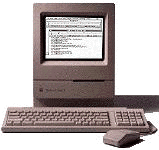 Unlike the SE,
it had no PDS expansion slot for adding ethernet, a
video card, an accelerator, or a DOS card.
Unlike the SE,
it had no PDS expansion slot for adding ethernet, a
video card, an accelerator, or a DOS card.
On the other hand, it was Apple's first US$999 Macintosh ($1,499 if you wanted it with an internal hard drive and 2 MB of RAM). It had SCSI for adding peripherals, serial ports for LocalTalk and printers, and ADB for the keyboard and mouse.
It even had a unique feature - you could boot the Classic without a floppy or hard drive by holding down cmd-opt-x-o at startup. That meant you could run programs from a floppy-only Classic and avoid a lot of disk swapping.
The Classic only had a handful of real drawbacks. First, it was still an 8 MHz computer, just like the original Macintosh introduced in January 1984. If it had been designed around a 16 MHz 68000, like the Mac Portable, it probably could have supported grayscale instead of 1-bit black-and-white, addressing a second drawback.
The third drawback was a lack of SIMM slots on the motherboard. To expand RAM beyond 1 MB, you had to buy a 1 MB board the fit into a special slot. That board gave you room for two additional 1 MB SIMMs.
The fourth drawback, which the Classic II continued, was a complete lack of internal expansion other than memory. There was simply no way to drop in an ethernet card, DOS card, or anything else.
Still, it sold fairly well and made the Macintosh experience accessible to many who could not otherwise afford a Mac.
The LC
Low Cost. Limited Color. Lightly Crippled. Whatever LC was meant to stand for, the Macintosh LC was Apple's first entry-level color Mac. It had a 16 MHz 68020 CPU, which was very much entry-level power in those days. It came with 2 MB of RAM, twice as much as the Classic and enough to run System 7 when it became available.
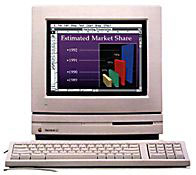 With Apple's new 12" color monitor
and less costly keyboard, you
could buy an LC setup (including a hard drive!) for around US$3,000.
That was a big breakthrough for Apple, although DOS users could get by
for much less than half that price.
With Apple's new 12" color monitor
and less costly keyboard, you
could buy an LC setup (including a hard drive!) for around US$3,000.
That was a big breakthrough for Apple, although DOS users could get by
for much less than half that price.
The LC was the first Mac to support 10 MB of RAM under System 6; except for the Portable's 9 MB ceiling, other Macs couldn't access more than 8 MB using the 24-bit addressing of the old OS. It wasn't until System 7 introduced 32-bit addressing that the LC's 10 MB memory ceiling became a drawback.
With the 12" color display, the LC supported 8-bit color, but with the more traditional 640 x 480 monitors, the standard video memory only supported 16-color, 4-bit displays. You had to buy a 256 KB VRAM chip to get 8-bit color on a regular monitor.
Through some clever, cost-cutting engineering, the LC used a 16-bit memory bus with the 32-bit bus of the 68020 CPU. That meant it only needed two SIMM slots for memory expansion, but it also crippled performance. The LC offered about 75% of the performance of the 16 MHz 68020 in the Mac II. This design compromise made its way into the Classic II, LC II, and Color Classic.
To help move the Mac into the education market, AppleDesigned an Apple II card to fit into the LC PDS (processor direct slot). By plugging a 5.25" floppy into the card, the LC could run both Mac and Apple II software on a single machine. A cool hack, but unfortunately the LC PDS had the same 16-bit bottleneck as the rest of the motherboard, something not corrected until the LC III of 1993.
Like the Classic II, the LC was compact and affordable, compromised, but still a decent entry-level machine for those on a budget who wanted a Mac instead of a DOS PC.
The IIsi
The 16 MHz Mac IIcx and 25 MHz IIci were two of the most dependable computers Apple had ever built, but they were far from affordable. The IIcx needed an additional video card to be useful, and the IIci was over US$6,000. The 20 MHz Mac IIsi was designed to sell for under US$4,000 while offering most of what the average business user needed.
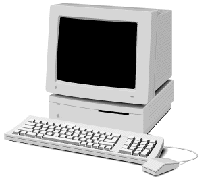 While the IIcx and IIci had three NuBus expansion slots, the IIsi
had none. Like the IIci, it had a processor direct slot (PDS), so the
IIsi could accept an ethernet card, an accelerator, or even a NuBus
adapter that allowed the use of a single NuBus card.
While the IIcx and IIci had three NuBus expansion slots, the IIsi
had none. Like the IIci, it had a processor direct slot (PDS), so the
IIsi could accept an ethernet card, an accelerator, or even a NuBus
adapter that allowed the use of a single NuBus card.
Earlier models in the Mac II series had included two banks of memory sockets. To keep costs down, the IIsi had 1 MB of RAM on the system board and a single bank of SIMM slots for memory expansion. This allowed the IIsi to support up to 65 MB total RAM - that was a lot under System 7.
Of the three models introduced on October 15, 1990, the IIsi was the least compromised. It had a 32-bit memory bus, ran 80% as fast as the IIci, had a decent amount of expandability, was relatively compact, and was the first model in the Mac II series to sell for under US$4,000. It became quite popular in business, especially since it supported a 640 x 480 color display or a portrait display, which was great for word processing.
Even today, a Mac IIsi can make a wonderful small network server. Drop in a 4 GB 3.5" SCSI drive and ethernet card, find a copy of AppleShare 3, add four 16 MB SIMMs, and run System 7.x with 32-bit addressing enabled.
History Repeats Itself
Then as now, the entry-level Mac was an all-in-one model, although the eMac is a much larger, more capable machine than the Classic ever was. And you can buy a 1.25 GHz eMac with a SuperDrive for the same price as the floppy-only Classic had in 1990.
Then as now, modular Macs cost more than the all-in-one models - even the LC didn't change that, although there have been times in Apple's history when low-cost modular Macs were available for a lot less than all-in-one designs.
I wish Apple would do that again.