Mac Musings
Marketing the Mac: Yes, Macs Are Different
Daniel Knight - 2004.04.26
Apple is in a rut. They've been selling about three millions Macs a year since the "beleaguered" era. While the broader PC market grows, Apple's unit sales are stagnant, and their market share is dropping.
In this series of articles we'll be looking at some ways Apple could grow their market.
Growing the Mac market isn't a simple process, but the best place to start is by looking at why people choose Windows PCs instead of Macs.
- Macs are different. They don't run Windows software. They're not what people use at work. They're not what most computer users are used to. They don't follow industry standards (a myth - Mac use PC memory, PCI and AGP cards, standard hard drives, etc.). There's no floppy.
- Macs aren't expandable or upgradable. Outside of the 15" and 17" PowerBooks, which have a single PC Card slot, and the Power Mac G5, Macs don't have any expansion slots. You can't pull the CPU and drop in a faster one. You can't swap out the motherboard. What you buy is what you're stuck with.
- Macs are too expensive. In the era of $599 (after mail-in rebate) Dells, fully configured eMachines systems on sale at Walmart, and the like, why pay $799 and up for a Mac?
- Nobody I know uses or recommends Macs. With Mac users only 5% of the broader computing market, that's a real possibility
Over the course of the coming week, we'll look at these and other issues, both obstacles to growing the market and opportunities for growth and profits.
Yes, Macs Are Different
In a society that supposedly celebrates diversity, what's wrong with one major computer brand marching to the beat of a different drummer? Why is there the assumption that different is bad when it comes to computers?
We have to take this argument on in two ways: First, that different is good. Second, that the Mac isn't as different as people tend to believe.
Think Different
Whatever you think of the grammar of Apple's Think Different campaign, it attempted to celebrate the diversity of our world and link the Macintosh to diversity. Apple has always been different, and that worked to their advantage when the Apple II dominated schools. However, it has worked to their disadvantage with the Mac.
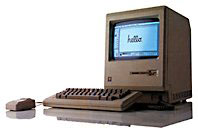 The first Mac (Jan. 1984) was different,
very different. Is had a built-in 9" display and no color graphics
- not even shades of gray. You were stuck with that. It had a 3.5"
floppy drive in a world dominated by 5.25" floppies. It had a
graphical interface and mouse in a world of the command line and
keyboard-only input.
The first Mac (Jan. 1984) was different,
very different. Is had a built-in 9" display and no color graphics
- not even shades of gray. You were stuck with that. It had a 3.5"
floppy drive in a world dominated by 5.25" floppies. It had a
graphical interface and mouse in a world of the command line and
keyboard-only input.
The computer world was dominated by Intel 8088 and 80286 computers, but Apple chose Motorola's 68000, making it completely incompatible with existing software.
It was a long, slow sell to get the Macintosh accepted anywhere, at least until PageMaker and the Radius Full Page Display made the Mac the darling of the publishing world. And as far as most people today are concerned, if you're not working with graphics, why in the world would you use a Mac?
Change Different
The next step forward was adoption of the SCSI expansion bus with the Mac Plus (Jan. 1986). This immediately addressed another complaint about the "different" Macintosh was that you couldn't pop in a hard drive, an increasingly popular part of DOS computers. Although Apple had released a slow serial hard drive to use the Mac's floppy port, SCSI was a world faster. It was also versatile, allowing Mac users to add hard drives, scanners, backup tape drives, and other devices - up to seven SCSI devices on a single chain.
Apple added color with the Mac II (Mar. 1987), which supported 640 x 480 pixels and 256 colors out of a palette of 16 million. This in a world where VGA allowed 256 colors at 320 x 200 or 16 colors at 640 x 480 - and that was a new video standard in the PC world. Not only that, but the Mac could also support multiple displays and other monitor sizes.
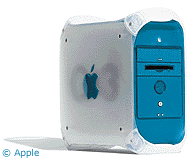 Great, but Apple chose to use a
DB15 connector for their monitors just as IBM was releasing VGA
with a much more compact 15-pin connector. It wasn't until the
blue & white G3 (Jan. 1999) that
Apple finally adopted the industry standard VGA connector.
Great, but Apple chose to use a
DB15 connector for their monitors just as IBM was releasing VGA
with a much more compact 15-pin connector. It wasn't until the
blue & white G3 (Jan. 1999) that
Apple finally adopted the industry standard VGA connector.
Apple adopted NuBus expansion slots, a 10 MHz 32-bit standard while the rest of the world was still using 8-bit and 16-bit ISA slots usually running at 8 MHz. It was better, but it was also different. (Being different was also what ultimately doomed IBM's Micro Channel Architecture and OS/2. The good is the enemy of the better.)
Less Different
Apple continued to use NuBus expansion slots until the Power Mac 9500 (May 1995) and has used the industry standard PCI expansion slot ever since. Apple adopted the AGP slot for video cards with the Power Mac G4 (Sawtooth) in August 1999.
But that wasn't the first time Apple had included something in the Mac's design that simplified coexistence in a PC world. That honor goes to the introduction of the 1.4 MB high-density floppy (a.k.a. SuperDrive) in the Mac IIx in Sept. 1998. Still, it wasn't until third-party programs allowed the Mac to mount PC floppies on the desktop that the promise of the drive was completely fulfilled.
Apple has learned that using industry-standard components makes sense. Macs now use the same hard drives and optical drives as Windows PCs and include the same PCI and AGP expansion slots as the Dells, HPs, Gateways, and Compaqs so many people use. (Granted, the cards used in those slots usually have to be modified for the Mac's PowerPC processors, but that's usually done in firmware.)
Essentially Different
What essentially defines today's Macintosh as different is the use of PowerPC processors (instead of Intel or AMD CPUs), the Mac OS, innovative hardware design, and some excellent Mac-only software. Except for case design, Apple has done what it can to use readily available parts and ports for years now.
The Mac's use of PowerPC processors undoubtedly plays a role in Apple's survival. If Apple were to switch to Intel or AMD processors, it would be trivial for Microsoft to make Windows run on Macs and for other companies to port their software over, even if Apple did use a somewhat different architecture than the mass of Wintel boxes on the market.
The Death of Apple
What Apple might gain in sales by switching to the Pentium 4 and offering 3.4 GHz computers is would probably lose in terms of OS X sales. Developers would be even less likely to write software for the PowerPC Mac as Intel-based models grew in popularity, and they'd also be less likely to write apps for X-on-Intel as Windows grew in popularity on Intel-based Macs.
Despite the pundits who believe that Apple must switch to Intel or perish, the opposite is true. Were Apple to switch to Intel, Apple's fate would be sealed. The Mac OS would continue to decline in market share, and we'd be left with Linux, BSD, and a handful of more obscure operating systems as the only real alternative to Windows hegemony.
The Growth of Apple
To survive, Apple must remain unique. To grow, Apple must let the world know where Macs are different and where they are very much like the Windows PCs the masses are used to.
Different is neither bad nor good. Different is just different.
The problem with the Think Different campaign is that it stressed the difference without reminding people that Macs ran Microsoft Office, had Web browsers, worked with email, and handled pretty much any task done on a Windows PC very comfortably. That was the failing of Think Different.
To grow, Apple has to stress that the Mac does what people need to do on a computer. You can read Office documents without buying Office. You can visit websites using Internet Explorer, Apple's Safari, or one of several very competent alternatives. You can read email using Apple's Mail program, Microsoft's email client, or one of several nice alternatives.
As long as different doesn't mean you can't do the same work, different isn't a bad thing. In fact, it can be a good thing in some respects.
Different Is Good
If you're a Mac user, how many times have you picked on Windows users about the viruses, Trojan horses, and other forms of malware that seem to pop up every week or so? They make an appealing target, both the operating system and Windows users.
That's one place where Mac users have a right to feel superior. At this point, there has never been an OS X virus or Trojan released into the wild. I haven't heard of any adware or spyware designed specifically for the Mac, although as a Mac user I don't pay much attention to that category.
Granted, Macs aren't immune from malicious software, but with just 10 million OS X users, we're a much less inviting target than Windows users. The smaller user base would also make it more difficult to spread a virus, and the security designed into Unix (the BSD variant of Unix is at the heart of OS X) means that malware would have a harder time doing significant damage.
Another place where different is good is Mac-only software. If you want to use iMovie to edit videos and iDVD to burn them to disc, the Mac is your only choice. There are a few niches where Mac-only software is the best solution, something Apple has already used to their advantage and should continue to do in the future.
In terms of hardware design - and laptop battery life in particular - Apple definitely stands apart from the crowd. Mac hardware is consistently attractive, often copied, and distinctive enough that the presence of a Mac is an ad for Apple in and of itself.
And quite frankly, Apple can stop worrying about the Megahertz Myth or having The Fastest Personal Computer on the Planet. Most buyers don't care. They just want to know that it's going to feel fast, and today's Macs do.
Different Is an Obstacle
While there are some wonderful Mac-only programs, it's equally true that there are a lot of Windows-only programs out there, and sometimes they are better than Mac programs or even have no equivalent on the Mac platform (Microsoft's Access database is a good example of a widely used program that doesn't have a Mac version).
Emulating a PC on a Mac, using software such as Virtual PC, is a limited solution. While it works on pre-G5 Macs, it's much slower than today's slowest Windows computer - and its generally more expensive than a faster, used Windows computer. Frankly, if you need to run Windows software, you're best off using hardware designed for Windows.
Before CD burners became pretty much a standard feature of computers, the fact that the Mac didn't have an internal floppy drive was raised as a big obstacle to Mac acceptability. It's less of a factor today, and for those who really need to use a floppy disk with a modern Mac, single-speed USB floppy drives generally sell for US$30, and double-speed floppy drives often go for US$45 or so.
Macs can read and create CDs that work on Windows computers, so moving files between the platforms isn't a big issue, even if you're not on a network.
Another place where being different presents a challenge is work habits. Windows users reach for the Ctrl key when using the keyboard commands to cut, copy, paste, and so forth. Mac users have a Cmd key for those functions, and while it's much easier to reach (sitting next to the space bar), going back and forth between Windows and the Mac OS means retraining your fingers.
Windows is spatially different from the Mac OS, both X and classic. Our Apple menu is in the upper right corner; their Start menu is in the lower right corner. Our pulldown menus are tied to the menu bar at the top of the screen; their pulldown menus are tied to the menu bar in the window they're working in.
There are lots of small differences that I'm finding using a Windows PC part-time, and I'm sure Windows users sitting in front of a Mac the first few times feel equally out of their element. Some have suggested that Apple offer a Windows "skin" or mode that would move the OS X elements around the places familiar to Windows users. I like the idea, although it flies in the face of Apple's desire to control the horizontal and vertical of the user experience.
Marketing the Difference
Being different is a big part of what makes Macs special, better integrates the hardware and operating system, and keeps us virus-free, but it's not all for the good. Some of the differences are obstacles, making it challenging for Windows users to become comfortable with the Mac OS.
But in the end, it's a matter of what the computer does, how well it does it, and how reliable it is. The Mac runs Office, surfs the Web, does email, and runs practically any type of application imaginable.
It does this without Windows, which means that Macs are essentially immune from the tens of thousands of Windows viruses out there. If that's not a marketable advantage, I don't know what is.
The really market the Mac, Apple has to stress that the Mac is compatible with the Web, email, and both Word and Excel documents. The Mac may have a different CPU, may not win any Megahertz War, and use a unique OS, but in terms of functionality, it does exactly the same things as Windows PCs - and with less headaches.
As Mr. Spock once noted, the difference that makes no difference is no difference. Most of the objections to the Mac being different are myths, and where there are real differences (especially malware), it is generally to the Mac's advantage.
Think Different. Think Macintosh.