Mac Musings
Living the Low-end Life: It's Not Just About Computers
Daniel Knight - 2004.04.23
Computers have fascinated me since the first TRS-80s arrived at the Woodland Mall Radio Shack, but it wasn't until 1983 that I first owned one. I bought a Commodore VIC-20 and a cassette tape drive from Highland Appliance for about $200 - and to this day my (soon to be ex)wife reminds me that it wasn't in the budget.
My next computer was a refurbished Commodore 64 for $99, and in 1987 I "graduated" to the DOS world with a refurbished Zenith PC. If I recall the details, it had two 5.25" floppy drives, 512 KB of memory, and Zenith's version of CGA video. With a good C.Itoh dot matrix printer, the whole thing set me back about $1,200.
By this time my wife had gone back to college, discovered the power of word processing, and was on to graduate school. With the Zenith and PFS: First Choice (an early Works-like program), she could type papers for other students and avoid having to work outside the home.
My next low-end computer was my first Mac, a Mac Plus obtained through an Apple sales promotion at the end of the product's life cycle. All I had to pay was income tax on the value of the computer.
Since then I bought a low-end Centris 610 (the non-ethernet one), a SuperMac J700 on fire sale as Umax left the Mac clone market, a 400 MHz PowerBook G4 (my most expensive computer ever at over $2,500, and the only computer I've bought when it was brand new on the market), and last summer a 700 MHz eMac.
It's Not Just Macs
For most of my life I've lived on limited means. In high school, that meant buying used accessories for my 35mm SLR. In college, that meant shopping the low-price New York dealers when I needed a new lens or flash.
When I got into audio, I looked for value. Sixty watts was plenty of power, the amplifier I picked had 3 dB of overhead beyond that, and it worked for years and years. I picked up a great JVC direct drive turntable at close out, and it's still working fine. My tuner worked last time I tried it, but that was ages ago. And the low-cost speakers I built lasted over a decade before the kids managed to blow the drivers.
The only components that wore out were tape decks, speakers, phono cartridges, and the amplifier, which developed a nasty buzz after about 15 years. Buying quality stuff at good prices pays off in the long run.
A lot of it is knowing what you want, what you need, and what you'll be happy with. It's 2004, digital TV is just around the corner, and I still haven't bought a stereo television. I did buy a stereo VCR for my apartment at Walmart - it was just $7 more than the mono version, and I can play the sound through my stereo.
"Good enough" is an important mantra for the low-end lifestyle. I'm typing this article on a USB Acer Aspire keyboard I bought for $19 in 1999, long before anyone else thought to make inexpensive USB keyboards. It's connected to my 3-1/4 year old PowerBook G4, which is still fast enough for almost everything I do. (Yes, I do prefer the speed of my "wicked fast" 700 MHz eMac, but I can't imagine toting it between my home office and my apartment.)
I'm still using Claris Home Page for page design and writing articles, the same program I've been using since I created my first personal pages in 1996. And I'm using a great little freeware program, uControl, that remaps the CMD/Windows and Alt keys on this PC keyboard to act like the Mac's Option and Cmd keys.
I'm living in the smallest, most affordable one-bedroom apartment I could find when my wife and I separated. I bought a new bed, brought a lot of furniture from the house, received a futon from my folks for Christmas, and do my best to keep overhead down. My TV is an ancient one borrowed from my parents, as is the dining room set (not the prettiest, but functional).
I have a couple chairs discovered next to the dumpster one weekends, and I'm living with dialup Internet access at $8.88 for 240 hours per month. The only reason I have a regular phone line is so I can use the modem.
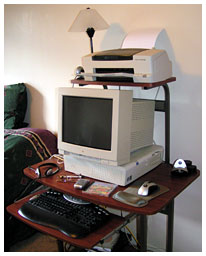 My two computers are the PowerBook G4/400,
which is great for use in the living room while watching television or
videos, and a 450 MHz Dell I picked up used for $185 including 128 MB
RAM, a 9 GB hard drive, Windows 98SE, a modem, and a headset.
(More on why I bought a Windows PC when I have the time to write about
it.) I used that initially with an ancient 15" Compaq monitor that was
kinda fuzzy at 1024 x 768, and, thanks to finally locating an adapter
that allows using an old Mac monitor with a DB15 plug on a PC with a
VGA port, I'm using a beat up old 17" Apple Multiple Scan display. It's
much crisper, although this monitor has definitely seen better days and
the color cast seems to randomly shift with time.
My two computers are the PowerBook G4/400,
which is great for use in the living room while watching television or
videos, and a 450 MHz Dell I picked up used for $185 including 128 MB
RAM, a 9 GB hard drive, Windows 98SE, a modem, and a headset.
(More on why I bought a Windows PC when I have the time to write about
it.) I used that initially with an ancient 15" Compaq monitor that was
kinda fuzzy at 1024 x 768, and, thanks to finally locating an adapter
that allows using an old Mac monitor with a DB15 plug on a PC with a
VGA port, I'm using a beat up old 17" Apple Multiple Scan display. It's
much crisper, although this monitor has definitely seen better days and
the color cast seems to randomly shift with time.
Beyond Products
The low-end lifestyle means using those $5 fluorescent bulbs that fit in a regular light socket to reduce electrical consumption by about 75% - and opening the blinds and turning off the lights when possible. I'm averaging under $10 a month on my electric bill.
I've learned to comparison shop and buy various items at Aldi, Walmart, Sam's Club, Meijer, Walgreen, or CVS. I try to buy my gas when prices are low, but that's a real crap shoot these days.
When going to the movies, I try to hit matinees, which can save $2-3 per ticket - that can add up with four sons. When I buy DVDs, they're almost always previously viewed or from the $5.50 bin at Walmart.
Low-end living also means eating at home more and making the most of your insurance.
I'm grateful that my wife is a social worker and makes sure that her agency has good mental health coverage. We've spent a lot of hours in therapy, both individually and together, as we tried to figure out just where things had gone wrong and whether the marriage could be saved. Without a low copay, I'm sure we would have had less professional help.
Low-end living means doing what we can to reduce the cost of divorce. There are forms available, a $25 book that walks you through the "divorce with minor children" process, and filing fees - but we won't need a lawyer. We've talked things over, agreed on terms, and just need to get all the paperwork finished.
A Bit Less Low-end
The whole process put me through a lot of stress over the past 6-7 months. Not understanding. Moving out (the worst day of my life). Facing the reality that it wasn't going to work and we were going to have a divorce. Telling the boys.
I haven't written a lot on Low End Mac until this past week. I wrote volumes offline as I examined my life, corresponded with my wife, processed my thoughts - that was the priority. But now that I've come to accept the reality of divorce, I'm able to move on, to put the stress behind me, to think about more than how painful life can be.
And we're moving on up. Instead of dealing with child support or moving kids from one parent to the other, we're doing joint custody in the family home for the next year. We'll be taking turns living at home, which avoids disrupting the boys' lives as much as possible. We fully expect to have three of the four out of the house by Fall 2005, so we'll be able to sell the house and move to smaller quarters next summer.
In this crazy situation, we've come up with an unusual plan. Joint custody at home plus a shared apartment. We'll each have our own bedroom and bathroom as personal space, the rest of the apartment will be shared space, and it's unlikely we'll ever be there at the same time once we've both got our things moved in.
We will be retaining our home offices for as long as we own the house. We will have broadband in the apartment, something I'm really looking forward to after living with dialup since December 1st. We've even worked out a joint budget to cover family expenses and the fixed costs of the apartment. Each of us will contribute to that budget in proportion to our income, and we'll each be responsible for our own groceries and the like when living in the apartment.
The apartment is more spacious, newer, a bit more expensive, and definitely a step up from my current one, but it's still a low-end solution to what could have been a messy and expensive problem. We're pretty confident it's going to work for the next three years or so, at which point our youngest will graduate high school.
About the only reason we can even pull this off is that we're living essentially debt free. Except for our mortgage, we don't have or use credit. Hundreds of dollars a month in credit card interest would put an incredible financial strain on us right now - it certainly did in the past.
Priorities
A lot of choices come down to the values in your life. If having the best regardless of cost is your thing, you probably don't visit Low End Mac to begin with. If conserving your money is your priority, you may not have a computer or Internet access. Most of the rest of us live between those extremes, trying to determine which things should be higher quality (hint: look for the Apple logo) and where it doesn't really matter. It's a big part of what we at Low End Mac call the value equation.
Other values are also important. I'm spending a lot more time with the boys than I used to - despite not living at their home 80% of the time. (Because my apartment is so small, I move into the family home on my weekends, and my wife plans business trips or stays in my apartment.) I'm involved in a men's group at church, the first time since we joined five years ago.
I've been spending less time on Low End Mac than any time since I started publishing the site full time in January 2001. I've discovered that traffic levels didn't fall when we went to a Monday, Wednesday, Friday publishing schedule. I've learned that I don't have to start working at 7 a.m. and stay at the computer until mid-evening. I've found some freedom from the tyranny of my own business.
Good things can come out of hard times.
I'm reprioritizing my life, reinventing myself in light of the divorce and what I've learned through therapy, and starting to move on with life. I'm even facing the prospect of dating again. I'm also making time to write, and I've probably got 8-10 articles bouncing around in my head, things I hope to start working on as soon as I finish this.
Next week I hope to start a series on marketing the Mac that will look at ways Apple could grow from 3 million computers a year. (Despite dropping in market share, Apple is remarkably consistent at selling that number of Macs year after year.)
Until then, take care of yourselves and work to strengthen your relationships. They're worth a whole lot more than computers.