Mac Musings
The Longer Apple Sticks with Motorola, the Behinder They Get
Daniel Knight - 2003.01.24 -
When Apple moved to the PowerPC processor in 1994, the 60-80 MHz clock speeds were a tempting jump from the 25-40 MHz 68040 Macs. The RISC design of the PowerPC meant that the Power Macs could outperform Pentium machines, which ran at about the same clock speed.
The other side of the RISC promise was that in addition to being more efficient, because it was less complex, it would be easier to design it to run at higher clock speeds. And as well all know today, that didn't pan out.
Clock Speed
The simple fact is that Intel won the MHz Wars. Today you can buy a 3 GHz Pentium 4 computer, a 2 GHz+ AMD Athlon computer, or a dual 1.25 GHz Power Mac G4. Where RISC architecture and clever design made the PowerPC G3 up to twice as fast as a Pentium at the same clock speed, the newest Pentiums run at far more that twice the clock speed of the fastest G4.
With dual 1.25 GHz processors we come close to holding our own in terms of performance, but we have lost the MHz War. And for the average computer buyer, clock speed is the primary indicator of computer performance. They are less concerned with Photoshop benchmarks. Show them the MHz.
Yes, the PowerPC is a more efficient design, but Intel has not been standing still. MHz for MHz the G4 easily outperforms the Pentium 4, and it draws a lot less power, too (making it ideal for laptops), but just imagine the power of a Power Mac today if we were even close to clock speed parity with Intel.
What Happened?
The PowerPC chips were the brainchild of Apple, IBM, and Motorola. Motorola was developing their 88000 RISC CPU. IBM had their Power architecture. Apple convinced them to work together to create a new processor for the next generation of Macs, and the PowerPC was born.
When the first Power Mac shipped, we had MHz parity with the Pentium. As the PowerPC and Pentium processors evolved, clock speeds remained close right up to the 350 MHz mark in 1997.
Then came the G3. The G3 was (and still is) a leap in efficiency compared with the earlier 603e and 604e PowerPC processors. The 233 MHz G3 nearly matched the performance of the 350 MHz 604e. The G3 was roughly 50% more powerful per MHz than earlier PowerPC processors - and it was up to twice as efficient as Intel's Pentium at the same speed.
It was at this point that the PowerPC began to lag in the MHz race. From 1998 to the present, the Pentium family of processors has pulled further and further ahead, as shown in this chart:
PowerPC, Pentium, Athlon MHz Comparison
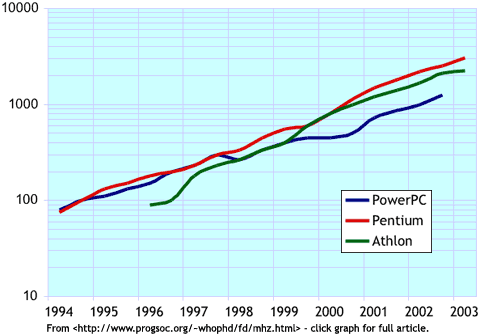
The chart shows shipping CPUs. IBM demonstrated a 1.1 GHz PowerPC in February 1998, although the prototype was not ready for production. Five years later Apple has only gone 30% past that mark.
Who knows how fast Macs would be today if Apple had followed IBM's road map instead of tying its future to Motorola's G4 processor. From August 1999 until today, Apple has been limited to offering the fastest G4 available from Motorola:
- Power Mac G4/450, announced 1999.08.31
- Power Mac G4/500, finally shipped 2000.02.16
- Power Mac G4/733, first shipped 2001.02
- Power Mac G4/867, introduced 2001.07.18
- Power Mac G4/1 GHz (dual), introduced 2002.01.28
- Power Mac G4/1.25 GHz (dual), available 2002.09
- Power Mac G4/1.42 GHz (dual), introduced 2003.01.28
Over three-and-a-half years, Motorola increased CPU speed a bit more than threefold, from 450 MHz to 1.42 GHz. Moore's Law predicted the design would have reached 1.8 GHz by last summer and 2.25 GHz today, but Motorola seems unable to follow Intel and AMD in adhering to Moore's Law. In Motorola's case, perhaps it should be called Moore's Guideline - or Motorola's Unachievable Goal.
Seriously, just because the PowerPC is more efficient than the Pentium doesn't mean Motorola (and Apple with them) can keep falling further and further behind in MHz speed. If the whole industry is quadrupling speed every three years and you only triple it, you've lost any advantage the PowerPC's efficiency provided.
If Apple had followed IBM's lead, we might well be running 2-3 GHz G3 computers today. Or maybe not.
IBM PowerPC 970
IBM has taken a different tangent with their Power architecture, building two processing cores on a single chip, and also designing these chips to work well in conjunction with several others, making it easy to scale performance by simply plugging in more processor modules.
The initial design of the PPC 970 uses IBM's 0.13 micron SOI process and supports speeds from 1.4 to 1.8 GHz. IBM estimates performance of the 1.8 GHz PPC 970 will be roughly comparable to a 2.8 GHz Pentium 4 based on SPEC benchmarks. This is a big step forward from the performance of today's PowerPC 7455 (G4).
In terms of sheer power, the 970 can have up to 200 instructions in various stages of execution at the same time, over 50% more than the 126 instruction maximum of the Pentium 4 - and more than a 12-fold improvement compared with the G4's 16 instruction limitation.
Where the Pentium 4 takes a "narrow and deep" approach to instruction queues (to borrow a phrase from ars technica), the PPC 970 is characterized as "wide and deep." IBM's chip has a 16-stage execution queue, so processes are completed in less CPU cycles than required by the Pentium 4's 20-stage pipeline. With more pipes using less steps than the P4, the PPC 970 is roughly 50% more efficient per CPU cycle.
Better yet, the PPC 970 is designed from the ground up to function well in a multiprocessor environment; despite the availability of dual-CPU Pentium systems, the P4 functions best in a single processor environment. It looks like a dual-processor Power Mac with PPC 970 processors could outperform that fastest dual processor P4 system - and a quad-processor system would smoke it
The 970 is a 64-bit processor designed with strong 32-bit support. Although the Mac OS would have to be recompiled for the 970, current applications should be able to run without modification.
And the PPC 970 makes one crucial concession to Apple and Motorola - it includes the AltiVec "Velocity Engine" instructions.
IBM hopes to deliver samples in the 2nd quarter of 2003 and ship 1.4, 1.6, and 1.8 GHz chips during the 3rd quarter. If they can deliver according to this schedule, we could see Apple unveil the next generation Power Mac at July's Macworld Expo.
Or they may choose to remain mired in the mud with Motorola and fall further and further from the clock speed and overall throughput of the rest of the industry.