
For most Mac users, Apple’s Lisa isn’t even a footnote in Mac history. The $10,000 computer is rarely remembered as the Mac’s mother – and those who do remember it also tend to recall how Apple dumped thousands upon thousands of unsold Lisas in a Utah landfill when the computer was discontinued.
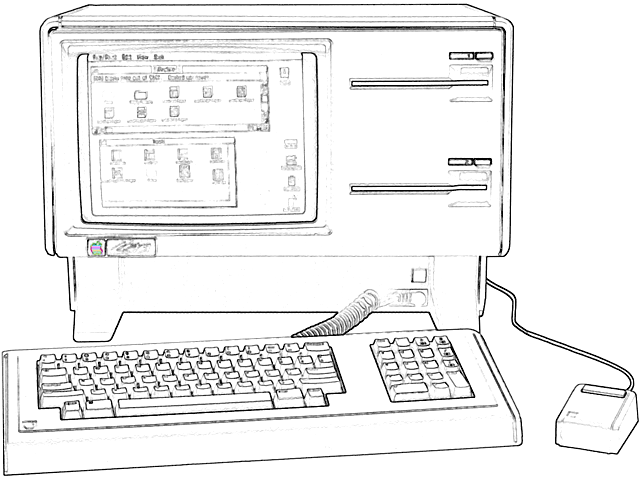
In the minds of many, the Lisa is best forgotten.
Before Lisa
The Lisa was Apple’s new business computer. Although the Apple II+ had helped Apple move from the home and education market to the workplace – thanks to VisiCalc, the original computer spreadsheet – things just didn’t work out.
First came the Apple III, an Apple II on steroids. The III used bank switching to support 128 KB of memory, ran at 1.4 MHz (40% faster than the Apple II), and had an internal floppy drive. But it wasn’t fully backwards compatible with the Apple II, had serious teething problems (the entire first production run was recalled – and the Apple III was not re-released for another year), and had to compete with the IBM PC when it finally shipped in late 1981.
Too little. Too late. The Apple III is far more deserving of the Road Apple label than the most poorly designed Mac ever.
The IBM PC
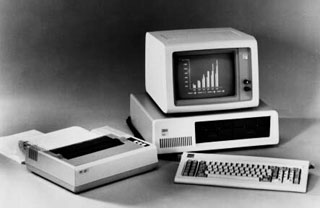 IBM tested the waters of the personal computer market in 1981 – and the rest is history. Over the course of a few years, DOS PCs killed off CP/M, Commodore’s computers, Radio Shack’s TRS-80 line, and eventually the Apple II. The abbreviation PC went from meaning personal computer to a computer that ran MS-DOS (and later Windows).
This is what Lisa was designed to compete against.
Looking at Lisa
Apple believed that computers were too hard to use – and they were. The first personal computers came as kits to be assembled by geeks. Around 1976, you could buy an assembled computer, but you’d probably buy it to do programming.
The first word processors and spreadsheets helped change that, turning the computers from toys and programming tools into productivity tools. But you still had to learn DOS. You had to be trained in Lotus 1-2-3, WordPerfect, dBase, and the operating system.
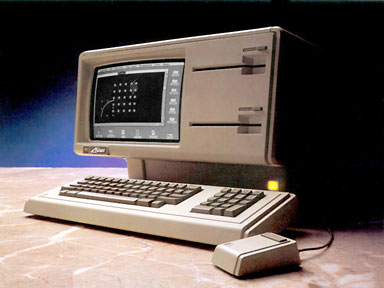
Lisa was the first consumer computer with a graphical user interface (GUI). It had a mouse, an integrated family of programs, and a big 12″ b&w display that let you actually see what your documents would look like. It was a huge breakthrough with a huge price tag – and it shaped everything that was to follow.
It was far from perfect. The Lisa operating system was bloated; in an era of 640 KB DOS machines, the Lisa had and needed 1 MB of memory (expandable to 2 MB). The “Twiggy” floppy drives were not the most reliable. The serialized software protection scheme could cause all sorts of problems. And a 5 MHz computer was nothing to get excited about.
Road Apple?
Innovative as the Lisa was, and as important is it was to the genesis of the Macintosh, it should be considered Apple’s second Road Apple. There just wasn’t much of a market for a $10,000 business computer that didn’t run DOS programs. Apple was trying to swim upstream against the IBM and Microsoft current.
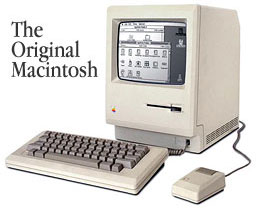
Apple addressed most of the Lisa’s shortcomings with the original Macintosh, which came out one year after the first Lisa. Instead of Lisa’s flaky 5.25″ Twiggy floppies, the Mac used 3.5″ floppies. Instead of a bloated OS, the Mac OS and ROMs were polished machine code, making it possible for the Mac to operate with only 128 KB of memory.
The big 12″ display with rectangular pixels gave way to a crisp 9″ display with square pixels – because square pixels were easier to work with on a low memory computer. The processor speed jumped from 5 MHz to 8 MHz.
The Mac’s only real drawbacks were a complete lack of hard drives at first and no way of expanding system memory. With only 128 KB of memory, developers were generally unable to develop Mac software on the Mac itself.
Lisa 2
Instead of killing off Lisa, Apple morphed it into Lisa 2. The new Lisa had the same 3.5″ floppy as the Mac and had room for an internal 10 MB hard drive (in 1984, that was a lot of space). The “baby” Lisa had 512 KB of memory, which helped make it more affordable.
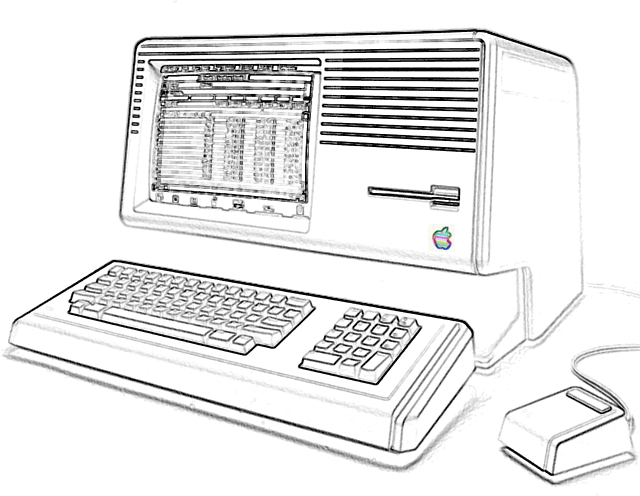
Best of all for Lisa owners, Apple offered a free upgrade from the old Lisa to the Lisa 2. Unfortunately for computer historians, that means there are a lot less original Lisas in the world today.
Lisa 2, at $3,500 to $5,500, was vastly more affordable than the original Lisa – and not too much more expensive than the $2,500 128 KB Macintosh. Until the Fat Mac shipped with 512 KB of memory in September 1984, the Lisa 2 was the premier development platform for Macintosh programmers.
Macintosh XL
One year after the Macintosh and Lisa 2 were introduced, Apple morphed the Lisa 2 into the Macintosh XL. Running MacWorks software, the Lisa/Mac XL could emulate the Macintosh to the point where it would one day be able to run System 6.
Three months later the Macintosh XL was discontinued, the Lisa line was dead, and thousands ended up in the Logan Landfill in Utah. But the Lisa legacy lives on in every Macintosh, every Windows PC, and every GUI for *nix operating systems out there today.
We should remember the Lisa not for what it was, but for what it lead to. Personal computing would not be the same today without it.
Further Reading
- Apple Lisa group on Facebook.
- The Real History of the GUI, SitePoint
- The Innovative Lisa, Dan Knight, Online Tech Journal
- The Apple Lisa SAQ, Tom Stepleton
- The Apple Lisa Computer: A Retrospective, David T. Craig, Archaic Apples
- Apple Lisa Computer, Eric Smith
- Apple Lisa Tribute, Simon White
- Apple Lisa, PC Museum
- The Legacy of the Apple Lisa Personal Computer: An Outsider’s View, David T. Craig
- The Five Biggest Computer Failures Ever: The Apple Lisa, Tech TV
Kewywords: #applelisa
Short link: http://goo.gl/BKxzpZ
searchword: lisalegacy
