Mac Musings
The New Power Mac Value Equation
Daniel Knight - 2002.01.28 -
It had to happen sooner or later - Apple is finally shipping something with a CPU faster than 867 MHz, a speed it's been stuck at since July 2001. Today Apple announced a new set of Power Macs at 800 MHz, 933 MHz, and 1 GHz (with dual processors).
G4 History: Round 1
Motorola has caused Apple numerous headaches with its inability to offer faster G4s in a timely manner. When Apple announced the first Power Mac G4s on August 31, 1999, it offered a 400 MHz Yikes! model, a 450 MHz Sawtooth model, and promised a 500 MHz Sawtooth "Real Soon".
Real Soon translated to Apple finally getting the G4/500 out of the
gate on February 16, 2000. In the meantime, Apple was 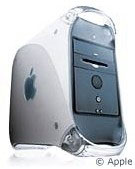 unable to meet demand for the G4, since Motorola
couldn't provide the speeds and quantities necessary. On October 13,
1999, Apple reduced the speed of the Yikes! model to 350 MHz at no
change in price, introduced a 400 MHz Sawtooth at the previous 450 MHz
price, and offered the 450 MHz model at the proposed 500 MHz price.
unable to meet demand for the G4, since Motorola
couldn't provide the speeds and quantities necessary. On October 13,
1999, Apple reduced the speed of the Yikes! model to 350 MHz at no
change in price, introduced a 400 MHz Sawtooth at the previous 450 MHz
price, and offered the 450 MHz model at the proposed 500 MHz price.
Although this made G4s readily available, offering reduced performance without a price reduction didn't make Apple many friends.
The low-end Yikes! model (based on the Blue and White G3 motherboard) was retired on December 2, 1999. It was replaced with a 350 MHz Sawtooth model. (Sawtooth motherboards offer faster memory access, an AGP slot for a faster video card, and AirPort support.)
The G4/350 with AGP lasted until February 16, 2000, the day Apple finally released the 500 MHz G4 it has promised five-and-a-half months earlier.
G4 History: Round 2
Five months later, Apple introduced the "Two Brains Are Better Than One" Mystic Power Mac G4, a dual-processor model running twin 450 or 500 MHz G4s. If Motorola couldn't provide a faster CPU, Apple could darn well give users two G4s at the same price as the earlier single-processor models.
It sounded nice, but except for Photoshop and a few other applications, Mac users would have to wait for OS X to have an operating system and a lot of applications that could benefit from that second processor.
G4 History: 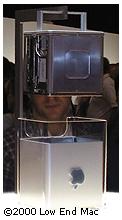 Round
2-1/2
Round
2-1/2
We really can't cover the history of the G4 without looking at the unmarketable Power Mac G4 Cube. It was a piece of art, a brilliant design, and had extremely limited expansion options. Performance tended to be a bit slow, about the same as a 50 MHz slower Power Mac G4, so it was quickly labelled overpriced.
Apple eventually trimmed the prices, but even Steve Jobs and his famed Reality Distortion Field couldn't make the Cube a success. The Cube was introduced on July 19, 2000 and discontinued on July 3, 2001, just before its first birthday.
G4 History: Round 3
Six months later, Apple finally broke past the 500 MHz mark with a new series of G4s built around a 133 MHz system bus. Breaking with tradition, Apple offered the Digital Audio model in four speeds - the 466 and 533 MHz models shared one motherboard, while the 667 and 733 MHz machines shared a different one. They all shared one more new feature: a fourth PCI slot.
From a marketing standpoint, Apple called these five-slot machines, since the PC world had long counted the AGP slot in addition to PCI slots.
There was a dual processor 533 MHz model, but if two brains had been better than one, why did only one of the new models have a dual-processor option?
G4 History: 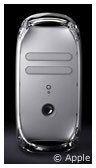 Round 4
Like clockwork, Apple replaced that series with the Quicksilver G4 six months later. Suddenly 733 MHz was the entry level, 867 MHz provided the highest MHz rating, and a dual-800 MHz model reinstated the "two brains" philosophy.
And that's where we've been for the last six months.
You can see all of the above models briefly compared in our Power Macintosh G4 Guide.
Let's take a quick look at the three models we've had available in both their base configurations and ones that more-or-less match the new G4s:
Entry Level: G4/733
- 128 MB RAM, 40 GB hard drive, CD-RW, $1,699
- 256 MB RAM, 40 GB hard drive, CD-RW, $1,749
Middle: G4/867
- 128 MB RAM, 60 GB hard drive, SuperDrive, $2,499
- 256 MB RAM, 60 GB hard drive, SuperDrive, $2,549
Top End: G4/800 Dual
- 256 MB RAM, 80 GB hard drive, SuperDrive, $3,499
- 512 MB RAM, 80 GB hard drive, SuperDrive, $3,599
Nice machines, albeit hard to market in the day of 1.3 GHz Celerons and 2 GHz Pentium 4s. Sure, we all know the G4 is much more efficient, but the Pentium 4 is approaching 2.5 GHz.
G4 History: Round 5, the LCD iMac
Huh? Why mention the flat panel iMacs here? Because they're running G4 processors, just like the Power Mac. Apple now offers 700 MHz G4 performance for as little as $1,299 - and an 800 MHz model with a SuperDrive for $1,799. You can't look at the new Power Macs without taking a sideways glance at the G4 iMacs.
G4 History: Round 6
Today Apple finally hit the gigahertz mark - and doubled it. The latest incarnation of the Power Mac G4 looks just like Quicksilver, but inside you'll find a single 800 MHz or 933 MHz G4 - or a pair of 1 GHz G4s.
Entry Level: G4/800
256 MB RAM, 40 GB hard drive, CD-RW, ATI Radeon 7500 video, $1,599. That's $150 less than the old entry-level Power Mac for 10% more horsepower. Or it's 92% of the G4/867's performance at $950 less. Value: excellent if you need a Power Mac and don't need a SuperDrive.
It's also every bit as fast as the top-end iMac, but lacks the SuperDrive and 15" flat panel display. Of course, you can add Apple's 15" flat panel display to the Power Mac for $599 and qualify for a $100 mail-in rebate. However, you cannot order the Power Mac G4/800 with a SuperDrive. Unless you need the expansion slots or internal drive bays, the iMac is a better value.
Middle: G4/933
256 MB RAM, 60 GB hard drive, SuperDrive, Nvidia GeForce 4 video, 2 MB level 3 cache, $2,299. That's $250 less than the old G4/867, give you 7% more CPU horsepower, and the brand new GeForce 4 video card. An excellent value, especially since you can add a 15" LCD display for a net cost of $499 or a 17" one for $799.
Top End: G4/1 GHz Dual
512 MB RAM, 80 GB hard drive, SuperDrive, Nvidia GeForce 4 video, 2 MB level 3 cache, $2,999. That's 25% more CPU horsepower than the old G4/800 Dual plus GeForce 4 video - at $600 less than a comparably equipped G4/800 Dual would have cost you last week. Value: fantastic, especially if you're running OS X to take advantage of both processors.