Mac Musings
Thinking Different About a Low Cost Mac for Home
Daniel Knight - 2002.12.20 -
Earlier this week we looked at one way Apple could create a low cost Mac for the education market that would be inexpensive, have fewer breakable parts, and not be a target for thieves. We ended up with a net booting desktop Mac with no hard drive or CD-ROM that could work with a regular PC monitor. An Xserve would be used to host the OS, applications, and student files.
I speculated that such a model would be hard to fence because it couldn't run by itself, and that a net boot only machine like this could even find a home in the business world.
Of course, this would be a terrible computer for other markets, especially if AppleDesigned it so this model couldn't boot from an external FireWire or USB device. And that's part of the attraction - the NetMac wouldn't cannibalize iMac sales.
The Home Market
Today it's not uncommon for American homes to have one or more computers. In fact, homes without computers are the exception in our culture - and in many other nations as well. But, just as in the business world, most of these are Windows PCs.
There are a lot of reasons for choosing Windows PCs. The most important one is that it's probably what consumers are already familiar with, so they don't even consider the Mac as an option. Apple's Switch campaign is designed to raise awareness of the Apple brand and the successes real people have had switching from PCs to Macs.
Another important factor for the home market is cost. Walmart is now successfully selling $200 Lindows PCs (Lindows is a Linux distribution that emulates Windows). Windows PCs are sometimes available for $400, and Dell sells a full-blown home computing system for under $700.
Apple's lowest cost computer is the $799 CRT iMac.
iMac Minus
Ever since Apple announced the iMac in 1998, I've been suggesting that they hack off the monitor, use a less robust power supply (since it won't be powering a CRT), and package it as a "tiny iMac" - nothing more or less than a headless iMac. I still think the concept has merit, but it's also shortsighted in today's market.
Consumers want options, and in some ways Apple has been very good about providing them. Some models have run the range of offering CD-ROM, CD-RW, Combo, or SuperDrive options right from the factory. Some are available in two or three different CPU speeds. There are two different video cards used in the Power Mac G4.
But Apple doesn't give consumers on a budget many options. If your ceiling is US$1,000, you can pick:
- a 600 MHz 15" CRT iMac with 128 MB RAM, a 40 GB hard drive, and CD-ROM for $799
- a 700 MHz 17" CRT eMac with the same amount of memory and drive space for $999 - but only if you can find the CD-ROM or DVD version, or are willing to wait for a $100 mail-in rebate
- a 700 MHz 12" iBook with 128 MB RAM, a 20 GB hard drive, and CD-ROM for $999.
Look at the specs a minute. Remember that these Macs run OS X. Remember that OS X runs poorly with 128 MB of memory. Remember that classic mode in OS X runs very poorly with so little memory. Remember that memory is so cheap these days that a lot of online retailers are giving away 256 MB or 512 MB with the purchase of most Macs they sell these days.
Then ask yourself why in the world Apple is still selling computers with a paltry 128 MB. After all, Apple wants us all to switch to OS X, but the only way to get decent OS 9 performance with so little memory is to reboot the computer in OS 9. By providing so little memory, Apple is working at cross purposes - sell new Macs cheaply and get Mac users using OS X.
Looking Forward
Apple must bite the bullet and offer any new models with no less than 256 MB of memory if they want users to have a good OS Xperience and good enough classic mode performance that they will be less tempted to boot into OS 9. Buying a new computer shouldn't require immediately adding memory for a good user experience.
Home users do a lot of different things on their home computers. Kids write papers, IM, use the Web, and email. And they probably play some games, too. Adults may crunch numbers, edit video, and work on PowerPoint presentations for the office. Any Mac designed for the home market should either be all things to all users or offer several different configurations depending on the final use.
I opt for the second, since it makes for a less costly computer. And as much as possible, options should be inside the computer, not more costly USB or FireWire peripherals connected to the Mac.
It's hard for an old timer like me to comprehend 40 GB hard drives as entry level, but that's where we are today. The basic HomeMac should include 256 MB of memory and a decent 5400 rpm 40 GB hard drive. Build to order (BTO) options should include both faster (7200 rpm with bigger buffers) and higher capacity (80-120 GB) drives, but the basic box will be adequate for most users.
Nothing less than a G4 will do, and to keep costs down, the least expensive HomeMac should use the same CPU found in the entry level eMac or G4 iMac. Today that would give us a 700 MHz machine, but after Macworld Expo in January, I expect that will move to 800 MHz or higher. This model should be available in at least one higher speed.
This would be enough power to handle iDVD, so the SuperDrive should definitely be one option. On the low end, the ability to burn CDs is really the entry level these days, so Apple should not offer a CD-ROM option. CD-RW on the bottom, a Combo drive in the middle, and a SuperDrive at the top end.
Video is an area I'm no expert in. The HomeMac has to work well with Quartz Extreme, so the ATI Radeon 7500 with 32 MB of video memory would probably be adequate. The question is whether Apple should integrate this into the motherboard or use an AGP slot that would make the Radeon 9000 an option today - and other video cards in the future. But at that point we have to ask if we're going to cannibalize Power Mac sales.
The other side of video is television, and here's one place where the HomeMac would diverge from anything Apple offers today. Apple should design an expansion bay or slot that can hold a TV tuner, a video I/O card, or a card that combines both. This should be something the consumer can easily buy and install after the initial purchase. This could be done with a PCI card, but a plug-and-play media module would be less intimidating for the average consumer.
Looking Back
In the end, we have something not unlike the Quadra
630, lacking only the floppy drive. That was the first 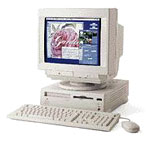 desktop
Mac with an IDE hard drive. It had CD-ROM, a 68040 CPU, and slots for
TV and video I/O cards. It was definitely a consumer computer and
even had a remote control for the TV tuner. It was fairly compact,
although pretty heavy for its size.
desktop
Mac with an IDE hard drive. It had CD-ROM, a 68040 CPU, and slots for
TV and video I/O cards. It was definitely a consumer computer and
even had a remote control for the TV tuner. It was fairly compact,
although pretty heavy for its size.
One more thing - the HomeMac should have stereo speakers built into the computer, just like the CRT iMac and eMac. And just the opposite of the way most PC makers do things, with their multitude of external components.
With the 17" eMac effectively selling for $999 today, I don't see any reason that Apple couldn't sell such a computer for $649 or less. Include AppleWorks and the usual complement of iApps. Bundle it with a nice, low-cost monitor, even if the monitor doesn't bear the Apple brand. Make the big profit on options - faster processors, memory upgrades, Combo and SuperDrives, the media modules, etc.
It still wouldn't be as cheap as a Dell, but with entry level Windows PCs, the question is if any computer should be so cheap. Quality, a good user experience out of the box, and prices not completely out of line with with Wintel world could remove a very significant obstacle to Apple's market growth.
Of course, this computer would have uses outside of the home market. It would make a great computer for teachers who use Macs at school, a wonderful system in the dorm room, a decent small office/home office machine, and so on.
It wouldn't cannibalize Power Mac sales - people who need dual processors, dual media bays, several PCI slots, or four internal hard drives simply wouldn't be tempted by such a computer. Those who want an all-in-one design will still be attracted to the eMac and flat panel iMac.
Current Mac users could buy this as their entry to the world of OS X and keep their old monitor. Windows users could choose this as their "switch" machine and also keep their monitors. New users would have a lower-cost alternative to the G4 eMac and iMac. And Apple could finally let go of the gumdrop CRT iMac without leaving a hole in the low end of the desktop line.
It all makes sense to me, but as Anne Onymus noted in Why We'll Never See Another Modular Desktop Design from Apple, Apple seems to have some "Think Different" mental block about creating a low cost entry level desktop Mac. After all, it might grow their market, and then their underdog status would be threatened.
It's too bad Apple has a monopoly on Mac OS computers, because you can bet dollars to donuts that if SuperMac or Power Computing were around today, they'd be making such a computer. But the pigs are not flying, and Mac clones are unlikely to return, so it remains Apple's decision whether to pursue or ignore the low-end market.
For our part, we try to make Mac computing more affordable by helping Mac users get the most out of their existing hardware - and pointing to the best deals on new, used, and refurbished CRT iMacs, eMacs, flat panel iMacs, and iBooks every week. We believe in low-end Macs and hope that Apple will someday do the same.