
2000: Last week a reader named Mike Donahue asked if I would do an in-depth investigation into Apple’s CPU processor plans. I don’t know about in-depth – I don’t think I’m qualified – but this is a topic that I’m concerned about as well, so here is an overview at least. Others have been writing about the issue, so I’ll hit some of their highlights and offer a few thoughts of my own along the way.
Mike noted that a friend of his had recently used his Mac to order a new Gateway PC with a 700 MHz Athlon (K7) processor. Mike says he was “shocked at how inexpensive the total system – including 19″ color monitor – was.” Other bells and whistles bundled with the Gateway box included a DVD-ROM drive, a Zip 250, a Nvidia TNT2 32 MB graphics card, a SoundBlaster card, stereo speakers, and a subwoofer for a total system cost $1,968.
Now I suppose some Mac-loyal readers are saying to themselves something like: “Yes, but you get what you pay for, and the G4 500 MHz will handily dust that 700 MHz CISC Athlon.” Well, maybe and maybe not. Read on.
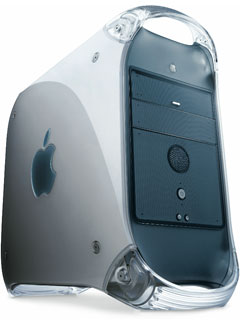 Mike Donahue has another friend who runs a mostly Mac graphics design shop with several G4s and one Gateway Athlon. Now here’s the kicker: Mike reports that his friend believes that the Athlon is noticeably faster than the G4s and that it’s a joy to use Photoshop on the Athlon machine.
Mike poses the operative dilemma: “If the G4 is not expected to reach higher than 500 MHz until 2001 or later, what can Apple do as AMD and Intel chips reach for 1 GHz?”
Indeed, the reach is apparently within their grasp. The Register reported last Friday that AMD will begin shipping its 1 GHz Athlon chip later this month – much earlier than had been expected. The article notes: “We understand that the first 1 GHz Athlon PCs will be available in Germany week 14 or 15. They will use standard cooling and will be produced for the market by a major international first-tier vendor.”
Note that reference to “standard cooling.” Actually, you’ve been able to buy a 1 GHz PC machine, sort of, since last Fall. The $2,500 KryoTech Super-G comes complete with a built-in refrigeration unit to keep its AMD Athlon processor from melting down. KryoTech supercools an AMD 700 MHz Athlon to -40°C to get it to perform at 1 GHz.
Motorola Is Stuck at 500 MHz with the G4
Apple is clearly caught with its proverbial pants down in the clock speed race. Jobs & company – shortsightedly, IMHO – opted to throw all their high-end desktop eggs into one G4 basket, and now they’re stuck in a bind largely of their own making. Reportedly, Motorola is having trouble getting the G4 to run at more than 500 MHz (and took an excruciatingly long time achieving that speed), and only about one-third of 500 MHz chips produced are shippable.
IBM Has Pushed the G3 Well Beyond 500 MHz
Meanwhile, IBM, which had a parting of the ways with Motorola over licensing of Moto’s AltiVec “Velocity Engine” technology for the G4, has been able to push the G3 chip to well over the 500 MHz level shipping in the new PowerBooks – almost certainly to 600-700 MHz, and perhaps as high as 800 MHz if some reports are accurate. The cruel irony here is that for most users, a 600-700 MHz G3 would handily outperform a 500 MHz G4, and the G3 is only found wanting in multiprocessor support and the lack of AltiVec. Unfortunately, Apple more or less burned its bridges by dropping the G3 entirely in its professional desktop range when it introduced the G4s last year.
Theoretically, Apple could retrench and introduce some fast G3 desktops, but as Mike Donahue puts it, “Does Apple want to sell 700 MHz G3 machines alongside 500 MHz G4 Power Macs and expect most consumers to appreciate why the Power Mac G4 is still faster?” Probably not, so the G4’s clock speed limitations will probably force Apple to keep its G3 machines under 500 MHz for marketing reasons, even though faster G3 chips are presumably available now.
Mike suggests that only solution he can think of is for Apple to release dual-processor G4 machines.** “That way,” he says, “higher clock speed G3 machines (like a 700 MHz iMac) won’t outshine G4 machines because megahertz-minded consumers will believe that 500 MHz x 2 is faster than 700 MHz x 1. This is a very serious issue that could severely damage Apple if it doesn’t have a satisfactory solution – and quick!” he says. “I’m worried.”
I think he has ample reason to be worried. The PC sharks are beginning to smell blood in the water.
Dan Knight (who is not a PC shark 😉 ) wrote last week:
“AMD and Intel are expected to announce 1 GHz processors this month, while Apple languishes at 500 MHz. When you double the speed of a CPU that’s half as efficient, you match performance. The Pentium III and Athlon at 1 GHz will hold their own against the G4 except in certain classes of AltiVec operations. No longer will we be able to brag that our ‘up to twice as fast’ processor really is more powerful.”
But is “RISC megahertz” really twice as efficient as “CISC megahertz?” Not according to a very tech-literate report on Ars Technica by Jon “Hannibal” Stokes, who claims that the RISC vs. CISC dichotomy is obsolete, and that, “Though some would have us believe that the K7 is from Mars and the G4 is from Venus, both processors actually have quite a bit in common,” sharing a number of architectural similarities and respectively incorporating such post-RISC elements as out-of-order (OOO) execution and vector processing capabilities, and each has a superscalar design with functional units that perform comparable functions.
“Regardless of marketing spin,” says Stokes, “stone-age controversies between platform factions, and general hysteria surrounding the terms ‘RISC’ and ‘CISC,’ the K7 and the G4 are remarkably similar. They face similar problems, and they solve them in similar ways. The majority of the differences between these two CPUs are not the result of any sort of fundamental difference between ‘RISC’ or ‘CISC’ design philosophies – most of the K7’s CISC baggage is taken care of in its front end, and the back ends of both CPUs are fully post-RISC designs . . . AMD’s K7 and Motorola’s MPC7400 (the unit which, when paired with a particular chipset, becomes known as the G4) are, in fact, cousins with common ancestry.”
Ben Apple of Mac Junkie thinks it’s “pathetic” that Mac advocates continue to claim that PowerPC (PPC) Macs can “mop the floor” with Intel and AMD PCs processor-wise. To those who insist that the PPC’s RISC technology is faster than Intel/AMD’s CISC, Mr. Apple says, “Give me a break . . . Stop making excuses for Apple.” He notes that Apple’s claims of superior processor performance are narrowly-based, mostly on BYTEmark integer scores and AltiVec-optimized Photoshop filters, and that “comparing the graphics output of an iMac to that of a Celeron with an obsolete graphics card is simply low.”
Of course, all this is not to say that the G4 is a dud, or that a 500 MHz G4 is “slow.” Sean Terrill, Ben Apple’s colleague at Mac Junkie, notes, “According to Wintel overclockers, a 950 MHz Athlon sits at about 1.02 GFLOPS; a 500 MHz G4 does around 1.04.”
That should be more than enough performance for most of us. The real problem is, as Mike Donohue has pointed out, the matter of perception. There is no substantial market demand yet for gigaflops (billion operations per second) capable computers, although I’m sure that high-end graphics folks and movie editors are delighted to have all the speed they can get.
For the rest of us, it’s icing on the cake, so to speak, at least until average software begins to demand more processor power. Of course eventually, software developers will optimize their applications to take advantage of the faster performance as chip speeds increase, gradually leaving those of us with slower machines behind
Nevertheless, clock speed is only one aspect of computer performance. System bus speed and especially hard drive performance are often the weakest links in the performance chain. I never considered deserting the Mac when Intel 486s were leaving 68040 Macs in their dust. Raw speed will not entice me to forsake the Mac now either.
But our pro-Mac arguments must be based on fact and truth, not selective statistical data and wishful thinking.
If it was tough to convince consumers that a 233 MHz G3 was faster than a 300 MHz Celeron, even fewer are going to accept that a 500 MHz G4 is as fast as a 1000 MHz Athlon or (soon) Intel chip, which it isn’t anyway.
Mr. Donahue’s multiprocessor idea would be one workaround. After all, multiprocessor support is one of the G4’s advantages. But IMHO the smartest move would be for Apple to figure out a way to bring some of those fast G3s to market.
* The first 1 GHz Athlon computer was announced on March 6.
** Apple introduced dual-processor Power Mac G4s at 450 and 500 MHz in July 2000 at the same time the iMac also hit 500 MHz.
