Miscellaneous Ramblings
Religious Computer Wars Revisited
Charles W. Moore - 2001.04.04
Besides being a freelance journalist both on the Web and in print media, another hat that I wear is as moderator of an ecumenical Christian email listserv forum. We have members on five continents and somewhere between one and two dozen Christian denominations represented, so the conversation can get lively at times.
Occasionally, the thread strays onto computer related topics, as it did recently in the course of a theological debate I was having with a Calvinist friend and former newspaper publisher who I worked with as an editor several years ago. In one of our exchanges, I used the term "Catholic" in the generic sense, and my friend chided me that it was an "Interesting accretion, capitalizing,'Catholic'."
I replied that in this instance the capitalization had been purely unintentional, and that ViaVoice, which I had used to dictate my posting, had chosen to capitalize it. I suggested, in jest, that perhaps the IBM was a "papist outfit." (I should clarify here than I am an Anglican Catholic who has a lot of time for Pope John Paul II and the Roman Catholic Church, while my friend, a rock-ribbed Reformer, has little use for anything associated with Roman Catholicism.)
He responded that perhaps "We could get a religious war going between Catholic IBM and Protestant Microsoft." (He is a PC user.)
Well, been there, done that, sort of. This thread made me think of a newspaper column I had written back in 1994 which addressed somewhat the same topic in tongue-in-cheek fashion. I dug out the article, and found it amusing revisiting the "religious computer wars" and my own opinions in the context of seven years ago. I decided to post the article to the forum, and it occurred to me that given the retrospective theme of Low End Mac, it might prove interesting to readers here as well.
I think the article has held up pretty well, although of course certain details, like my reference to the abortive CHRP platform, turned out to be chimerical.
The Holy War: Mac vs. DOS
First published in 1994.
The cold war between today's two main personal computer (PC) tribes - Microsoft DOS/Windows and Apple Macintosh - is heating up again after an interregnum of relatively peaceful coexistence.
The battle is also getting more complicated after a realignment of major players' alliances. Former arch-rivals IBM and Apple have joined forces in a ménage à trois with chipmaker Motorola to develop the PowerPC microprocessor to slug it out head-to-head with former IBM ally Intel's Pentium chip. This has driven Intel into a closer relationship with software colossus Microsoft and other major PC manufacturers like Compaq.
Adding to the confusion, IBM is aggressively marketing its new OS/2 Warp operating system, while Microsoft struggles to get its long-anticipated Windows 95 OS (nee Chicago) ready for consumer launch. Meanwhile, IBM and Apple have announced joint development of a common hardware platform that will run everybody's operating systems when it debuts in 1996.
However, at the user level these rivalries play out in more intuitive terms than the high-stakes corporate maneuvering noted above. DOS/Windows-Intel machines seem to appeal to one sort of person, and Macintoshes to another.
DOS/Windows is widely perceived as the OS preferred by no-nonsense business and techno-geek hacker types, while Macintosh is popularly pegged as the tool of artists, writers, and other creative individuals. This arbitrary pigeonholing reflects practical reality to a considerable degree, although Macs can be superb business computers, and plenty of writers and graphic arts people use DOS/Windows. You've probably guessed by now that your humble scribe is solidly in the Macintosh camp, and I'm convinced that there are precious few, if any, things a Mac can't do better, and in all cases more elegantly than an Intel PC. I concede that there are very good non-Mac PCs out there. It's just that Macs are better.
Macintosh is easy to learn and a pleasure to use, unlike the often frustrating and obtuse DOS-based system. "Plug and play" has long been a reality with Macs. Peripherals like printers, scanners, and CD-ROM drives are easy and quick to hook up to Macs. OS/2 Warp and Windows 95 close the user-friendliness gap somewhat, but the operative question is, "What took you so long?" Unfortunately, the Intel-based machines' hardware and configuration clunkiness still haven't been addressed. The Mac is still slicker, and the PowerPC is faster, cheaper and cooler-running than Intel's Pentium.
But loyalty to one or the other platform and OS transcends even these rational considerations. Some of it has to do with familiarity - i.e., which machine you learned on. Macintosh is fighting an uphill battle here, since about 85% of PCs sold are Intel-based. But even that is not enough to explain the fierce partisanship.
Italian novelist Umberto Eco (Foucault's Pendulum; Name of The Rose) thinks he knows what is. He calls the DOS/Mac rivalry "a new underground religious war which is modifying the modern world." Eco says he is "firmly of the opinion that the Macintosh is Catholic and that DOS is Protestant. Indeed," he declaims, "the Macintosh is counter-reformist.... It is cheerful, friendly, conciliatory, it tells the faithful how they must proceed step by step to reach - if not the kingdom of heaven - the moment in which their document is printed." Eco points out that with a Mac you deal with simple formulae and sumptuous icons, and "everyone has a right to salvation."
On the other hand, Eco argues, "DOS is Protestant, or even Calvinistic," demanding difficult decisions and interpretations, and taking "for granted the idea that not all can reach salvation." The DOS user "is closed within the loneliness of his own inner torment."
When the Windows graphical user interface is added to DOS, there comes a superficial resemblance to the Macintosh's "counter-reformist tolerance," sort of like Anglicanism, says Eco, with "big ceremonies in the cathedral," but "always the possibility of a return to DOS to change things in accordance with bizarre decisions."
Umberto Eco's tongue-in-cheek theological analysis of the computer wars is entertaining, and it captures a great deal of fundamental truth. If you still can't decide which computer "denomination" to join, or if you're stuck with using a DOS/Windows machine for work but would like to have a Mac for personal and family computing, or if you'd really rather switch to a Mac, but don't want to orphan your investment in DOS/Windows software, Apple has a tailor-made solution for you. The new Power Macintosh 6100 DOS Compatible contains both the astronomically fast PowerPC chip and also a complete Intel 486DX2/66 microprocessor to run DOS/Windows software. With two computers in one, you can shift between operating systems with a keystroke. True computer ecumenism!
One of the forum members, Odessa Elliott, replied with her own reminiscences of the contemporaneous religious computer wars. She has kindly granted me permission to reprint them in this column. I think you will find her take on the topic enjoyable.
Charles Moore's 1994 posting engulfed me in nostalgia as I read it.
The theological analogy is a bit far-fetched, of course, but I must say
that my first experience with using a computer 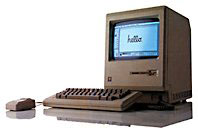 was using the brand-new Macintosh in
1984. I took a one-week course at Vassar College ("Theory and
Practice of Computer Science"), and adored the Mac with its mouse. Had
I had had to learn those clunky DOS commands at that time, my career in
computing would have ended before it began.
was using the brand-new Macintosh in
1984. I took a one-week course at Vassar College ("Theory and
Practice of Computer Science"), and adored the Mac with its mouse. Had
I had had to learn those clunky DOS commands at that time, my career in
computing would have ended before it began.
Because my son-in-law is employed by IBM, I ordered a customized IBM PC in Dec. 1994, specifying that it had to have "Warp" O/S. Would you believe that the first two CPUs I got had no operating systems? Or that it took me until mid-February 1995 to get a CPU with "Warp" on the hard drive?
Over those weeks, during which I talked to several persons in the IBM PC distribution center in Raleigh, NC, I became aware that IBM had vipers in the bosom of its PC unit. I will not state that anyone was getting a personal "kickback" from MS to sabotage "Warp," but for sure, "Warp" was not being sold effectively.
I had ordered a 15" screen, and "Warp" ran perfectly, using the entire screen area for applications, unlike the iMac that I own today. However, IBM's promise to release a "Warp" version of Lotus Office Suite keep getting delayed... delayed... although the Lotus Suite that ran on "Windows" had been promptly produced. IBM techies kept advising me to run that version while waiting for "Warp."
My theological view of all of this:
- Steve Jobs has a messianic complex that does him no personal good and that almost wrecked Apple - and might wreck Apple again. One might say he's a Pentecostalism, relying on the Holy Spirit for "gifts," esp. since the epiphany given him as to solving the "bitmapping" problem.
- The leaders of the institutional infrastructures at Microsoft and at IBM remind me of the leaders of the institutional infrastructures in the Roman Catholic and Orthodox branches of Christ's Body. Having been quite successful in fighting turf wars in the early days, Mr. Gates thought the Internet was all about turf wars, too. Mr. Gerstner came into IBM proclaiming the necessity of salvation by mainframes, but then perceived that IBM could make much more money, at far less operating/labor costs, by selling salvation through technical services: "Got Calvinist, Pentecostalism, and Lutheran operating systems? We can supply the platform to make 'em all work - until you can get all your data transferred to our new, improved universal system."
Odessa Elliott