
Apple did a great job designing, marketing, and branding the iMac, but they also created a big problem – knowing which iMac you own or are looking to buy on the used market.
There are now four basic iMac designs: the original G3 iMacs with CD-ROM trays, the newer G3 iMacs with slot-loading drives, the hemisphere-supporting-a-screen G4 iMacs, and the everything-behind-the display G5 iMacs. The big questions involve the G3 iMacs, which were made in a great number of colors and processor speeds, not to mention using different system boards.
Revisions A-D
233 MHz iMacs
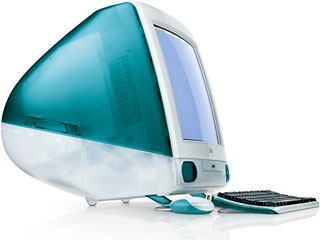 The original iMac was retrofitted with the Rev. A label when the first upgraded version of the iMac (Rev. B) appeared. Both computers are Bondi blue, have 233 MHz G3 processors, and look the same at first glance.
Internal differences include a better graphics processor (ATI Rage Pro) and more video memory (6 MB), but to discover that you need to run System Info or get inside the computer. The easiest way to tell is the part number – M6709LL/B.
That was pretty easy, and the Bondi blue color was unique to the Rev. A and Rev. B iMacs.
266 & 333 MHz iMacs
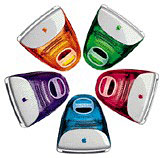 Next came the 266 MHz iMac, also known as Revision C. This model came in blueberry, strawberry, lime, tangerine, and grape – and the 333 MHz iMac (Rev. D) came in exactly the same colors. Both revisions shipped with 32 MB RAM, a 6 GB hard drive, and Rage Pro Turbo graphics. Except for the CPU speed, they were essentially the same computer.
If you can run System Info, you can determine CPU speed. If not, you can look at the part number. Each color had a different part number, but here’s the key
- the iMac 266 part numbers begin with “M73” – think 3rd generation
- the iMac 333 part numbers begin with “M744” – think 4th generation
Slot-Loading iMacs by Speed
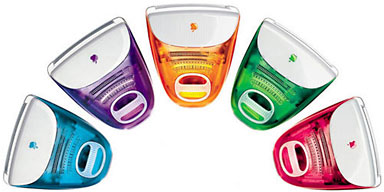
That was easy compared with the slot-loading models, which ranged in speed from 350 MHz to 700 MHz. Some used the same colors as the iMac 233 and 333. Others came in indigo, sage, ruby, graphite, snow, flower power, or blue Dalmatian.
There were internal differences as well – different graphics chips, different amounts of video memory, different hard drive sizes, and different versions of the G3 CPU.
The first round of slot-loading iMacs came in the same “fruity flavors” as their predecessors. Later iMacs went with a different color scheme, so if you see a slot-loading iMac in blueberry, strawberry, lime, tangerine, or grape, you know it’s from the first generation, released in 1999.
350 MHz iMacs
The 1999 350 MHz iMac came in blueberry, which clearly distinguishes it from the 350 MHz indigo iMac released in 2000. Neither of the 350 MHz iMacs includes a FireWire port.
The blueberry iMac 350 is part number M7469LL/A. The indigo iMac 350 is part number M7667LL/A. These numbers can be used to distinguish them from faster iMacs with the same color, although the lack of a FireWire port should also be a dead giveaway that these are 350 MHz iMacs.
400 MHz iMacs
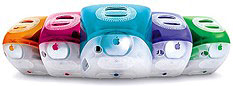 Apple had two different 1999 iMac models running at 400 MHz. The iMac DV (right) came in all five fruity colors. It includes a DVD-ROM drive and a FireWire port, making it easy to distinguish the blueberry iMac DV from the 350 MHz blueberry iMac.
Except for the blueberry iMac 350 and iMac 400, these should be easy to identify by their color and use of a slot-loading drive.
The iMac DV SE (for special edition) also ran at 400 MHz, but it came in graphite gray.
But there was also a Summer 2000 model called the iMac DV, and it also ran at 400 MHz. This model was available in indigo and ruby.
Finally, there was the Early 2001 iMac 400, Apple’s entry-level machine that only came in indigo and included a CD-ROM drive, the only 400 MHz iMac not to include DVD-ROM.
450 MHz iMac
The Summer 2000 iMac 450 was the only iMac to ship at 450 MHz. It was available in indigo, ruby, and sage. DVD-ROM was standard. If you’re looking at a 450 MHz iMac, this is it.
500 MHz iMacs
Summer 2000 also saw the iMac DV SE, which ran at 500 MHz and came in snow white or graphite gray and included a DVD-ROM drive.
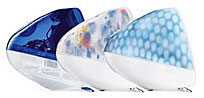 The Early 2001 series also included a 500 MHz iMac that came in indigo, flower power, and blue Dalmatian (left). One big difference between the Early 2001 models and their predecessors was the use of CD-RW drives instead of DVD-ROM drives on all but the entry-level model. (The entry level G3 iMac model, regardless of revision, always shipped with a CD-ROM drive.)
There was another version of the 500 MHz iMac introduced at the same time, this one for the international market. This model differed from the North American iMac by using the older PowerPC 750 chip and a backside cache. The North American model used the new PowerPC 750CXe, which included an onboard cache.
The “poor sibling” international version also had ATI Rage 128 Pro video (vs. Rage 128 Pro Ultra) and 8 MB of video memory (vs. 16 MB in the North American version). This is the same configuration as the earlier 500 MHz iMac DV SE.
600 MHz iMacs
The 600 MHz iMac was essentially a faster version of the Early 2001 500 MHz iMac – it had the same CPU (although faster) and video system. This model came in graphite gray, flower power, and blue Dalmatian.
700 MHz iMac
Shipping in August 2001, the 700 MHz iMac was the fastest G3 iMac Apple produced. It shipped in snow white and graphite gray. Architecturally, it was the same as the 600 MHz iMac, but with a faster CPU.
Slot-Loading iMacs by Color
Blueberry
Only two slot-loaders came in blueberry – the 350 MHz entry-level model with no FireWire port and the 400 MHz model with FireWire. Look for the FireWire port to tell these two apart.
Strawberry, Tangerine, Lime, Grape
The 400 MHz iMac DV was the only slot-loading model available in these colors.
Indigo
The first indigo iMac came in 350 MHz, 400 MHz, and 450 MHz versions. The 350 MHz model included CD-ROM and had no FireWire port. The faster models included FireWire ports and a DVD-ROM drive. Except for speed, the 400 MHz and 450 MHz models were pretty much identical.
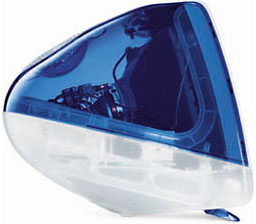
Part numbers: M7667LL/A (350), M7639LL/A (400), M7647LL/A (450).
The Early 2001 400 MHz iMac, 500 MHz, and international 500 Mhz were also available in indigo. The 400 MHz model was CD-ROM only; the other two models had CD-RW drives. The “international” iMac 500 shares the same CPU and video as the 400 MHz model. The North American iMac 500 shares the same CPU and video as the 600 MHz iMac.
Part numbers: M7683LL/A (400), M7669LL/A (500), unable to locate number for international iMac 500.
The Summer 2001 500 MHz iMac was available in CD-ROM and CD-RW versions. Part numbers: M8534LL/A (CD-ROM), M8582LL/A (CD-RW).
 Ruby
Ruby
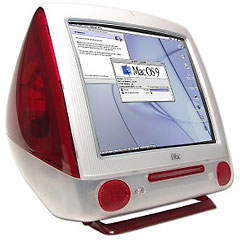
The only two iMacs available in ruby were the 400 MHz and 450 MHz Summer 2000 models. Except for speed, the 400 MHz and 450 MHz models were pretty much identical. Part numbers: M7706LL/A (400), M7652LL/A (450).
 Sage
Sage
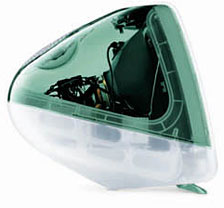
Apple only used sage on the 450 MHz Summer 2000 iMac.
Graphite
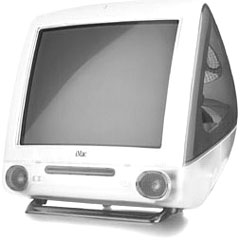 Too much of a good thing: Apple used graphite for top-end iMacs all the way from 400 MHz to 700 MHz. The first graphite iMac was the 400 MHz iMac DV SE – it was also the slowest graphite iMac. Part number: M7668LL/A.
The Summer 2000 iMac DV SE ran at 500 MHz. Other improvements include ATI Rage Pro 128 graphics and a 30 GB hard drive (vs. Rage 128 VR and a 13 GB drive in the 400 MHz iMac DV SE). Part number: M7651LL/A.
The Early 2001 600 MHz iMac introduced the PowerPC 750CXe CPU and a CD-RW drive, replacing the DVD-ROM drive of earlier iMacs. Part number: M7680LL/A.
The Summer 2001 600 MHz and 700 MHz iMacs were pretty much just faster versions of the Early 2001 design. Part numbers: M8492LL/A (600), M8510LL/A (700).
Flower Power, Blue Dalmatian
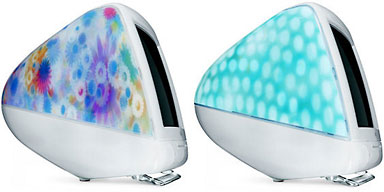
What were they thinking? Flower Power? Blue Dalmatian? A few people chose them, but most people avoided these color schemes.
The Early 2001 500 MHz iMac, international 500 MHz, and 600 MHz iMac were available in flower power and blue Dalmatian. All models had CD-RW drives. The “international” iMac 500 shares the same CPU and video as the 400 MHz model. The North American iMac 500 shares the same CPU and video as the 600 MHz iMac.
Part numbers: M8347LL/A (500 blue Dalmatian, North America), M8348LL/A (500 flower power, North America), M7675LL/A (600 blue Dalmatian), M7679LL/A (600 flower power), unable to locate number for international iMac 500.
Snow White
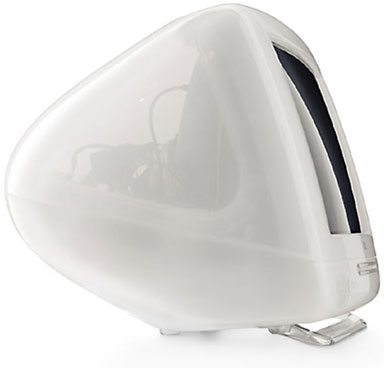
The 500 MHz Summer 2000 iMac DV SE was the first snow white iMac. Part number: M7709LL/A.
Snow was also picked up for the Summer 2001 iMacs in 500 MHz, 600 MHz, and 700 MHz speeds. Part numbers: M8490LL/A (500), M8490LL/A (600), M8554LL/A (700).
The iMac Guide
I hope this helps you identify which G3 iMac you’re looking at. There were a few uniquely colored models and CPU speeds, but there are so many blueberry, indigo, graphite, snow, 400 MHz, and 500 MHz models that it’s really easy to get confused.
Once you know which iMac you’re looking at, you might want to look at our Quick Guide to G3 iMacs for a brief overview of differences between the many different G3 models that bore the iMac name.
Keywords: #g3imacs #imacg3
Short link: http://goo.gl/i4OQTc
searchword: g3imacguide
