
2006 – Did Apple lie? Or did they just not tell the whole truth?
On August 17, Low End Mac published Ted Hodges article, PowerPC vs. Intel: Has Apple Been Lying to Us?.
In it, Hodges notes Apple’s one-time advertising campaign claiming that the then-current PowerPC G3 was “up to twice as fast as its Pentium II counterpart”. He also notes later ad campaigns claiming the G4 was faster than the then-current Pentium III, that the G5 was more powerful than the Pentium 4, and so on.
About Face
Since then, Apple has replaced PowerPC-based Macs with Intel models across the product line, claiming its new (Intel-powered) models are twice as fast as the previous PowerPC equivalents.
Hodges’ question is understandable. However, like many questions, it’s easier asked than answered – and the answer probably isn’t anything as clear as “yes” or “no”.
Part of the problem is that the CPU landscape has never been static. It’s an evolving one, with new models replacing one another at a rapid clip. Moreover, it’s difficult to compare CPU power across model lines; benchmarks that claim to compare CPUs as different as the Intel product line and the PowerPC end up with little relation to the ways people use computers in the real world.
That’s part of the reason why the buying public is attracted to figures like the megahertz or gigahertz measure of CPU clock speed. It’s a single number that appears to make it easy to tell whether one CPU is faster than another.
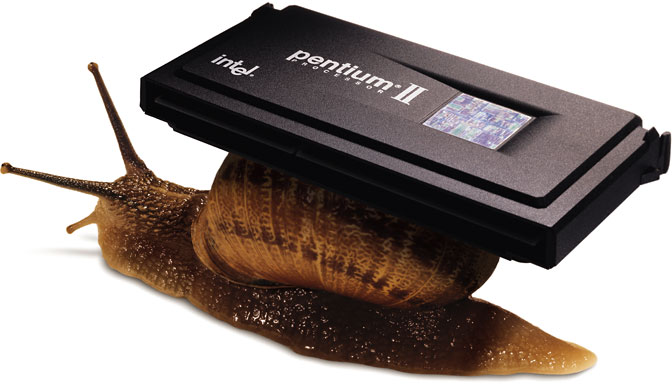
As Hodges points out, one of Apple’s ad campaigns during the PowerPC years focused on “the Megahertz myth” to suggest that a PowerPC was actually more powerful than an Intel processor running at a higher clock speed.
There’s some reality behind the various Apple ads, but there’s also some manipulation of the numbers. Remember 19th century British prime minister Benjamin Disraeli’s claim that there are “lies, damned lies, and statistics”?
Some Background
In the mid-1990s, PowerPC and Pentium-family clock speeds ran pretty much neck and neck. At the time, I owned a Mac-clone Motorola system with a 160 MHz PowerPC 603e CPU and a Windows system with a 166 MHz Pentium CPU. Later, I replaced it with an iMac using a PowerPC G3 running at 266 MHz, and at about the same time the school where I teach was buying Pentium II systems with 266 MHz CPUs.
Soon, however – and perhaps partly in response to Apple’s ad campaigns – Intel started boosting clock speeds, opening a gap between the advertised speeds of the CPUs used in Macs and Windows systems. This led to what Apple’s ads referred to as “the Megahertz Myth”.
There was reality behind it. When Intel replaced its own Pentium III line with the Pentium 4, even the PC press noted that the older Pentium IIIs were more efficient. However, Intel was able to ramp up the clock speed of the Pentium 4 architecture more easily.
Reviewers noted that the first generation P4s were not much more powerful than the P3s they replaced – but they ran at a higher clock speed, making them appear more powerful.
The Megahertz Myth: Not Just Apple
Intel-competitor AMD stopped referring to its more-efficient CPUs by their actual clock speeds, naming models after the higher clock speeds of a presumably equivalent Intel model. (A process that continues to this day – this morning I noticed an ad for a system using an “AMD Sempron 3000+ 1.8 GHz” CPU, comparing this CPU running at 1,800 MHz to a mythical 3,000 MHz Intel model).
While there was reality behind Apple’s claim that each CPU cycle of their processor got more done than an equivalent cycle of an Intel processor, the “up to twice as powerful” claim always had to be taken with a grain of salt. The key words here were up to.
‘Up To’
I watched all of Steve Jobs’ keynotes during that era; typically they featured a competition between a Mac and a presumably comparable Windows PC running an automated set of Photoshop tasks. Inevitably the Mac won, often by a large margin, even if it had a CPU with a slower clock speed. The ratio of the difference was used to support the “twice as fast” claims.
Worth noting, however: The AltiVec acceleration built into the G4 processors typically used during these competitions was clearly more efficient than the MMX multimedia acceleration built into Intel’s CPUs of that era. These bits of processor design can make a huge difference in performance – but only when program code is compiled to make use of them. And these instructions don’t make any difference at all for most software, which doesn’t need to make use of them.
Also, the Photoshop tasks used in Jobs’ demonstrations were carefully chosen because they were the ones that most clearly showed Mac superiority. It would have been possible to create a set of tasks where the two systems ran neck and neck or where the Windows system appeared faster, but obviously that wouldn’t have been in Apple’s interest.
Pick and Choose
If you carefully pick the tests, it’s easy to show any results you want. My Windows XP system boots to the desktop much faster than my OS X system. Is that because XP is much faster or more efficient? Not really. In fact, one of Microsoft’s design goals for Windows XP was to speed up the time it took to display the desktop, a response to the fact that its predecessor, Windows 2000, was criticised for doing this much slower than Windows 98. (XP displays the desktop relatively quickly, but then it pauses, not letting the user actually get anything done while it continues to load.)
Back to Intel – for several years, Intel pushed the Pentium 4 architecture to faster and faster speeds. Then a funny thing happened; the company released a CPU, aimed primarily at mobile systems, that was advertised as either Pentium M or Centrino. (Centrino was meant to be used on notebooks built around a Pentium M CPU, Intel motherboard chipset, and Intel WiFi radio, while a Pentium M notebook used the Intel CPU with a competitor’s chipset or radio.)
At a time when P4 systems were running at 3 GHz or faster, these Centrino systems were being advertised with speeds in the 1.2 to 1.8 GHz range. Yet the Centrino models were typically priced higher than apparently faster (by clock speed) Pentium 4 systems.
The problem for Intel was that it was easy to push the Pentium 4 architecture to ever-higher clock speeds, but these high clock speeds required more and more power and ran hotter and hotter. This wasn’t a major problem in desktops, but it became a real problem in notebooks. As a result, P4-powered notebooks had poor battery life and real heat issues; I had a P4-powered Dell notebook that required a motherboard replacement; apparently motherboard meltdowns due to cooling issues were common to that model.
Back to the Future
The Pentium M/Centrino didn’t evolve from the Pentium 4 architecture at all; instead, in a “back to the future” move, Intel built it from the older, slower, more efficient Pentium III architecture. It ran at a slower speed, but it got an equivalent amount of work done while running cooler and offering better battery life.
That’s what got Apple’s attention. Apple was having the same sort of issues with heat and power use. Like the Pentium 4, the PowerPC G5 used in Apple’s high-end Macs was a big CPU that ran hot and wasn’t well-suited for notebooks – and notebooks were accounting for an increasing share of the Macintosh product mix.
Apple, however, accounted for a relatively small percentage of PowerPC-family chips. While Intel was trying to address the needs of PC notebook manufacturers, IBM (maker of the PowerPC G5) didn’t seem to be addressing Apple’s needs. Hence Apple’s move to Intel-architecture systems.
In making the announcement a year ago, Jobs carefully referred to performance per Watt.
Two Brains Are Better than One
In most of its new, Intel-powered product line, Apple is making use of Intel’s so-called Core Duo CPUs, in effect two Pentium M/Centrino processors in a single package.
 In comparing the Intel-powered iMac to last year’s PowerPC-powered model, both running at about 2 GHz, Apple is comparing two CPU cores to one. And that doubling accounts for much of the “twice as powerful” benchmark results.
Did Apple Lie?
Over the past decade or so, Apple carefully chose the tests they wanted to use to bolster their claims. At the tasks they chose, Macs were faster than comparable Windows systems. At other tasks, however, the results would have been less clear.
Maybe to get some sort of answer, it’s necessary to reverse the question. Instead of asking, “Did Apple lie” with their now-abandoned claims of PowerPC superiority, we should be asking, “Did Apple tell the truth?”
And the best answer is that they told a truth. They reported factually about tests comparing Macs and Windows systems, but they only reported the facts that they wanted us to hear.
Keywords: #twiceasfast
Short link: http://goo.gl/Zo1Uct
