
Intel chose Pentium as the name for its next generation CPU, avoiding the expected 80586 designation – because numbers cannot be trademarked, but names can. The Pentium originally shipped at 60 and 66 MHz in 1993 and eventually reached speeds as high as 200 MHz in 1995. It has 3.1 million transistors using 0.8 micron technology at the start and 0.35 micron traces in its final version. Like the 80486, it supports 4 GB of RAM and 64 TB (terabytes) of virtual memory.
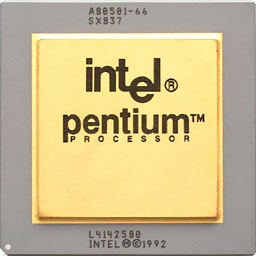 The Pentium (a.k.a. P5) is a superscalar design, which means it can process multiple instructions at the same time – something we take for granted today. It also has twice the cache space of the 486: an 8 KB instruction cache and an 8 KB data cache.
Just as the 486 was significantly more efficient than the 386 at the same clock speed, the Pentium offers a performance advantage over the 486. Part of this comes from its wider 64-bit data bus.
Byte magazine (May 1993) notes that the Pentium has a MIPS (million instructions per second) rating of 112 at 60 MHz or 1.85 MIPS/MHz. This compares very favorably (about 2-1/3x time higher!) with the 0.8 MIPS/MHz rating of the earlier 486DX, although we must keep in mind that MIPS is not an accurate pedictor of real world CPU performance.
In running real world comparisons of the 60 MHz Pentium vs. a 66 MHz 486, the Pentium scored up to twice the performance of the older CPU as reported by the same issue of Byte.
Another way to improve Pentium performance was to use software compilers optimized for the Pentium, a strategy that would be even more important to Intel’s Itanium processsor. According to Byte magazine, Pentium-optimized code was up to 30% faster on a Pentium system and also 5-10% faster on existing 386 and 486 hardware.
Next: Pentium MMX
Intel CPU Series: 8080/Z-80, 8086/88, 80286, 80386, 80486, Pentium, Pentium MMX, Pentium Pro, Pentium II, Pentium III, Pentium 4, Pentium D, Pentium M/Core Duo, Core 2 Duo, Core i
Keywords: #intelpentium
Short link: http://goo.gl/1d3Xi0
searchword: intelpentium
