
2002 – One of the things that limits the ability of semiconductor manufacturers to make large chips is the nature of optics.
In astronomy, when you look through a telescope, the image isn’t necessarily in sharp focus all the way out to the edge. Sometimes the images are fuzzy or elongated out toward the edge of the field of view. Various correctors are available to fix this abberation effect, and they all work to varying degrees.
Semiconductor manufacturers are faced with similar problems in attempting to make large-scale semiconductor circuits. These circuits, as you may know, are created using a process involving the focusing of an image of the circuit on a plate that reacts to the light. The light knocks some electrons loose from the places it is allowed to strike, altering the chemical characteristics of the material, which can then be etched or washed away with chemicals, leaving the circuits behind. (Plus several other deposition and bonding steps; it’s not a one-shot deal.)
Just like in astronomy, these circuits don’t focus well out on the edge of a large flat surface. The corrective lenses used to sharpen them up have the undesirable side effect of decreasing the contrast and thus the precision with which such circuits can be displayed. Chip manufacturers do things like use shorter wavelengths of light to increase the resolving power of the image projectors.
All current research in the semiconductor industry is geared toward solving this problem in an efficient way so that the cost per circuit board goes down and things can be made more cheaply.
What I propose is a little touch of classic lateral thinking. Instead of solving the problem optically, why not solve it by moving the surface to where the image is in focus? In other words, using technology similar to what is used in a Schmidt camera on a telescope (which focuses light on a curved surface and is used to take large, large images of the sky), why couldn’t a manufacturer contrive to build a large curved LCD monitor (or motherboard or CPU, for that matter). With an adaptive optics system (similar to what is used to focus telescopes through our shifting, hazy atmosphere) small surface imperfections could be compensated for on a board-by-board basis, reducing waste.
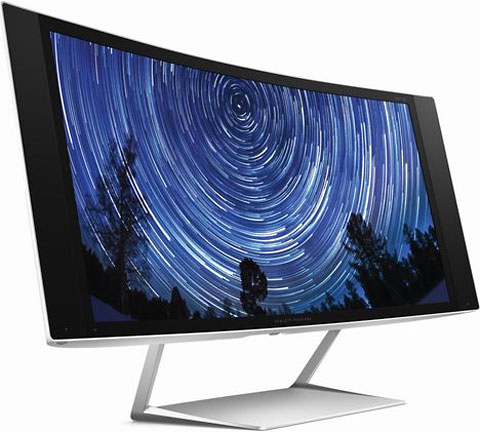
This is just one of many curved computer displays at the January 2015 CES.
Imagine what Apple’s new iMac would look like with a mildly curved LCD screen aimed at the user. If an LCD were made large enough, you could even approach a panoramic effect; say something a little bigger than the Cinema Display.
In a curved CPU, you could have the radiative surfaces face on the outside of the arc, giving more efficient heat emission due to the slightly increased surface area and larger gaps between radiative surfaces. Active cooling might be more effective on the interior.
Might be worth looking in to. You never know.
Just like Apple to set me thinking about new possibilities. As Steve Jobs says, “That’s why we do what we do.”
Yes, this article was written over 12 years before the first curved flat-screen TVs were introduced to consumers in April 2014. Curved computer monitors were the hot new technology at the January 2015 Consumer Electronics Show. Someone should have patented the idea in 2002! Dan Knight, publisher
Keywords: #curvedscreen #curvedscreen #curvedtv #curvemonitor
Short link: http://goo.gl/wjzyN4
