
1999: I’ll admit it right up front: I was expecting the iBook to come in at about $1,400, not $1,600. But then, I was expecting a different computer. A lot of us were expecting something smaller and lighter than the Lombard PowerBook G3.
The 300 MHz processor and 800 x 600 screen were things we expected. A color scheme fitting for a “portable iMac” we expected also. USB, no floppy, a rugged case, and a long battery life – more things we expected.
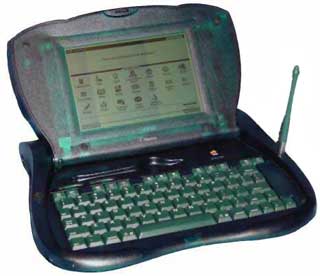
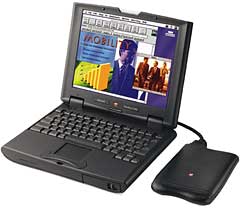 We also thought wireless networking would be an option (it is), as would the CD-ROM drive (it’s standard). We expected a compact portable, something perhaps more akin to the Newton eMate or PowerBook 2400.
Instead, we got a full sized laptop.
Five Portable Computer Markets
What I didn’t really understand is that there are five different markets for portable computers. (This doesn’t include semi-computers – a.k.a. PDAs – such as the Palm, the Windows CE devices, or Apple’s discontinued Newton.)
PC Magazine (8/99) lists the following markets:
- Mini-notebooks. These weigh 3-4 pounds and run full-blown desktop operating systems and applications. At present, this is exclusively a Windows market, although the PowerBook 2400 was just a few ounces over the limit.
- Thin and light notebooks. These weight 4-5 pounds and have a full-size keyboard. Again, this is a Windows-only market. (The 2400 was thicker than these and had a reduced size keyboard.)
- Mainstream notebooks. Usually 7-8 pounds with a 13-14″ screen. The current PowerBook G3 qualifies here.
- Desktop replacements. These have high-end processors, large (14-15″) screens, and weigh about 9 pounds. Except for the weight, the PowerBook G3 qualifies.
- Value notebooks. These are less expensive alternatives to mainstream computers. The emphasis is price, not performance. That is the iBooks’ forté.
Mini-notebooks reviewed by PC Magazine ranged from $1,600 to $2,300. Thin-and-light models from $1,900 to $4,000. Mainstream notebooks were all in the $1,800 to $2,350 range. Desktop replacements covered the $2,000 to $4,600 spectrum.
For the value-conscious, notebooks ranged from $1,300 on the low end to $1,700 at the top. Weights ranged from 6.2 to 7.5 pounds. Almost all models have a 12.1″ 800 x 600 screen, a 24x CD-ROM, and 32 or 64 MB of memory. Most have an integrated 56k modem, 2 MB of video memory, and no ethernet port.
With one exception, hard drives are in the 4.0-4.5 GB range. Memory can be increased at least 160 MB on all but one. Processors range from the 300 MHz Mobile Pentium MMX to the 300 MHz Mobile Pentium II. Battery life as tested with ZD Batterymark 3.0 can be as little as one hour and twenty minutes or as long as five hours and five minutes.
iBook vs. Wintel Value
I think you already see how the iBook compares. At $1,600, it fits comfortably within the range of value notebooks. At 6.7 pounds, it’s midway between the lightest and the heaviest that PC Magazine looked at. Size is comparable. The 3.2 GB hard drive is smaller than all but one value model.
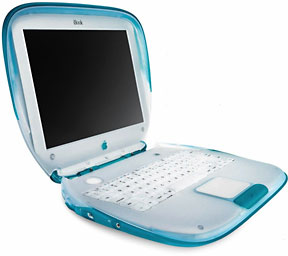 The 12.1″ TFT screen matches what the Wintel notebooks offer, as do the 24x CD-ROM and 56k modem.
In terms of battery life, the iBook should rank with the best PC Magazine tested. Memory can be expanded well beyond the needs of most value-oriented users, so that’s pretty much a tie with the Wintel world.
Of course, the 300 MHz G3 inside the iBook will absolutely smoke the 300 MHz Mobile Pentium, Celeron, Mobile Celeron, and Mobile Pentium II processors in these laptops, let alone the underpowered AMD K6 used in the WinBook XL.
Factor in ethernet, which requires a separate PC Card on the Wintel portables, and the iBook pulls comfortably into the lead. (Since AirPort PC Cards will be available, I’ll call the iBook’s $100 AirPort option a tie.)
Compared with the best value Windows laptops, the iBook easily holds its own. To top it off, Apple is an established brand – some of the less expensive Windows notebooks sport obscure names like AMS, ChemBook, and WinBook.
iBook vs. iMac
The iBook is also being marketed as a portable iMac. Feature for feature, color for color, they are quite comparable. The iMac’s CPU about 10% faster (333 MHz vs. 300 MHz); has a larger, higher-resolution screen (13.8″ viewable, 1024 x 768 resolution); and includes a bigger, probably faster hard drive (6 GB vs. 3.2 GB).
The iBook is a lot lighter (6.7 lbs. vs. 38.1 lbs.), more compact (I won’t even bother quoting specs), and runs about 6 hours longer when not plugged into the wall.
For $400 more than the price of an iMac, you gain 6 hours of battery life while losing over 31 pounds of weight. You also have the AirPort option, which is not yet available for the iMac or other desktop systems (let’s hope someone fills that void).
Considering the cost of an active matrix display and a LithIon battery, the fact that Apple can sell the iBook for only $400 more than the iMac is quite impressive.
iBook vs. Lombard
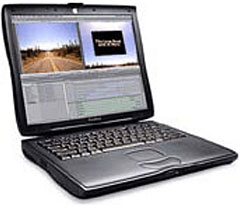 Apple is most emphatically not marketing the iBook as an alternative to the $2,500 and up PowerBook G3. Lombard has a much larger screen (14.1″ 1024 x 768), runs 10-33% faster (333 or 400 MHz), weighs less, is a bit more compact, has a larger hard drive, and looks absolutely professional and gorgeous in black with a white (backlit) Apple logo.
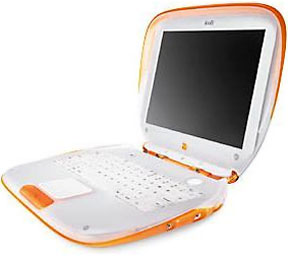 Of course, the 333 MHz PowerBook G3 does cost $900 more than the iBook, so Mac lovers who crave portability without breaking the bank shouldn’t feel they’re making any unacceptable compromise buying the blue-and-white or orange-and-white iBook.
Conclusion
The iBook is an excellent value, whether compared with value-priced Wintel notebooks, the best selling iMac, or the only laptop on the market that’s more powerful than it, Apple’s Lombard PowerBook G3.
keywords: #ibook
short link: https://goo.gl/yxs9vv
