
1999: Admit it, Mac fans, you’d love one. Sure, it may not be the right Mac for you, but the iBook (like the iMac) calls out to be embraced. Buy me. Use me. Show the world your colors.
As noted in The Price Is Right, there are five different portable computer markets: thin-and-light (under 4 pounds), slim (4-5 pounds, under 2″ thick), mainstream (7-8 pounds with 13-14″ screens), desktop replacement (usually even bigger, and with leading edge processors and huge screens), and value-priced (under $1,800).
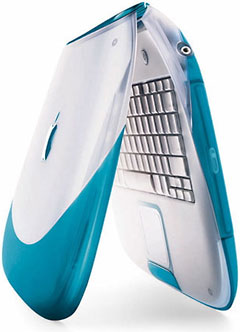 The iBook is no lightweight, so it’s out of the running in the first two categories. The screen is too small for the mainstream category, although it otherwise comes close. (Leave that niche to the PowerBook G3, which can also be a desktop replacement.)
Unless your desktop is slower than a 200 MHz PowerPC and you’re only using a 13-15″ monitor, the iBook is no desktop replacement, either. At least, it isn’t intended as such.
No, the iBook is emphatically a value computer – and one that compares very nicely with what the Windows world has to offer. (Again, see The Price Is Right.)
Market: PowerBook Owners
My wife has a PowerBook 150. We bought the 33 MHz portable shortly after the education price dropped below $1,000. It’s served her well for about four years. We recently bumped RAM from 4 MB to 24 MB and replaced her 5-10 minute battery (originally 2 hours or so) with a 5 hour LithIon battery. Between that and a modem, we spent under $200 to make the PowerBook much more useful.
But it’s still slow. With ClarisWorks, it’s a decent field machine, but the screen is dim and it’s easy to out-type the computer. So we’ve been hoping to replace it, expecting to have to invest $2,500 in a PowerBook G3.
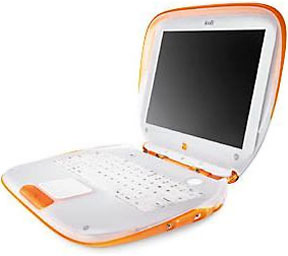 Thanks to the iBook, it looks like her small adoption agency can save some money. Even if we budget for the AirPort card and hub, we’ll be saving $500 compared with the PowerBook. (And with AirPort, she can be on the network and internet anywhere in the house or yard.)
A strong market for the iBook is PowerBook owners, at least those who aren’t using a PowerBook G3. (One rule: Never go back to a smaller screen. You’ll regret it constantly.)
The iBook offers more power and features than any portable Mac outside of the PowerBook G3. It is a great market for Apple to tap.
Market: Low End Mac Owners
My site isn’t called Low End Mac for nothing – until last summer, my fastest computer was a 20 MHz Centris 610. Even today, I’m “only” using a 180 MHz 604e processor in my SuperMac J700.
You can’t buy anything nearly that slow unless it’s refurbished or runs Windows.
As with PowerBook owners, anyone with an older desktop Mac and a 15″ or smaller screen is a potential iBook customer. It’s fast, has a great screen, doesn’t cost a whole lot more than the iMac, and it’s very, very portable.
Of course, this overlaps the iMac market, which Apple doesn’t want to shrink. On the other hand, that also means Apple has two products for this market: iMac and iBook.
Market: First Time Buyers
Steve Jobs notes that one-third of all iMac buyers are buying their first computer. They may use a Mac or a Windows computer at work or school, but they’ve never owned one before.
That market also buys portable computers, although rarely something as costly as the PowerBook G3. As demonstrated in The Price Is Right, the iBook isn’t just a good value as a portable Mac, but also as a portable computer.
First-time buyers who are attracted to the iMac but need portability are a logical market for the iBook. I know I will be promoting it to coworkers looking to replace old Macs or buy their first computer.
Market: Students?
Until Wednesday, the iBook was assumed to be targeted specifically to the education market. It would be compact, robust, and inexpensive.
Instead, Steve Jobs unveiled something of average size and weight, still very robust, and a good value – but far from the $1,000-1,200 education laptop a lot of us had hoped for.
I think the iBook will find a ready market on college campuses. Those on campus will especially appreciate the built-in ethernet capabilities, something generally lacking in Windows computers.
Below college, I don’t see a huge market. I don’t anticipate a lot of elementary school, middle school, or high school students toting a $1,600 computer between home and school.
To tap into this market, Apple needs to think different. For a start, they could strip the iBook for the education market. Leave out the CD-ROM and modem while making AirPort a standard feature. This combined with bulk purchases or direct sales from the Apple Store might get the educational iBook down to $1,350 or so, but not much lower – at least until screen, battery, and memory prices drop.
I don’t see the current iBook as a viable field computer for school children. It’ll do well at college, may penetrate the high school market a bit, but is simply too expensive for our sons and daughters to take to grade school.
Conclusion
There’s a lot of overlap between the iMac and iBook, as well as the PowerBook G3 and iBook. In Apple’s current scheme, the iBook is the intersection of the personal market and the portable market. So it makes sense that a lot of current Mac users (desktop or PowerBook) will consider buying the iBook – especially at its very competitive price.
Likewise, a lot of first time buyers know Apple, know the iMac, and are willing to buy an easier-to-use computer (easier than Wintel).
Parents with school children have the added reason that Apple remains the leading brand in schools. It’s what their kids know. It’s also what their kids can help them learn.
At the same time, education pricing should make the iBook very popular among college students this year. I hope Apple can have them to college bookstores before registration, which often takes place in late August. (Anticipated iBook release is September, but I’ll bet Apple could push that up a week or two for this market.)
The only problem I foresee is that Apple is contracting production at 250,000 units per quarter. Assuming production began in late-June, they should have no trouble selling that many in September.
I wonder if that would be enough to finally dethrone the iMac as America’s favorite personal computer?
keywords: #ibook #clamshellibook #ibookg3
