Vintage Mac Living
When Did a Computer's Visual Appearance Become More Important than the Hardware Inside?
- 2005.12.20
I may be only 17 years old, but I remember a time when computers were tools. You didn't buy a computer because of what it looked like; you bought a computer because of what it did.
These days it seem like more and more people buy computer not because of what they can do but because of what they look like.
Enter the iMac
This change seems to have started in May of 1998 when Apple introduced the iMac. The iMac was supposed to be "the Internet age computer for the rest of us".
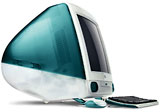 Everyone was raving about how powerful
it was, and they were also raving about how cool it looked. Everyone
loved the futuristic looking Bondi blue case.
Everyone was raving about how powerful
it was, and they were also raving about how cool it looked. Everyone
loved the futuristic looking Bondi blue case.
The iMac came in one configuration - 233 MHz G3, 32 MB RAM, 4 GB hard drive, 24x CD-ROM - so it would be easy for consumers to buy one without making a million decisions.
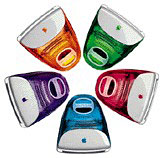 In January of 1999, Apple introduced
the Rev. C iMac, the
one that came in blueberry, grape, tangerine, lime, and strawberry.
In January of 1999, Apple introduced
the Rev. C iMac, the
one that came in blueberry, grape, tangerine, lime, and strawberry.
Steve Jobs thought that people didn't care about megabytes, megahertz, or gigabytes - customers wanted to trust the computer company to sell them a really great computer. The only question they should have to answer is, "What's your favorite color?"
The iMac was popping up everywhere. It was on busses and billboards, in TV and magazine ads, on radio ads, and all over the Internet.
It was everywhere. No one could get enough of it.
About Face
But Steve Jobs was wrong about one thing: People do care about megabytes, megahertz, and gigabytes.
In the summer of 1999, Apple decided it was time to get rid of their easy-to-buy single configuration iMac and introduced the new iMac.
From this point on, it would no longer be as easy for a newbie to buy an iMac. He or she would have to choose from different speeds, not just colors. These were the new models:
iMac (blueberry, $999)
- 350 MHz G3, 64 MB RAM, 6 GB hard drive, slot loading CD-ROM drive
iMac DV (blueberry, grape, tangerine, line, strawberry, $1,299)
- 400 MHz G3, 64 MB RAM, 10 GB hard drive, slot loading DVD-ROM drive
iMac DV SE (graphite, $1,499)
- 400 MHz G3, 128 MB RAM, 13 GB hard drive, slot loading DVD-ROM drive
The iMac kept selling in record numbers, and then Apple went a little crazy in the summer of 2000 with the next set of models. Now if you wanted a certain color, you might have to spend a certain amount of money:
iMac (indigo, $799)
- 350 MHz PowerPC G3
- 64 MB RAM
- 7 GB hard drive
- slot loading CD-ROM drive
iMac DV (indigo, ruby, $999)
- 400 MHz PowerPC G3
- 64 MB RAM
- 10 GB hard drive
- slot loading CD-ROM drive
iMac DV+ (indigo, ruby, sage, $1,299)
- 450 MHz PowerPC G3
- 64 MB RAM
- 20 GB hard drive
- slot loading DVD-ROM drive
iMac DV SE (graphite, snow, $1,499)
- 500 MHz PowerPC G3 Processor
- 128 MB RAM
- 30 GB hard drive
- slot loading DVD-ROM drive
It was out of control. There were just too many models and colors and price points - eight different iMacs in all. These models (and the colors ruby and sage) only lasted a few months before iMacs with the CD-RW drives entered the picture.
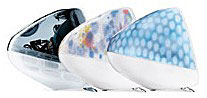 Anyone remember the Blue Dalmatian and Flower
Power models? I don't know what Apple was thinking with those two
color schemes, but for some reason they lasted longer than the ruby and
sage. Can someone explain that one to me?
Anyone remember the Blue Dalmatian and Flower
Power models? I don't know what Apple was thinking with those two
color schemes, but for some reason they lasted longer than the ruby and
sage. Can someone explain that one to me?
Enter the iPod
Then in October of 2001, Apple introduced the iPod. At first it was a Mac-only accessory, but when Apple developed software so it could run on Windows, it started selling in record numbers. Now it's the #1 selling MP3 player in the market.
People love the way it looks and the way it works, and back then there was only one model to choose from.
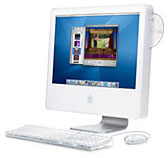 As for today's
computers, I don't know if people are buying them because of the way
they work or the way they look.
As for today's
computers, I don't know if people are buying them because of the way
they work or the way they look.
Apple has a big presence in the world of fashion right now - everyone wants an iPod, and everyone is trying to make their computers look like Apple's computers.
Why did computers become such a big fashion statement?
When you're using your computer, are you really thinking about how
much you like the way it looks?

Join us on Facebook, follow us on Twitter or Google+, or subscribe to our RSS news feed
Today's Links
- Mac of the Day: PowerBook 500 Series, introduced 1994.05.16. 'Blackbird' includes a 25 to 33 MHz 68040 along with smart batteries and grayscale or color displays.
- Support Low End Mac
Recent Content
About LEM Support Usage Privacy Contact
Follow Low End Mac on Twitter
Join Low End Mac on Facebook
Favorite Sites
MacSurfer
Cult of Mac
Shrine of Apple
MacInTouch
MyAppleMenu
InfoMac
The Mac Observer
Accelerate Your Mac
RetroMacCast
The Vintage Mac Museum
Deal Brothers
DealMac
Mac2Sell
Mac Driver Museum
JAG's House
System 6 Heaven
System 7 Today
the pickle's Low-End Mac FAQ
Affiliates
Amazon.com
The iTunes Store
PC Connection Express
Macgo Blu-ray Player
Parallels Desktop for Mac
eBay