
In early 1995, Apple announced that it had shipped one million Power Macs within one year of their introduction, showing an overwhelming acceptance of the new technology.
Faster
In January, the Power Mac 6100 was bumped from a 60 MHz PowerPC 601 to 66 MHz, the 7100 went from 66 MHz to 80 MHz, and the top of the line 8100 moved from 80 MHz to 100 MHz.
Slower
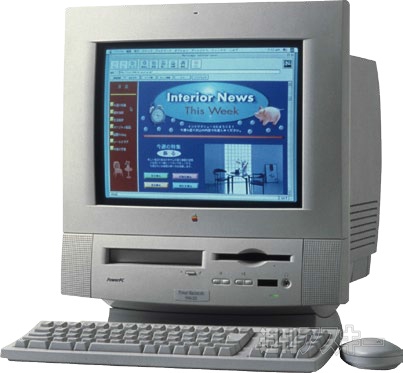 The first Power Mac for the education market was released in April. The 5200/75 put the new PowerPC 603 processor in a case similar to the one used for the LC 575, but with a larger display and stereo speakers. The all-in-one design was a natural for schools, since it meant less cables to come loose and fewer parts to set up.
Unfortunately, although the PowerPC 603 was a match for the earlier, more expensive PowerPC 601, the 5200 and several subsequent models were hobbled by some very poor design decisions on the motherboard. These are covered in general in the Road Apples section and our Online Tech Journal. They boil down to this:
- The 603 has a 64-bit bus, but the motherboard has a 32-bit bus. It takes four memory cycles to collect and integrate 64 bits of data so the CPU can process it.
- The motherboard has two sections that can only communicate with each other via the CPU. One section handles ADB, networking, and SCSI; the other deals with IDE, video, and graphics.
These compromises were rooted in a decision to use as many components and subsections from the Quadra 605 and Quadra 630 as possible to reduce design costs.
Send in the Clones
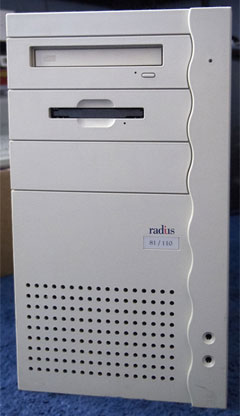 Radius became the first licensee to bring a Macintosh clone to market. The Radius System 100 was essentially a Power Mac 8100 with a standard video port, a high-end Radius NuBus video card, and a case built like a tank. The System 100 topped out at 110 MHz.
Power Computing introduced its first licensed Mac clone, the Power 80, which had an 80 MHz PowerPC 601 and three NuBus slots, in April. Over time, speed was increased to 100 MHz, and eventually to 120 MHz. The 120 MHz PowerCurve, introduced in May was its first model with PCI slots. The PowerWave joined the line in October, and as far as I know was the only Mac OS computer ever that could support both PCI and NuBus cards.
Power Computing went on to be a very successful company – until Apple pulled its license in 1997, bought its clone business for $100 million, and took over tech support for its computers. Power Computing tried to make it in the x86 world, but it closed its doors later in the year.
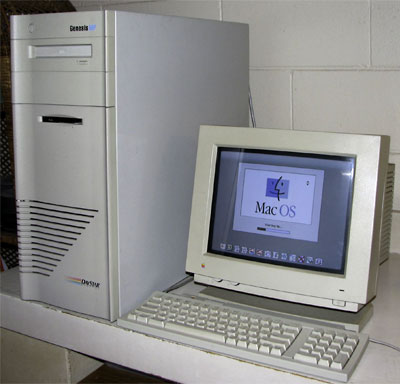 The third company to enter the market was DayStar Digital, which was widely known for accelerators for existing Macs. DayStar would bring something new to the table October – its quad-processor Genesis MP 528 had four 132 MHz PowerPC 604 CPUs, making it the first multiprocessor Mac. DayStar’s clones became very popular among Photoshop power users, as Photoshop was one of very few applications that could use multiple CPUs under the classic Mac OS.
DayStar licensed its multiprocessor technology to Apple, which began to use it in 1996.
Pip Pip?
 In addition to licensing Mac clones, Apple also decided to enter the video game market indirectly.
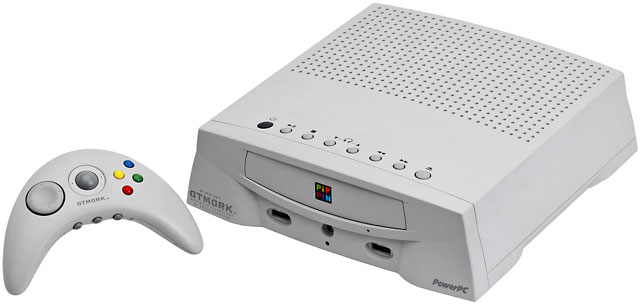
It designed a platform, known as Pippin, which used a low-end PowerPC CPU and ran from a 4x CD-ROM drive – no hard drive, no system ROMs. It ran a modified version of the Mac OS, and programs had to be “pippinized” before they could run on the platform. Bandai was the only company to license it, and its @world was a bust.
Adopting PCI
Until June 1995, Apple had stuck with the 10 MHz 32-bit NuBus slot as the standard Mac expansion slot, something it had adopted in 1987 with the introduction of the Mac II. But June saw the first Mac with PCI slots, a 33 MHz 32-bit architecture pioneered on the Wintel side.
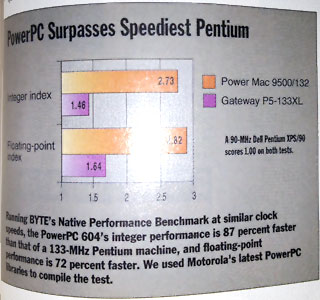 The Power Mac 9500/120 not only used PCI slots (six of them), it was also the first Power Mac to use the powerful PowerPC 604 processor. In October, Byte magazine noted that the 8500/132 (which also used a PPC 604) was 87% faster than a 133 MHz Pentium for integer math. Never again would the Wintel crowd be able to look down on the Mac’s performance.
But perhaps the most forward-looking feature of the 9500 was the CPU daughter card. Over the years, CPU upgrades for this family of computers became very popular, especially G3 ones.
Small Improvements
Apple moved from 2x CD-ROMs to 4x mechanisms in 1995, which sounds pretty slow in this day of 24x to 52x drives.
The LC 580 improved upon the price of the LC 575 by moving from the Sony Trinitron to a less expensive monitor and adopting an IDE hard drive instead of a SCSI drive.
More Power to Go
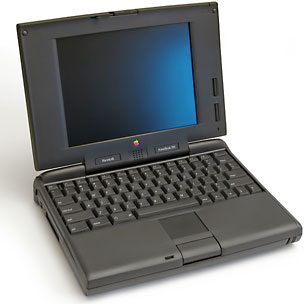 May saw the introduction of three PowerBooks, the 190, 190cs, and 5300. They all used the same case, and the 190s could be upgraded to PowerPC status with a 5300 motherboard.
The 190s were the last PowerBooks designed around the Motorola 68LC040, and both ran at 33 MHz. The 190cs has a color screen, while the plain 190 displays grays.
The 5300 uses the newer PowerPC 603e, a version of the 603 with a larger on-chip cache that greatly improves performance when running old Mac software using 680×0 emulation.
And although 5300s were very nice laptops, that was mostly because Apple fixed some teething problems, and newer versions of the Mac OS work more reliably on it. The initial production run was recalled due to a combustible battery. The case plastics tended to chip, a characteristic shared by the 190. Because of this, the PowerBook 5300 earns a Road Apple.
More Power Macs
In August, Apple replaced the 7100 with the 7500, which sported a 100 MHz 601 and a brand new case with a slide-off top. The 8100 was replaced by the 8500, which shares the same minitower case originally used by the Quadra 800.
Both the 7500 and 8500 had three PCI slots and used CPU daughter cards (like the 9500), allowing CPU upgrades for years to come.
The Competition
After many years of working on a replacement for Windows 3.1, Microsoft finally shipped Windows 95 in August. Intel introduced the Pentium Pro in November.
The most significant computing event of the year had nothing to do with Microsoft, Intel, IBM, Apple, or any other company: 1995 was the year World Wide Web entered our language.
Personal Perspective
1995 really wasn’t a breakthrough year for Apple. The x100 series of Power Macs were evolutionary jumps, the 5200 suffered from too many compromises, the Power 80 was nothing to get excited about, and the LC 580 was no faster than its predecessor.
Apple adopting PCI was news, and the 9500 remained in strong demand on the used market for some time, mostly due to its six expansion slots and the ability to plug in a fast G3 or G4 processor.
The PowerBook 190 was a step backward after the PowerBook 500 series. The earlier models came with built-in modems and ethernet; with the 190 and 5300, you had to add your own. While this lowered the price of the computer, it made support more difficult, since you never knew which PC Card modem, ethernet adapter, or combination card you’d be working with.
With millions of Power Macs in use by the end of the year, Apple was leading the personal computer revolution from older designs into the RISC world.
Next – 1996: Quad Processor Clones, PowerBook 1400, and the Acquisition of NeXT
Keywords: #powermac5200 #radiussystem100 #powercomputing #pippin #powermac9500 #powermac7500 #powermac8500 #powerbook190 #powerbook5300
Short link: http://goo.gl/A5O79M
searchword: machistory1995
