
Hold on to your hat: 1993 was the wildest year for model introductions in Apple’s history. Apple also passed the 10 million Mac mark in February 1993.
Round One
Ten years and one month after announcing Lisa, Apple launched six new models at once: a much faster LC, the Color Classic, two low priced cousins to the Quadra, a new Quadra, and the firsts color PowerBook. Let’s look at them in order of speed.
The Classic Gets Color
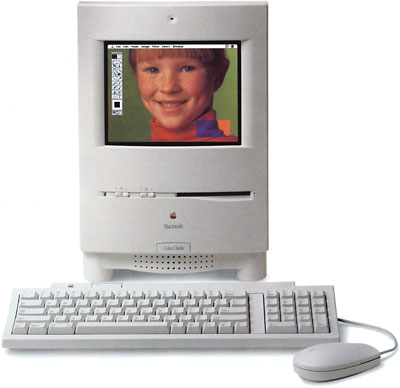 By grafting a 10″ Sony Trinitron display with an LC II/Classic II motherboard in a case just a bit larger than those used by black & white compact Macs, the Color Classic was born. It was nearly as cute as the iMac, worked with the Apple IIe card to make it appeal to schools, and had the same hardware limitations as the LC II.
Apple got a lot of mileage from that 16-bit motherboard with a 32-bit CPU and 10 MB maximum memory – and that means the Color Classic is a Road Apple, just like the other Macs with the same hardware architecture.
The Color Classic became a favorite among hardware hackers, and several different mods to display 640 x 480 on its 512 x 384 display were developed. This could be coupled with a 500-series motherboard, which supported 640 x 480 by default and could also provide a faster 68030 or 68040 CPU. Some of those motherboards could even take PowerPC upgrades.
There is still a cult following for the Color Classic, and they are relatively rare on the used market. In addition to swapping the motherboard for a faster one, a later generation of modders have created “Power Color Classics” with G3 or G4 CPUs inside, and some have gone so far as to install a Power Mac G4 Cube or a Mac mini inside the Color Classic’s enclosure.
The LC Grows Up
The original LC would have seemed pathetically slow if Apple hadn’t introduced the even slower Mac Classic at the same time. The LC II offered no more speed than the LC, just a bit more memory (4 MB instead of 2 MB) and virtual memory support.
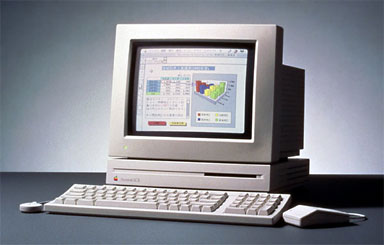 The LC III offered significantly more performance in the same compact case. The 25 MHz 68030 sat on a 32-bit data bus, which made it over twice as fast as the earlier 16 MHz models thatwere hobbled by a 16-bit data path. Apple also removed the artificially imposed 10 MB memory ceiling, giving the LC III support for 36 MB of RAM, which gave the LC III a lot more room to grow.
The LC III also includes an enhanced version of the LC PDS with 32-bit support.

The PowerBook Gets Color
Essentially a PowerBook 180 with an 8-bit 640 x 400 passive matrix color screen, the PowerBook 165 was a big hit – and the first color PowerBook.
Centris: Quadra Light
Apple started migrating users toward the 68040 with two new Centris models, so named because they fit in the center between Quadras and 68030-based Macs. (I’m not sure which name is more lame: Centris or Performa. Apple must have thought that Centris was, since it abandoned the name by the end of 1993.)
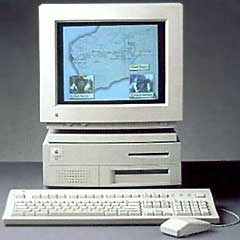 The Centris 650 shared the same case as the Mac IIvi, IIvx, and Performa 600, but it put a 25 MHz 68040 processor on the motherboard. It could handle lots of memory, an internal CD-ROM player, and even had ethernet in most configurations. The Centris 650 was a best buy on the used Mac market for some time.
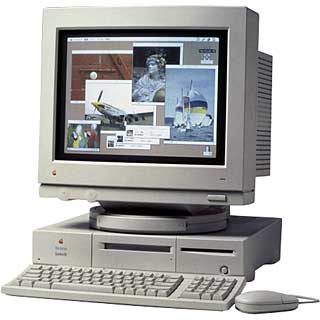 With the Centris 610, Apple introduced a slimline case with no NuBus slots. Boasting a 20 MHz 68LC040 (a 68040 without a math section), the 610 handily outperformed the IIci and IIvx. As with the 650, some versions of the 610 had ethernet ports.
 Quadra Heavy
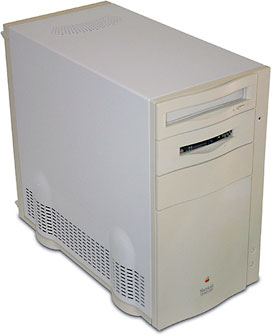
Except for a difficult-to-open-and-work-inside case, the Quadra 800 was one of Apple’s best machines of 1993. The minitower made a great graphics workstation at 33 MHz – and also a very competent server. It pretty much made the Quadra 950 obsolete.
Round Two
Apple didn’t stop with the February 1993 introductions. June saw three new models, then two more came in July, and another one arrived in August.
Beyond the Color Classic
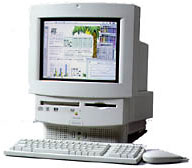 Released in June 1993, the LC 520 was the first all-in-one Mac designed around a 14″ color monitor, making it quite a bit larger than the Color Classic. It was also a lot more computer, since it was designed around an LC III motherboard with a 32-bit data path and 25 MHz processor.
The LC 520 was designed specifically for the education market, where the reduced number of cables and easy setup would be beneficial.
More PowerBooks
Of the two June PowerBooks, the 145b was designed as a more affordable version of the PowerBook 145, while the 180c grafted a 640 x 480 active matrix color screen onto the 180, giving the 165c some real competition.
Let’s Get Audio-Visual
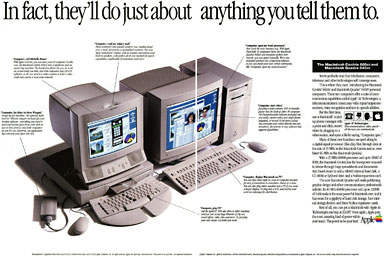 In July 1993, Apple brought out the Centris 660av and Quadra 840av. The 660av ran a 25 MHz 68040 along with a 55 MHz AT&T digital signal processor (DSP). Housed in the same case as the Centris 610, the 660av was a powerhouse when dealing with audio or video input.
The same can be said of the 840av with its 40 MHz 68040 and 66 MHz AT&T DSP. It was the fastest 68040-based model Apple ever released.
In addition to audio and video I/O, both AV models used a high speed serial port dubbed the GeoPort, which could be used for telecommunication, faxing, and telephony. With the right software and a GeoPort modem, these models can connect to the internet, send and receive faxes, and run a voice mail system for your office.
Another PowerBook
Still not running out of steam, the PowerBook 165 came out in August, replacing the 160 and sporting a 33 MHz processor.
Hello, Newton
In 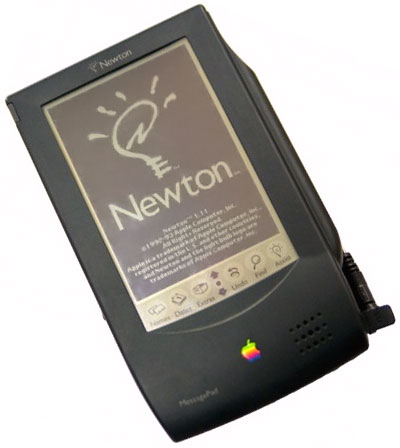 August 1993, Apple introduced the original Newton MessagePad. Although its handwriting recognition was less than perfect, in many respects the Newton was well ahead of its time and paved the way for the PDA industry – which Palm entered in 1996 with a much more compact device that quickly dominated.
Early Newtons were somewhat underpowered, based on a 20 MHz ARM CPU. Apple moved to a 163 MHz StrongARM CPU in 1997 with the MessagePad 2000. Steve Jobs axed Apple’s Newton division on February 28, 1998 but held on to the technology, some of which made its way into Mac OS X 10.2 Jaguar as Inkwell in 2003, where it requires a graphics tablet.
Round Three
More Macs? Why not! Apple seemed to want to overwhelm the Mac community with one new model after another in 1993 and released seven more models in October.
Beyond the LC III
Take an LC III, replace the 25 MHz CPU with a 33 MHz one, and you’ve got the Peforma 460, also known as the LC III+ in some markets.
Beyond the LC 520
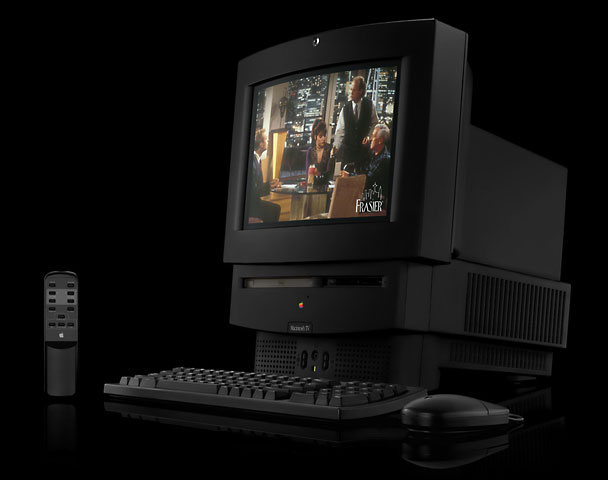 Take the LC 520, paint it black, create a matching black mouse and keyboard, then drop in a TV tuner, and you’ve got MacTV, a very limited production model built to test the concept of melding a TV and computer in a single unit.
Most sources peg production at about 10,000 units, although some estimates are twice that high. And although it wasn’t quite as hot a seller as Apple had hoped (in part due to selling it only through consumer electronics outlets), those who own MacTV don’t want to give them up.
Unfortunately, Apple made some serious design compromises with MacTV.
- The 32-bit 32 MHz 68030 is on a 16-bit data bus.
- It can only address 8 MB of memory – less than the original LC.
- Although it can display 16-bit TV images, computer images are only 8-bit.
- You either watch TV or compute; you can’t do both at once.
Had Apple used some of the Quadra AV technology to allow capturing TV images to QuickTime and display a small TV image within a window, along with the ability to accept more memory, MacTV might have been a lot more than an odd footnote in Apple’s history. (Yes, it did earn the Road Apple label.)
Beyond Centris
As mentioned earlier, Apple dropped the Centris name in October 1993. The Centris 610 became a Quadra 610, and the CPU was boosted to 25 MHz and was almost always the full 68040, not the math deprived 68LC040.
The Centris 650 likewise became the Quadra 650, also seeing a performance boost. With a 33 MHz 68040, it offered the same power as the Quadra 800 in a more traditional desktop configuration. It was also an excellent value on the used market for some time.
More Duos
The PowerBook Duo 250 replaced the 230, and the 270c added color to the equation, including a 16-bit option at a reduced screen size of 640 x 400.
The Competition
With so many models to choose from, who needs competition? Apple had so many models – some available with two or three different names – that it was rumored nobody knew the entire product line or what was current at any given moment.
Sometimes choice is good, but sometimes you can have too much of a good thing.
In the Wintel world, where Windows 3.1 was making serious inroads, the new Pentium chip was the rage – although it would soon become the butt of jokes when an undetected math bug surfaced and the CPU was recalled.
Microsoft reported 25 million Windows users in 1993, and NeXT released NeXTSTEP for Intel.
Motorola first showed the PowerPC in 1993. More on that in 1994!
Personal Perspective
These were heady days with new models almost every month. I have a lot of experience with some of these, starting with the Centris 610 I bought in the spring of 1993 and didn’t replace until in June 1998. When I bought it, I suddenly had more power at home than anything we had at work, since our powerhouse computer at work was still the Mac IIci.
We had several LC IIIs at work, which really begun showing their age by the end of the 20th Century. Still, for six-year-old computers, they definitely earned their keep. These were very stable machines, and we especially like the built-in support for the Portrait Display.
We had a lot of Quadras at work by 1999, mostly 650s, but also a 660av (which I used for several months), a couple 800s, and one 840av. Although the AVs were initially a bit buggy, moving to System 7.5 and beyond made them some of our most stable machines.
I also had my own 660av and 650 in 1999, when this series first ran, both running Mac OS 8.1 very comfortably. My goal was to set up the 660av with a GeoPort modem and make it a voice mail and fax server, but I never got around to it. The 650 was used as a web and email server.
My second-oldest son eventually found a reasonably priced Color Classic for his own use. I can sorta understand that, as it’s another seductive model from the folks in Cupertino.
Next – 1994: Apple DOS Cards, First Power Macs, System 7.5, and IDE Hard Drives
Keywords: #colorclassic #maclciii #powerbook165 #centris610 #centri650 #quadra610 #quadra650 #quadra800 #powerbook145b #powerbook180c #quadra60av #quadra840av #newton #macintoshtv #mactv
Short link: http://goo.gl/cufvJ6
Searchword: machistory1993
