
Apple addressed some little things with System 7.1, introduced in 1992. The biggest innovation was putting a Fonts folder inside the System Folder. An entire generation of Mac users has now grown up never having had to move fonts to or from the System file using Font/DA Mover.
On the hardware front, the 16 MHz 68020-based LC gave way to the 16 MHz 68030-based LC II in March, which made virtual memory available. Two months later, the 33 MHz Quadra 950 replaced the 25 MHz Quadra 900 – computer evolution in action.
In August, the PowerBook 140 was replaced by the 145, jumping from a 16 MHz 68030 CPU to a significantly faster 25 MHz chip.
Performance?
September 1992 saw Apple once again attempt to embrace to consumer market, as they had done earlier with the Classic and LC (see 1990). But this time it wasn’t just new consumer models – it was a whole new brand: Performa.
The name was undoubtedly meant to imply performance, that these Macs were performers. But then you have to look at the recycled models bearing the new brand name:
- Performa 200, 16 MHz 68030 black & white Classic II
- Performa 400, 16 MHz 68030 LC II
In an era of 25 MHz and faster DOS machines and 68040-based Macs, who was Apple trying to fool with 16 MHz computers based on old technology? Did it want to give consumers a mediocre first computing experience and sour them on the Macintosh?
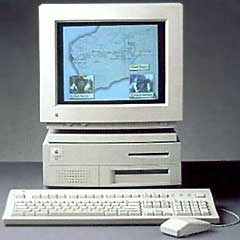 Even the top of the line, the Performa 600, was nothing to write home about. Although the 32 MHz 68030 sounded fast, Apple chose to run it on a 16 MHz bus, which crippled performance. In fact, the 16 MHz Mac IIx outperformed the 600 on some benchmarks!
The 600 was the first Mac with an internal CD-ROM drive – perhaps the first personal computer with that feature.
The Mac II Line
Apple introduced that last two computers in the Mac II line in October 1992. The Mac IIvx was essentially a Performa 600 with a 32 KB level 2 (L2) cache, which improved performance by over 20%. This cache fit into the processor direct slot; it could be removed and replaced with a 68040 accelerator.
Based on the few benchmarks I’ve seen, the 16 MHz Mac IIvi offered comparable performance to the 32 MHz IIvx. Why? Because the CPU wasn’t forced to wait for a slow memory bus. (The IIvi was never sold in the United States.)
More PowerBooks
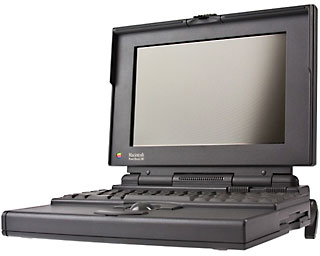 Also in October, Apple brought out the PowerBook 160 and PowerBook 180, its first notebooks with grayscale displays. The 25 MHz 160 offered the same performance as the 145 and 170, but with a 4-bit passive matrix screen capable of displaying 16 shades of gray.
The PowerBook 180, running a 33 MHz CPU and FPU, replaced the 170 combined with a 4-bit/16-shade active matrix screen. This was probably the finest laptop screen of that time. The 180 also offered a video-out port supporting external 13″ to 16″ monitors.
Apple added one new feature to the new PowerBooks: SCSI Disk Mode. With the right cable, you could set your 160 or 180 to slave mode, connect it to another Mac, and access the hard drive just as though it was directly connected to that computer.
Smaller than PowerBooks
The original Mac Portable was too big for almost anyone. The PowerBooks were smaller and lighter, averaging about 7 pounds. Still, that was bigger than some people liked.
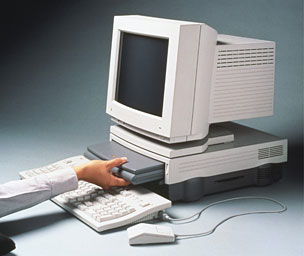
PowerBook Duo in a DuoDock.
Apple addressed that market with the PowerBook Duo 210 and 230. By eliminating the internal floppy and several ports, these weighed between 4 and 5 pounds, making them an even more portable alternative than the regular PowerBooks.
To provide full functionality, several docks were available from Apple and others – these provided all the traditional ports, floppy drives, video out, and several other options.
The Competition
Microsoft unveiled Windows 3.1, much more than a bug fix for Windows 3.0. Even the Mac magazines took the challenge seriously, publishing comparisons between System 7.1 and Windows 3.1. Windows 3.1 would remain a thorn in Apple’s side until 1995, when Windows 95 became an even more formidable foe.
And NeXT, Steve Jobs’ company, released the NeXTstep 3.0 and NeXTstep 486 operating systems, porting the operating system originally designed around the 68030 and 68040 to the dominant Intel-based hardware platform. (That all came full circle when Apple moved the Mac to x86 architecture in 2006. Jobs had been developing OS X on Intel in parallel to PowerPC since he returned to Apple – just in case.)
Personal Perspective
Working on a IIci when the IIvx came out, we evaluated the new model for work. Based on what we read in MacUser and Macworld, we concluded that the 32 MHz IIvx would be a significant step down from the 25 MHz IIcis we were using, so we continued buying the older model.
As for the PowerBook 180, we has several at work. They were slow by late 1990s standards, but the screens were still impressive. And thanks to Farallon EtherWave ADB connectors, they could easily be used on an ethernet network at three times the speed of LocalTalk.
Next – 1993: LC III, Color Classic, Centris, Mac TV, and the First Color PowerBook
Keywords: #performa #maciivi #maciivx #powerbook160 #powerbook180 #powerbookduo
Short link: http://goo.gl/40Od8C
searchword: machistory1992
