
In March 1990, Apple extended its warranty from 90 days to a full year, finally bringing it to parity with the majority of the computer industry.
The DOS world (Windows was not yet a popular option) was thrilled with its 33 MHz 80386 machines, which offered twice the performance of the 16 MHz 80386 models from 1986.
In the same time period, Apple had gone from the 8 MHz Plus to the 25 MHz IIci. However, due to the extra overhead of a GUI operating system compared with text-based DOS, much of the world viewed the Mac as sluggish.
We all knew the Mac had a lot of horsepower, but a good deal of it was dedicated to displaying a screen that used a lot more resources than 25 lines of 80 text characters did on the typical DOS box.
‘Wicked Fast’ Mac IIfx
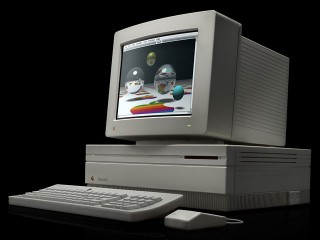 Apple took the speed issue by the horns in March 1990, rolling out the 40 MHz Macintosh IIfx along with the 8•24GC accelerated video card.
The DOS world was pretty content with 33 MHz computers with a 32 KB (or sometimes larger) Level 2 (L2) cache and often a memory bus running at half of CPU speed.
Apple didn’t go that route – the IIfx ran a 40 MHz 68030 CPU and 40 MHz 68882 FPU (math chip) on a 40 MHz system bus. It used a special 64-bit memory module that could overlap read and write operations for improved speed. It had a 32 KB L2 cache on the motherboard, since even its high speed memory couldn’t keep up at 40 MHz.
Speedometer benchmarks show a stock IIfx is almost twice as powerful as a base 25 MHz Mac IIci – and about 60% faster than the IIci with a 32 KB L2 cache.
On top of everything else, the IIfx used two 6502 processors to manage the floppy drive(s), ADB ports, and serial ports, which reduced the load on the CPU. And, like the earlier Mac II and IIx, it has six NuBus expansion slots.
Wicked Fast Graphics, Too
Apple went a step further. Where a normal video card was processor intensive, the 8•24GC took a lot of that burden off the CPU. With an onboard AMD 29000 RISC processor, the 8•24GC did certain tasks 5 to 30 times faster than previous Apple video cards. (This was Apple’s first RISC product, years before the first Power Mac shipped.)
The label “wicked fast” definitely suited the IIfx, especially with the 8•24GC card installed.
And for owners of the Mac II or IIx, a motherboard upgrade made it possible to acquire this level of performance for significantly less than it’s $10,000 list price.
It wasn’t until 1993 that Apple would offer another Mac running at 40 MHz, the Quadra 840av.
Consumer Macs
Unfortunately, Apple had acquired a reputation for announcing product before it could ship in any kind of quantity. I know – I was working at the local ComputerLand store and selling Macs at the time.
Apple went out of its way to address this with the release of a trio of consumer-oriented Macs in October. Every store that wanted stock was promised at least a display model and, when possible, sales inventory.
The Classic
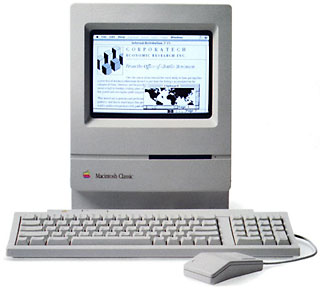 The new entry level computer, replacing the venerable SE, was the Mac Classic. Packaging the same 8 MHz 68000 used in the first Macs along with the same 9″ b&w screen, the Classic became the first $1,000 Mac – if you were willing to live without an internal hard drive.
Memory expansion from the base 1 MB required a special daughter card, which contained 1 MB and two SIMM slots. These could be populated with 256 KB or 1 MB SIMMs, resulting in 2.5 MB or 4 MB of memory, respectively.
The Classic was the only ROM-bootable Macintosh. By holding down Cmd-Opt-X-O at startup, the Classic would boot into a version of System 6 stored in ROM – complete with LocalTalk network drivers.
The LC
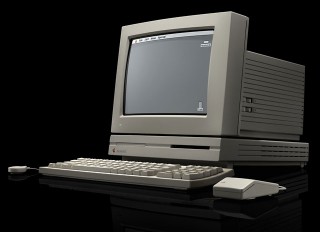 The Classic didn’t generate nearly as much excitement as the first low cost color model, the Macintosh LC. This compact unit contained the same 68020 processor once used in the Mac II, and it ran at the same 16 MHz as that 1987 model.
To reduce the cost of acquiring a system (and for one other reason, noted below), the LC supported a new 12″ color monitor with 512 x 384 resolution – the same pixel width as the black & white compact Macs, but 42 pixels higher.
The LC introduced a new expansion slot, the LC processor direct slot (PDS), which Apple had big plans for.
Apple II computers had long been used in the classroom, but the installed base made it hard to get Macs in the door. Apple’s solution was to put an Apple IIe on an LC PDS card. This let the user connect an Apple 5.25″ floppy drive and run Apple II programs on the LC’s 12″ monitor.
On the Mac side, with a VRAM upgrade, the LC supports 16-bit color on the 12″ display, 256 colors on the traditional 640 x 480 screen, and 256 shades of gray on a new 12″ monochrome display styled to complement the LC. (Without the upgrade, the LC only shows 16 colors on a 640 x 480 monitor.)
The $2,400 LC was not without some compromises, which earn it the dubious Road Apple label.
- The 68020 CPU was obsolete, but Apple used it to reduce costs.
- The motherboard has a 16-bit data path, but the 68020 is a 32-bit processor. This reduces performance by about 25% compared with the Mac II, as the CPU has to access memory twice to receive 32 bits of data.
- The LC can accept high capacity SIMMs, but it is hard wired to see no more than 10 MB of memory – no matter how much you install. This was probably done to keep the LC from competing with more expensive models.
Still, these compromises were what allowed Apple to sell the LC at a more accessible price, so we shouldn’t be too hard on it. And the LC was the foundation of perhaps the most popular line in Apple history – at least until the iMac came along.
The IIsi
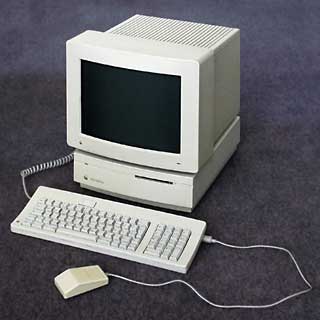 Between the 16 MHz LC and the 25 MHz IIci, Apple rolled out the 20 MHz IIsi. At under $4,000 and with about 80% the performance of a stock IIci, the IIsi represented a lot of power and value.
The IIsi shared a lot of hardware features with the IIci. In fact, many of the components were identical and the design could easily support the same 25 MHz speed as the IIci, but that would have taken sales away from the more expensive machine.
To reduce costs, Apple soldered 1 MB of memory to the motherboard. As on the IIci, this memory was used both for video and for software, which made things a bit less efficient but increased value. The IIsi officially supports 256 KB, 512 KB, 1 MB, 2 MB, and 4 MB SIMMs, giving it a RAM capacity ranging from 2 MB to 17 MB. Users have since discovered that the more recently introduced 8 MB and 16 MB SIMMs also work, allowing 33 MB and 65 MB configurations.
The IIsi’s great compromise, and probably the main reason is was so much less expensive than the IIci, is that it has no built-in NuBus slots. Instead, the IIsi has a single 68030 PDS, the same one used in the SE/30, but running at 20 MHz. For those needing a single NuBus card, Apple sold a PDS-to-NuBus adapter.
But by eliminating the NuBus slots, Apple could design a more compact case (4.0″ tall instead of 5.5″) and use a smaller, less costly power supply.
With the addition of an ethernet PDS card, the IIsi was popular as a low-end server, since it was compact and drew less power than the other models in the Mac II series, meaning an uninterruptible power supply would run it longer when the lights went out.
The Competition
This was the year Microsoft replaced Windows 2, Windows 286, and Windows 386 with a single product, Windows 3.0. The now-famous GUI was still fighting an uphill battle for acceptance by DOS users, but a unified product combined with the power of the new 80486 processor began to make it competitive with the Mac OS.
Windows 3.0 was a near miss. When it was replaced by Windows 3.1 in 1992, it created a standard that survived into the late 90s, when the so-called Millennium Bug got most people to upgrade to a version of Windows that understood four-digit years.
Personal Perspective
We had a big invitation-only roll out party for the new Macs at ComputerLand of Grand Rapids. We dressed up and had the event catered. The windows were covered with paper, a satellite dish was installed for the occasion, and customers were greeted at the door by hostesses. We watched Apple’s introduction live on a projection TV and then unveiled our display models.
This was nearly as big a deal as Steve Jobs unveiling the iMac prototype in May 1998, and sales of the new models were brisk, since more users could afford a Mac than ever before. (Another parallel with the iMac.)
Next – 1991: Classic II, First Quadras, and First PowerBooks
Keywords: #maciifx #macclassic #maclc #maciisi
Short link: http://goo.gl/NPJi8m
