
March 1987 was a milestone month for Apple: Apple built the one-millionth Macintosh, AppleShare file server software was introduced, the Mac SE and Mac II were introduced, ADB came to the Mac, and platinum replaced beige as the color for all new Mac gear.
I wish I had some hard numbers on how many of the earlier Macs Apple built, but my guess is that at least half of the first one million Macs were Pluses. With expandable memory and a SCSI bus, it was the best Mac ever – well, until March 1987.
Mac SE
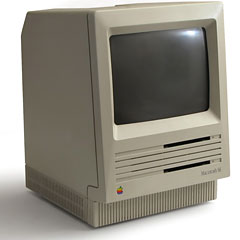
The Mac SE made a few improvements over the Plus. The biggest was the ability to put a SCSI hard drive inside the compact case, which was restyled to allow for a fan and better ventilation. But an even bigger improvement was hidden from most users: While the Plus could only transfer SCSI data at 2 Mbps (or 0.25 megabytes per second), the SE had a SCSI throughput of 5.1 Mbps (or 0.64 megabytes per second), allowing it to move data about 2.5 times as fast.
The SE used the same 9″ b&w screen and 8 MHz 68000 CPU as earlier Macs, along with the same 800 KB floppy drive found in the Plus and 512Ke. Although Apple packaged it in many configurations, a lot of retailers liked to sell the single-floppy model and add a third-party hard drive, which often provided much more storage capacity at a better price and with a longer warranty than the Apple drive.
There was even an expansion slot, which could hold a DOS card, a network card, or, later on, an accelerator.
The Mac II
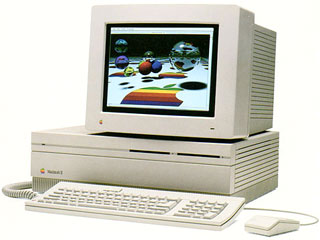 Where the SE was evolutionary, the Mac II set the Mac in a whole new direction. Steve Jobs had been adamant that the Macintosh was a closed system. But here was a modular Mac with six NuBus slots that could support a variety of video cards – and anything else that fit a NuBus slot, such as network cards and SCSI accelerators.
Even more radical, the Mac II wasn’t simply a black-and-white computer like earlier Macs. With the right video card it could display 256 shades of gray – or 256 colors from a 16 million color palette on the 13″ AppleColor High-Resolution Monitor.
Designed for the business market, the Mac II had two banks of SIMM slots, providing a theoretical ceiling of 128 MB of memory,* and twice the SCSI throughput of the SE. Powering all of this was a 16 MHz Motorola 68020, a chip able to hold its own against the top-end 16 MHz 80386 found in the DOS world.
* Unfortunately, there was no standard for high capacity SIMMs when the Mac II was designed, nor were its ROMs “32-bit clean“. This meant Mac II owners needed special PAL SIMMs along with other hardware upgrades to go beyond an 8 MB configuration. It also meant they would need a special software patch to permit use of 32-bit software after System 7 shipped.
Other Innovations
Apple created Claris, its software division, in April, and HyperCard (in many ways a predecessor to the Web) in August. Systems 3.3, 4.0, 4.1, 4.2, 5.0, and 5.1 all appeared during 1987.
System 5.0 introduced two things we take for granted today: background printing and the ability to run more than one program at a time. (With System 7, introduced in 1991, that became normal behavior for the Mac OS.)
The Competition
Working together, IBM and Microsoft released what should have been the first serious competition for the Macintosh operating system, OS/2. Fortunately for Apple, IBM insisted the new OS had to provide full support for the brain-damaged 80286. This prevented it from using the more powerful addressing modes of the 80386, which kept if from being a serious alternative to MS-DOS or the Macintosh.
The first fax boards were shipping for PCs; this feature eventually became a standard part of almost every modem.
And pointing the way to the future, Sun introduced SPARC, the first RISC CPU. It would be another seven years before Apple embraced RISC technology with the Power Macintosh – while the Wintel world remains caught in a legacy CISC architecture it refused to abandon.
Personal Perspective
This was the year I first sold personal computers. I’d been using low-end home computers (Apple II+, Commodore VIC-20 and 64) since 1979 and landed a job at the Heath/Zenith computer store in Virginia Beach, Virginia, shortly after we moved there so my wife could pursue a Masters degree.
The store carried Apple IIs and Macs, but we mostly sold Zenith PC compatible computers. I’d never worked with MS-DOS, but I took some books home the first week, became proficient the second, and began moving toward geek status the third.
I clearly remember the new Mac II with that amazing 8-bit 13″ color display. The Spectrum Holobyte sales rep gave us a copy of Solitaire Royale 1.0 for the color Macintosh, which looked just spectacular (and still did on my SuperMac J700 with Mac OS 8.1 in 1998).
One of our salesmen downloaded “GIF images” from an online service, along with a Mac GIF viewer program. It was very impressive seeing such lifelike color images after years of 16-color Apple and Commodore displays – to say nothing of the 4-color CGA mode that still dominated the DOS world in 1987.
I saw the future, but being a DOS geek at the time, I didn’t yet recognize it.
Next – 1988: LaserWriter II, A/UX, CD-ROM, and Mac IIx
Keywords: #macse #macii
Short link: http://goo.gl/pSR080
