
Linux to Mac
Taking Linux to Mac OS X with Virtualization
- 2008.03.17 - Tip Jar
If you are moving from Linux to the Mac, you'll find a BASH shell and a set of Unix command line utilities available to make you feel at home. If you need a complete Linux environment for development or special applications, you can run Linux in a virtual machine (VM) using VMware Fusion.
Fusion Basics
Version 1.0 of VMware Fusion was released on August 1, 2007. The shipping version as of this writing is 1.1.1. Fusion only works on Intel-based Macs. It builds on the experience of VMware in the Windows and Linux market. It is comparable in features to VMware workstation, and to its competitor in the Mac market, Parallels.
VMware sells Fusion primarily as a Windows-on-Mac solution. You have dig into the details to learn that it also supports Linux, Solaris, FreeBSD, and other Intel operating systems as guests.
While beta versions suffered with performance issues, the latest version is relatively snappy running different flavors of Linux. I currently have Centos 5.1 and Ubuntu 7.10 running nicely under OS X. Full screen support works as expected. VMware supplies extra software called VMware tools that improves video and mouse performance. Installation of VMware tools in a Linux guest works exactly as on other host operating systems.
Jump Start with Appliances
One of the advantages of the VMware universe is the availability of virtual appliances. Appliances are prebuilt virtual machines that can be downloaded and run with no installation or configuration. Many companies provide special purpose appliances as either demonstrations or deployable applications. There are also hundreds of user provided virtual machines with a variety of Linux distributions, making it easy to try out different flavors of Linux without much work.
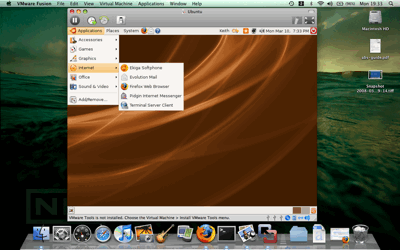
Ubuntu Linux on OS X with VMware Fusion
Fusion can run virtual machines created on the Windows and Linux versions of VMware. I downloaded and tried several appliances and had no problems.
Virtual Appliances and Security
The ease of downloading and running appliances can be a two-edged sword. Keep in mind that a virtual machine is essentially a completely configured computer system that you are booting up on your network. Depending on how it was created, each appliance may have the same access to the network as your host system - and it may also have limited access to host system files.
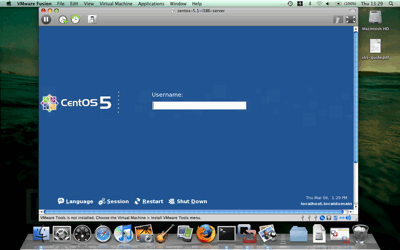
Centos Linux on OS X with VMware Fusion
For user created appliances, you should at least regenerate the system SSH keys and limit access to the network unless you trust the source. A trojaned virtual machine is another vector to get malware inside a network. Be aware of the risks.
The Competition
The main competitor to Fusion is Parallels, a company that gained a lot of traction by being first out of the gate with a high performance virtualization solution for the Intel-based Mac. Parallels was also priced below the VMware offerings on Windows and Linux. However, VMware has matched the Parallels price (currently $79) for their Mac solution.
Since I don't have Parallels, I can't compare the two products.
VMware does have a fully functional 30-day trial, while Parallels does not at this time. (Note: I have no financial or other relationship with either company.)
VMs Are Future Compatible
Some of the benefits of taking Linux with you to OS X are obvious. You can create an exact replica of a production server environment for testing and development. You can safely test new software and roll back to before installation if things don't work out as expected. It also lets you test multiple client environments on one system.
Virtual machines have been around since the 1960s on mainframes, where they have been part of the high reliability and performance equation. Modern microprocessors provide the needed hardware support for virtualization, and it is becoming a common part of computing environments at all levels.
It is interesting that Apple does not allow OS X to be a guest
operating system. My guess is that OS X is designed for specific
sets of hardware, not to handle any old motherboard or collection of
hardware thrown at it like Linux (and to some extent Windows). This
means OS X might not perform well in a virtualized environment.
Apple probably has other reasons, too, but it would be nice to see
OS X as a guest in the future. 
Join us on Facebook, follow us on Twitter or Google+, or subscribe to our RSS news feed
Keith Winston is a recent Mac convert after five years of Linux on the desktop. He also writes for Linux.com and created CommandLineMac to focus on the Unix-y power of the Mac. If you find Keith's articles helpful, please consider making a donation to his tip jar.
Today's Links
- Mac of the Day: Motorola StarMax 3000, introduced 1999.09.07. This inexpensive clone used lots of off-the-shelf parts.
- Support Low End Mac
Recent Content
About LEM Support Usage Privacy Contact
Follow Low End Mac on Twitter
Join Low End Mac on Facebook
Favorite Sites
MacSurfer
Cult of Mac
Shrine of Apple
MacInTouch
MyAppleMenu
InfoMac
The Mac Observer
Accelerate Your Mac
RetroMacCast
The Vintage Mac Museum
Deal Brothers
DealMac
Mac2Sell
Mac Driver Museum
JAG's House
System 6 Heaven
System 7 Today
the pickle's Low-End Mac FAQ
Affiliates
Amazon.com
The iTunes Store
PC Connection Express
Macgo Blu-ray Player
Parallels Desktop for Mac
eBay