
I recently joined the ranks of the iPhone enabled and am having a generally marvelous time with my new iToy. One of the best features is how seamlessly the iPhone works with my Mac’s Address Book and Calendar data via Apple’s Sync Services. No third party data conduit is needed – unlike Treo or BlackBerry handhelds, a frequent source of headaches for many of my clients.
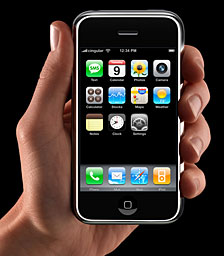 However, on my Mac I use Apple’s Address Book only for email addresses and instead keep my personal and business addresses in FileMaker Pro. I’ve used FileMaker for many years and have a set of linked databases that manage my business contacts and invoices. I need a way to get this contact info on my iPhone.
Unfortunately there’s no iPhone app from FileMaker to address this need. An older product, FileMaker Mobile, has been discontinued, and the company has made no announcement as to whether they intend to support the platform or not. FileMaker only suggests using the program’s web publishing feature and accessing your data via the iPhone Safari web browser. This can be useful in some instances, but it requires effort to create and host the database – and it’s not the same as having a local copy of your data on your iPhone
FMTouch
Fortunately an enterprising third party has stepped up to fill the void: FMTouch is a $70 iPhone app available from the App Store. With this application on your iPhone, a bit of data massaging on your computer, and some trial and error, you can now have full working FileMaker databases right on your handheld.
You will need FileMaker v8 or v9 on your Mac (or PC) to start. You will also need to install a sync plugin for FileMaker on your computer, which talks to the FMTouch app running on your iPhone. After installing the plugin, relaunch FileMaker, then launch FMTouch on the iPhone. On initial setup there is a one-time pairing (similar to Bluetooth devices) you will first be asked to do, via entering a code on the handheld to sync with the computer.
All layouts in your FileMaker databases will be available on your handheld. For best results it’s recommended you create one or more layouts specifically designed for the iPhone. The iPhone screen size is 320 pixels wide by 375 pixels high. A good online design guide has been provided by the developer. I have found it helpful to create a 320 x 375 pixel background for my layout in a graphics program, import that as a JPEG into my FileMaker layout, then overlay fields and text to stay within these boundaries.
Once your database is ready you need to generate a DDR file, which the FMTouch application uses to access your database on the phone. FM Web School has provided an online DDR creation service to create the necessary .xml file. To use this service, make an empty copy of your database by using File > Export > Clone (No Records). Save the file with a .fp7 extension and use only letters and numbers in the filename, no special characters. Then use the Finder to make a .zip archive of this file and upload the archive. In a few minutes you should get a link to download your DDR file.
Note: If you have a copy of FileMaker Advanced on your computer, you can export the DDR file directly using the Tools menu. See the FMTouch user guide for full documentation.
Now you’re ready to sync your database to the handheld. Open your database again in FileMaker on the computer. On the iPhone, launch FMTouch and create a new database. Hit the button to upload a DDR file, and (on your Mac) choose the DDR file you just created. Once that’s loaded, initialize the database, then click Sync to transfer data from your computer. Congratulations, you now have your FileMaker database on your iPhone or iPod touch!
Usage and Limitations
This solution is welcome and useful. Email addresses and phone numbers in your database act as links for sending emails or making calls on the iPhone, as they do with Apple’s Address Book. Data sync is a two way process, so any changes you make on the handheld will be transferred back to the computer at next sync. It took a few rounds of trial and error to get my layout tweaked appropriately, but all I do now is sync the database every few days as needed.
Implementation is fair but not yet ideal; there are some bugs and rough edges. Database scripts on the computer are not currently supported on the handheld, though the developer notes they are working on this for a future release. Layouts larger than a single iPhone screen often don’t scroll or resize correctly. Each time you make changes to a layout, you need to create a new DDR file and send this to the phone.
For best results I’ve found it best to completely delete, then recreate, my database on the phone when updating the DDR file, rather than updating an existing database. Also, synching must be initiated manually via several button presses – not really very hard, but not as convenient as the auto-push service happening with email and calendar data via MobileMe. The app has also crashed a few times, requiring reboots of the iPhone. Hopefully these issues will get addressed in future releases.
The creation and layout updating processes can be somewhat labor intensive and are not for the technically faint of heart. But the developer is a young company and responsive to feedback.
As of this writing (Oct. 2008), this is the only way I know to interact with local Filemaker data on your iPhone. It’s a solution I use daily, and it has been worth the effort to get it working.
This article was originally published on Adam’s Oakbog website. It has been adapted and reprinted here with his permission.
Keywords: #filemakerpro
Short link: http://goo.gl/LP0Ppl
searchword: filemakeroniphone
