
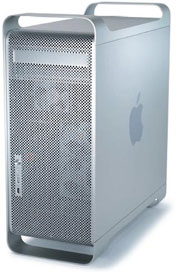
Five years ago this week, on June 23, 2003 (although it seems longer somehow), Apple Introduced the G5 Power Mac, claiming it to be “fastest personal computer ever” and “first 64-bit personal computer”. Speculation soon began about the possibility of a G5 PowerBook. Not so much at first, since the G5 was launched as a power chip in Apple’s pro desktop towers, but by January 2005 it was definitely the buzz.
 To the disappointment of Apple ‘Book aficionados, Macworld Expo came and went with no PowerBook announcements. Not even a hint of when -or if – a G5 PowerBook might be on its way.
I was always a bit of a G5 PowerBook skeptic and found myself becoming more rather than less of one as time passed.
After Expo 2005 with no PowerBook G5 announcement, the rumor mills revised the projected release venue for the PowerBook G5 to the Worldwide Developers Conference in May, and I wrote at the time, “Maybe they know, or think they know, something I don’t know, but I am getting increasingly skeptical that there will see a G5 ‘Book before the late fall – if ever.”
Earlier PowerBook Rumors
Indeed, I was beginning to think the if ever more plausible all the time, remembering that almost from the introduction of the first PowerPC PowerBookin 1995, the 5300, rumors and speculation swirled about an imminent PPC 604 PowerBook in the works – a machine that never materialized.
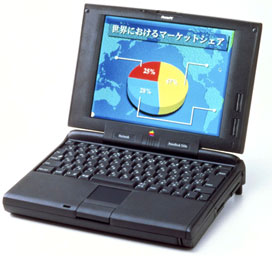
There was plenty of reason to speculate. The PowerBook 5300 used an anemic PPC 603e chip, of which it is an understatement to say that it left much to be desired performance-wise. The 603 series chips were designed to be a smaller, lower power consumption variant of the robust PPC 601 chips that powered the original Power Macs in 1994. Unfortunately, the engineering compromises that obtained resulted in extremely lackluster performance, notwithstanding the hefty price tag of the PowerBook 5300.
On the other hand, the Motorola PPC 604 chip, introduced first in the Power Mac 8500 in August 1995, like the earlier 601, was designed with desktop workstations in mind, without the low-power, low-heat, low-cost limitations of the 603. It had more powerful, sophisticated caching technology than the original 601. If you recall the large heat sink attached to a 604 processor in a desktop Power Mac, it was a clue as to what a challenge it would have been to shoehorn a 604 into even the thicker form factor PowerBook cases of the day and then keep it cool.
In 1995, Motorola began producing a smaller, cooler-running version of the 604 called the 604e, which incorporated 0.35 micron fabrication technology rather than the 0.5 micron technology used in the 604, along with a unified cache instead of the 604’s split cache to store data and program instructions. Theoretically, the 604e might have been a candidate for laptop use. I wouldn’t be surprised if Apple engineers cobbled up a PowerBook prototype or two using 604e chips, but no 604-based PowerBook ever made it into production.
 When the PowerBook 3400c was unveiled in early 1997, it had three different clock speeds of 603e processors. The first PCI architecture used in a PowerBook motherboard and a fast (for the day) 40 MHz system bus made the PowerBook 3400 the “fastest laptop on the planet” – at least for a few months – while 604 PowerBook speculation continued.
In the end, PowerBook technology took a quantum leap from 603e to G3 with the November 1997 introduction of the original PowerBook G3 (a.k.a 3500 and Kanga) that was faster than a 604 and eclipsed the 603e in performance.
Why Not a G5 PowerBook?
Could a similar phenomenon be about to repeat itself with G5 PowerBook speculation? I mused in January 2005, although I had in mind a “G6” chip IBM reportedly had under development, recalling that Apple spokespersons had been equivocal about prospects for a G5 ‘Book. For example, in September 2003 then Apple senior vice president of hardware engineering Jon Rubinstein told Macworld UK that the possibility of a G5 PowerBook was simply “an issue of good, solid engineering.”
In November 2003, David Russell, Apple’s director of product marketing for portables and wireless, told Computerworld that Apple would someday like to offer a PowerBook G5. “We certainly want to do that,” he said, “But it’s going to be a while. We think the G4 has a very long life in the PowerBook.” The main obstacle in getting a G5 processor into a portable was the need to keep the processor cool, Russell said. “Have you looked at the inside of the G5 tower?”
In February of 2004, Peter Glaskowsky of the Microprocessor Report told Mac Minute that IBM’s PowerPC 970fx had the basic power consumption characteristics required for laptop installation, and that he believed a PowerBook G5 “could be introduced basically at any time.”
On the other hand, in an interview with BBC News on April 19, 2004, Apple’s vice president of product marketing Greg Joswiak said, “In the very long run, the G5 is part of our long term processor roadmap, but it will be some time before that processor will be in a notebook,” and also noted that it had taken almost a year-and-a-half for the G4 chip to make it from the desktop to the notebook. [The first Power Mac G4 was unveiled on August 31, 1999, and the first PowerBook G4 on January 9, 2001. ed]
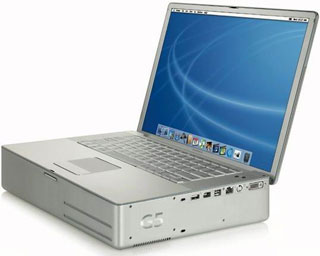
Tongue-in-cheek mockup of a PowerBook G5.
In September 2004, Joswiak reiterated that “The challenges of cooling a G5 in a PowerBook are significantly greater”, and also that month, Tom Boger, Apple’s director of worldwide product marketing, conceded to Mac Observer that: “There are great challenges in putting a G5 processor in a laptop. The issues range from power to cooling and its overall size . . . You’re not going to see a G5 in a laptop anytime soon.”
In January 2005, during Apple’s conference call discussing first quarter fiscal earnings with analysts, Rob Steerum of Fulcrum Global Partners asked Tim Cook, Apple’s VP of Worldwide Sales and Operations, about the chances of a G5-based PowerBook anytime soon. Cook admitted that making a G5 work in a PowerBook “would be the mother of all thermal challenges.” Asked if that meant there would never be a G5-powered PowerBook, Cook reportedly answered: “I don’t want to go further in the comment.” (Note that other reports said it was Apple chief financial officer Peter Oppenheimer who made the “mother of thermal challenges” observation.)
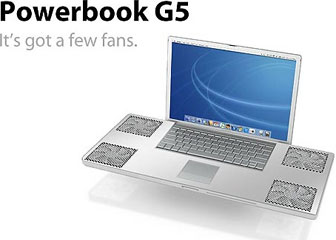
One solution to the “mother of thermal challenges.”
Anyway, it certainly was beginning to sound like engineering a G5 PowerBook had been more of a challenge than Apple had anticipated, and IBM’s 90nm PowerPC 970fx wasn’t proving as laptop compatible as originally touted.
However, it further muddied the waters when DigiTimes reported that same month that Asustek would start shipping iBook G5 notebooks to Apple in the second quarter of 2005, and that Quanta Computer would ship PowerBook G5s at a rate of 30K-50K per month by Q2 2005. This created a buzz among Apple watchers, and at the time I suggested that everyone keep their powder dry. With no sign of a G5 PowerBook yet, it beggared credibility that Apple could have a G5 iBook ready to go in a few months.
Rumors Undeterred by the Intel Announcement
 Of course, by that time – or very shortly thereafter – Apple was cooking the deal with Intel that became the subject of Steve Jobs’ bombshell announcement at WWDC 2005.
However, even the Intel switch revelation didn’t entirely quash PowerBook G5 speculation. Even as late as December 2005, less than a month before Jobs unveiled the first-ever Macintel ‘Book (the 15″ MacBook Pro) at Macworld Expo 2006, a ZDNet blogger whose name I won’t mention, predicted that “the appearance of Intel based PowerBooks from Apple this January” wasn’t going to happen, although we might see both Intel-based Mac mini and/or Intel-based iBooks. “Beyond that,” he declared, “Intel is just not going to happen for Apple next year – no PowerBooks, no iMacs, no Workstations, and no X-Serves.”
“The obvious answer,” he continued, “is to stick to PowerPC for another generation – pushing the first Intel products into 2007. IBM has a low power (13 Watt) G5 that would be a big winner in new PowerBooks, and Freescale’s 8641, a dual-core PowerPC G4 with integrated system logic and four Gigabit Ethernet media-access controllers….”
In my commentary on that, I expressed doubt that Apple will be interested in doing any major reengineering of the PowerPC PowerBook, which in any event would be a lame duck. Apple had been lengthening product life cycles since well before the Macintel announcement, and I just couldn’t see them allocating the development resources to getting a G5 PowerBook ready for market at that point – a deduction that would be proved correct sooner than I imagined.
In the end, the PowerBook G5 turned out to be the biggest vapor non-story in Apple laptop history.
Keywords: #powerbookg5
Short link: http://goo.gl/MWzyTF
searchword: powerbookg5

