
In 1984, Apple Computer, a pioneer in the personal computer field, announced its biggest gamble to date. With small personal computers having reached landmark sales over the past few years, Apple debuted the Macintosh, a “computer for the rest of us”.
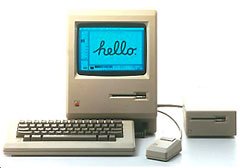
Although the story is well known now, it’s hard to overstate just how significant a break from the status quo that first Macintosh was.
Prior to that point, personal computers had been pretty much confined to business types who needed them for work and hobbyists. All commands had to be entered by typing arcane commands next to a blinking cursor on a forbidding black background. If the program to do what you wanted didn’t exist (which it probably didn’t), you were stuck having to write one yourself in BASIC, the programming language of the day.
Macintosh knocked all that into a cocked hat. When you turned it on, it smiled at you. The ominous black screen with its blinking cursor was replaced by a simulated white desktop, various tasks and programs were represented by icons, and to activate any one of them you simply guided a little arrow using a device called by the unthreatening term mouse to the icon of the program you wished to activate and clicked a button. It was so simple that anyone could use it – it truly was “a computer for the rest of us”.
The only fly in the ointment was that “the rest of us” didn’t need a computer. Beyond running a few business applications, playing games, and hobbyist-level tinkering, there just wasn’t that much for a computer to do in the mid-80s, and the Macintosh wasn’t the ideal tool in the marketplace for any of those tasks. IBM clones ran business software just fine, Commodores and Ataris had the game market sewed up, and the “sealed box” all-in-one nature of the Macintosh discouraged hobbyist tinkering.
Given a choice between a computer priced like a good used car or a Rolodex for storing addresses and recipes, “the rest of us” stuck with pen and paper.
There’s an old saying regarding technology that states that the railroad won’t be invented until it’s railroading time, and it clearly wasn’t railroading time just yet.
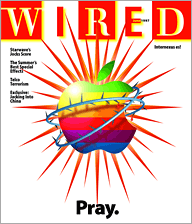
Apple and its Macintosh spent the next decade wandering in the wilderness. Aggressive marketing and its easy-to-use nature gave the Mac market penetration in fields where the user-hostile command-line interface of DOS machines made them unwelcome – desktop publishing, graphic design, and education – but it wasn’t enough to keep the handwriting off the wall.By the mid-90s, the future for an increasingly rudderless Apple looked grim indeed. In the Summer of 1997, Wired magazine’s cover featured the iconic Apple logo surrounded by a crown of thorns in a reference to the Sacred Heart over the single word: “Pray.”
In what was widely seen as a desperation play – a “Hail Mary” if you will – exiled Steve Jobs was brought back to provide direction to the fast-sinking Apple. Jobs quickly launched a palace coup and once again took control of his old brainchild. As events were about to prove, it was Railroading Time.
The Internet PC
The Internet had just taken off, and the buzzword of the day was the “Internet PC”. Using the adaptability of the Wintel machine’s open architecture and the faux-Macintosh friendliness of the latest version of Microsoft’s Windows, makers like Compaq trotted out computers in the $1,000 price range designed to let grandpa and mom and Aunt Edna access the Internet. They were all obviously kludged together from parts-bin pieces: oppressive mare’s nest tangles of cables and beige boxes and monitors and speakers and installation CDs and EULAs and legacy technology.
This was the moment Apple and Macintosh and Steve Jobs had been waiting for all those years: It was time for a “computer for the rest of us”.
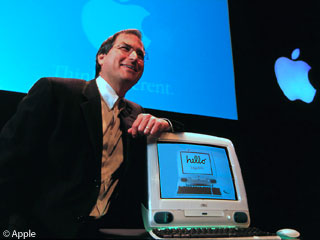
Fifteen years ago, on May 6, 1998, the announcement of the iMac hit the computing world like a bombshell. As far from the cable-twined tangle of beige boxes as you could imagine, its smooth-as-an-egg blue-and-white all-in-one shape was compelling and futuristic. There was no tangle of cables, and no muss or fuss to the setup: Plug the computer into the wall, the keyboard into the computer, the mouse into the keyboard, and the modem to your phone line, and off down the newfangled Information Superhighway you zoomed.
The iMac almost overnight joined Volkswagen’s New Beetle and the X-Files logo as one of the most iconic shapes of the end of the Millennium. People who had never before considered a computer, let alone a Macintosh, suddenly wanted one. More than one person remarked that it was the first computer they wanted to set up in their living room where it could be seen, not hidden away like a boring appliance.
At first there were howls of anguish and snorts of derision from all angles of the computing world. Howls of anguish from the longtime Macintosh faithful who complained that their investment in serial-port and ADB gizmos had been rendered useless by this new machine that abandoned a slew of such legacy technologies at a stroke. Snorts of derision from gamers and power users who mocked the new machine’s lack of expandability and merely average spec sheet.
But they didn’t matter; the iMac wasn’t for them, it was for “the rest of us” – and the rest of us responded in numbers Apple hadn’t seen in years.
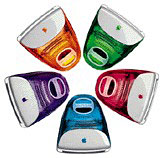 Given the timing of its introduction by a company still teetering on the brink from a Macintosh clone licensing fiasco and a near-disastrous foray into the world of handheld PDAs, it is no exaggeration to say that the introduction of the cheerfully colored little egg-shaped computer was the day that saved Apple. Capitalizing on its friendly plug-and-play nature, Apple would introduc a new operating system (OS X) and then a brilliant new substitute for the Walkman that would integrate seamlessly with their happy little computer, providing a one-stop solution for your music (and later, video) needs. Railroading time, indeed.
Just over ten years after the famous “Sacred Heart” cover, Wired magazine again put the Apple logo front and center, this time in a stylish, DeathStar-looking black and surrounded by razor wire instead of a crown of thorns. Where before it had implored “Pray”, now it praised “Evil/Genius”.
If you needed additional proof that the iMac had saved Apple, you need look no further.
This article was originally published on 2008.05.06.
Keywords: #imac #imacorigin
Short link: http://goo.gl/OZPOhx
