
Recycled Computing
Introduction to Camera Lenses
- 2011.04.13
Your eyes are extremely good optical tools. Years and years of evolution allow us to view a large forest in panorama, focus in on a deer breaking cover, then aim a projectile at the prey and bring it home for dinner. Excellent color vision allows us to tell the difference between red berries and burgundy berries so we can discriminate between the berries that are good food and the berries that are poison. We can see in the dark and in extremely bright light. We also have the ability to focus our eyes on very close objects. (Unfortunately, my close-up vision is compromised by my age.)
In a nutshell, a single camera lens cannot equal your eye.
However, just you can extend the range of your vision by the use of microscopes and telescopes, you can extend the range of your camera if your camera has interchangeable lenses.
Camera manufacturers make compromises, just like computer manufacturers. The percentage of folks who want to attach extreme optical devices to cameras is limited. Most folks use a camera to capture a slice of time, to remember a particular event. As technology advances, camera manufacturers can pack more and more features into "point and shoot" cameras designed for this market.
It has reached the point where you can honestly say that the latest digital camera that you purchased for a modest price can surpass that old Nikon F (the first Japanese camera embraced by professional photographers) or Canon A-1 (the first SLR to offer programmed, shutter-preferred, aperture preferred, and manual exposure options, as well as a dedicated intelligent flash).
Except for one thing: The lens on that camera will not come off. Even if you have a "super zoom" lens with a macro feature, it still will not come off the camera. There was (at one time) a universe of different lenses available for that old Nikon or Canon (or Pentax, Minolta, Miranda, Contax, Olympus, Leica, or Ricoh, to mention only a few). as well as adapters for telescopes and microscopes.
I feel the need for that sort of stuff. Most folks don't.
Lens Basics
This information is specific to full-frame 35mm SLR cameras. Most digital SLRs have a smaller-than-full-frame sensor so a lens works like one 50-60% longer on a full-frame camera. For 4/3 system cameras, which have even smaller sensors, they work like a lens twice as long.
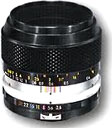
55mm f/3.5 Micro Nikkor
Normal: I have a problem with what a normal lens means.1 On a 35mm SLR, it's usually 50mm and often transmits more light than any other lens (f/1.4 to f/1.8 is typical).2 It's supposed to give an approximation of your vision, but as I mentioned before, your eyes can give you everything from a super wide-angle view to a telephoto view. I remember my compatriots and I at photo school using wide-angle lenses as our standard lens because of the exaggerated perspective. I do use standard lens to shoot portraits, and I have a macro lens (one designed for extreme close-ups) at the standard lens focal length.
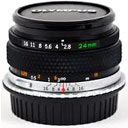
24mm f/2.8 Zuiko lens
Wide-angle: This is a lens with a wider angle of view than a normal lens. On a 35mm camera, any a 35mm or shorter lens is wide-angle. When you are trying to take that picture at Thanksgiving with all 12 of your nearest and dearest at the table, you need a wide-angle lens. The same thing goes the Grand Canyon or any architecture, interior or exterior.
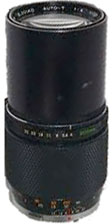
200mm f/4 Zuiko lens
Telephoto: Just like a telescope, a telephoto lens has a narrow angle of view and is used to magnify faraway objects, making them appear to be closer. On 35mm cameras, telephoto lenses start at 85mm. If you like to photograph sports action or wildlife, this is the lens for you. A number of portrait photographers use a mild telephoto lens to give a more flattering perspective of their subjects as well as some separation from the background.
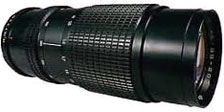
Old zoom lens for a 35mm SLR.
Zoom: If you like zoom lenses, it's time to leave the room. I admit that my opinions on this matter are purely my own, and many people use zoom lenses without mishap. I'm just an old curmudgeon who thinks that fixed focal lengths are sharper than zoom lenses.3 They tend to be cheaper and, of course, more convenient to me. But experts tell me that new, modern zoom lenses are just as sharp, easier to use, and will cure cancer in laboratory rats. I just don't care. I'd rather have two fixed focal length lenses (at opposite ends of a zoom lens range) than a zoom lens. Call me crazy, but zoom lenses are bigger and bulkier with higher f-stops, more lens elements, and a total disregard for those of us old timers who can frame a picture without having to zoom every which way.
I know I'm on there losing side of this argument, but someone has to
be. 
Publisher's Notes
- The official definition of a normal lens is a focal length equal to the diagonal of the film or imager frame. For a 35mm camera, that's a hair over 43mm. However, Oskar Barnack used a 50mm lens on his Leica prototypes, and that became the de facto normal lens for 35mm cameras. Early in the 35mm SLR era it was not uncommon to see 55mm to 58mm normal lenses, as this allowed extra room for the camera's flipping mirror. In the pre-zoom era, 35mm point-and-shoot cameras often had a lens in the 38mm to 42mm range.
- Lens speed, measured in f-stops, can be confusing, as it's not only a reciprocal (lower numbers mean more light transmission) and not linear. The range of full stops is f/1, 1.4, 2, 2.8, 4, 5.6, 8, 11, 16, 22, 32, and 45 - and there are partial stops in between, such as f/1.7, 3.5, 4.8, etc. Each f-stop transmits twice as much light as the next one in the series, so a f/1.7 lens passes four times as much light as an f/3.5 lens - and 12 times as much as an f/5.6 lens. Point-and-shoot cameras with built-in zoom lenses typically are f/3.5 at the wide-angle and and f/5.6 at the telephoto lens, which means they are much worse for low light photography than the vast majority of fixed lenses.
- Like John Hatchett, my experience with 35mm SLRs goes back to the 1970s, and zoom lenses were generally quite abysmal in that era. The first exception to the rule was the Vivitar Series 1 70-210mm f/3.5 macro zoom, which was big, heavy, expensive (especially for a third-party lens), had good lens speed for a zoom, and added a near-macro close-up mode. Zoom lenses have become a lot better since the 1970s, but a fixed lens will generally offer a crisper image and have a better lens speed.
Join us on Facebook, follow us on Twitter or Google+, or subscribe to our RSS news feed
Today's Links
- Mac of the Day: PowerBook 500 Series, introduced 1994.05.16. 'Blackbird' includes a 25 to 33 MHz 68040 along with smart batteries and grayscale or color displays.
- Support Low End Mac
Recent Content
About LEM Support Usage Privacy Contact
Follow Low End Mac on Twitter
Join Low End Mac on Facebook
Favorite Sites
MacSurfer
Cult of Mac
Shrine of Apple
MacInTouch
MyAppleMenu
InfoMac
The Mac Observer
Accelerate Your Mac
RetroMacCast
The Vintage Mac Museum
Deal Brothers
DealMac
Mac2Sell
Mac Driver Museum
JAG's House
System 6 Heaven
System 7 Today
the pickle's Low-End Mac FAQ
Affiliates
Amazon.com
The iTunes Store
PC Connection Express
Macgo Blu-ray Player
Parallels Desktop for Mac
eBay