
In early 1983, Steve Jobs and several other Apple employees visited Brown University for a tour of its computing lab, where they showed off brand new Apollo workstations. Andy van Dam was shown the Apple Macintosh before its introduction. He told Jobs that they were waiting for a “3M” machine (a term used in the 1980s to describe a powerful computer that has at least one Megabyte of memory, a Million pixel display, and a Megaflop of processing power).
At the time, Jobs didn’t know what a megaflop was.
Big Dreams
Jobs was given control of Apple’s new SuperMicro division in 1984, which combined the Macintosh and Lisa teams. His top priority was to create the Macintosh’s successor, a 3M machine dubbed BigMac. Rich Page was heavily involved in the project as well, and it was decided that BigMac would be as compatible as possible with the original Macintosh.
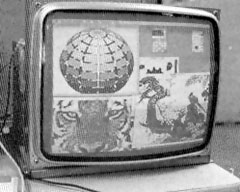 BigMac included a new type of peripheral bus known as FDB, which allowed up to six peripherals. This later became the Apple Desktop Bus (ADB). It was introduced with the Apple IIGS in 1986.
BigMac used separate video memory and system memory (RAM), compared to the Macintosh, which dedicated 21 KB of its 128 KB as video memory. The Motorola 68020 CPU would be used. BigMac included two serial ports, two SCSI ports, two disk drive ports, and three FDB connectors.
Macs with Unix
BigMac was expected to cost as much as a typical personal computer, even though it was actually a powerful workstation for its time.
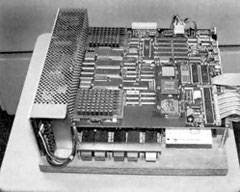
It would use the Unix operating system, and Jobs had hoped to port Macintosh software to a Unix base so developers could take full advantage of the multitasking and communications features of Unix in combination with the user-friendly interface of the Mac. Apple acquired an expensive Unix license from Unisoft through Jobs’ request, but very little progress was being made.*
Six prototypes were produced, but they all suffered from several defects. AppleShare never worked, MacBugs was incomplete, only one of the two serial ports was functional, and the sound was never completed.
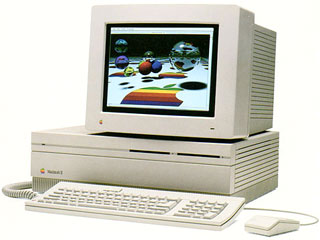 When Jobs left the SuperMicros division in the summer of 1985, the project was canceled by his replacement, Jean-Louis Gassée. Many ideas from BigMac made their way into the Macintosh II: two serial ports, internal and external SCSI, room for two internal floppy drives, and two ADB ports. However, the Mac II ran the Mac OS (not Unix), supported color, and had six NuBus expansion slots, one or more of which could be used for video, since there was no onboard video.
The Mac II, introduced in March 1987, was Apple’s first step toward a “3M” machine. It shipped with 1 MB of RAM, had a math coprocessor capable of 160 kflops (one-sixth of a megaflop), and could support megapixel displays with the appropriate video card and display. (The 25 MHz 68040-based Quadra 700 and 900, introduced in October 1991, would be the first Macs to reach the 3M mark with 3.5 mflops performance.)
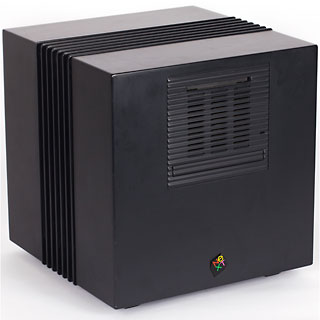 Jobs resigned from Apple later in 1985 to start his own computer company, NeXT (later NeXT Computer), which would create its own “3M” machine. NeXT produced its first Unix-based workstation, the grayscale, 68030-based NeXT Cube, which was introduced in October 1988. It included 8 MB of RAM, an almost-megapixel display (1120 x 832), and reached 265 kflops.
The NeXT Cube was followed by a line of color and grayscale models in September 1990. These 25 MHz 68040-based computers brought NeXT to the 3M mark a year ahead of Apple.
* Apple did finally deliver a Unix for Mac with its A/UX operating system, which came to market in 1988 and was maintained until 1995. A/UX provided a graphical Finder very much like the Mac’s, and it included a compatibility layer for Mac software. Unfortunately, A/UX only ran on Macs with 68030 and 68040 CPUs and FPUs; it was never ported to PowerPC. A/UX was abandoned in 1996, and after Steve Jobs returned to Apple, work began on porting NeXTstep, which is based on BSD Unix, to PowerPC Macs. This eventually became Mac OS X.
This article was originally published on 2006.11.14.
Sources
- What’s a Megaflop?, Andy Hertzfeld, Folklore.org
- Flops: Big Mac, L’Aventure Apple
Keywords: #bigmac #applebigmac
Short link: http://goo.gl/382EzJ
searchword: applebigmac
