
As a computer manufacturer, Apple gets a strangely distorted press. Its position as the only serious commercial competitor to Microsoft guarantees that every move the company makes is documented – and often distorted.
Over the years, the company has had a few models that failed to live up to sales expectations such as the Newton PDA, the Power Mac G4 Cube, and the Macintosh XL. These computers are often portrayed in the press as failures, but in most cases that’s an exaggeration.

Most people think that the Macintosh was the follow-up to the Apple II, but that’s not the case. Lurking in Apple’s Cupertino headquarters is the memory of a machine that the company would prefer to forget – the Apple III. With this machine Apple dropped a clunker. Literally.
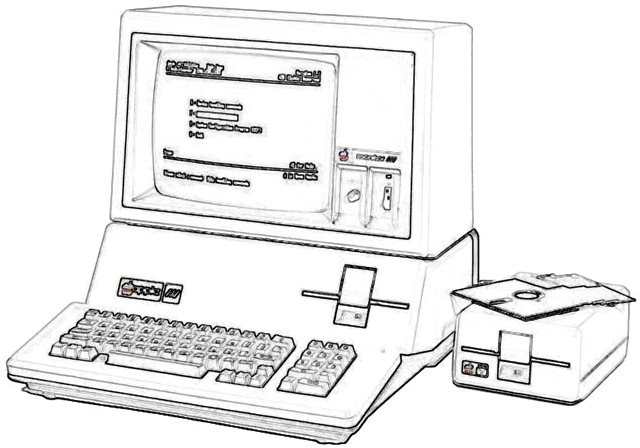
Where the IIGS was a successful product that failed to achieve all that it could have, the earlier Apple III was an unmitigated disaster.
The Apple III was stillborn, a doomed machine from the beginning. Priced between US$3,495 and $4,995 – plus a monitor and hard drive and printer – not only was the Apple III mind crunchingly expensive, it was made with none of the passion of the Apple II or Macintosh. Instead, it was designed to be a stopgap machine until Apple’s long term projects – Lisa and Macintosh – could be realized.
The Changing Market
In 1977, Apple had had the microcomputer market almost entirely to itself. Except for Tandy (Radio Shack) and Commodore, no other manufacturer produced computers in anything other than kit form. By 1980, Apple was facing stiff competition from several computer manufacturers including Atari, Tandy, and Commodore. (See Jeremy Reimer’s Personal Computer Market Share: 1975-2002 for more details.)
Worse still, Apple knew that IBM was due to debut its own PC the following year. The Apple II’s success was in part due to one piece of software, VisiCalc. This was the first spreadsheet software, and it had become a killer-app, guaranteeing the Apple II a place in business.
Apple knew that IBM would pursue this market aggressively.
The company’s management considered it inconceivable that the Apple II, originally released in 1977, could possibly last another twelve months, so they pushed the engineers to develop a new machine, a kind of super Apple II that was more suited to business applications.
Enter the Apple III
Announced on 1980.05.19 during the National Computer Conference in Anaheim, California, the Apple III shipped in the autumn of that year. It ran twice as fast as the Apple II and had 128 KB of RAM – twice as much memory as the Apple II. The Apple III was the first Apple computer to have a built-in floppy drive, a Shugart 5.25″ floppy drive that could store 143 KB of data (just like the Apple II).
The machine was code-named Sara and used a powerful operating system called SOS (standing for Sara’s Operating System and later changed to Sophisticated Operating System). SOS used an advanced memory management system and was device independent.
SOS was the only thing to be salvaged from the Apple III debacle, forming the basis of ProDOS, the improved OS for the Apple II. Some parts of SOS eventually made their way into the Lisa and Mac OS code-bases.
Flawed Design
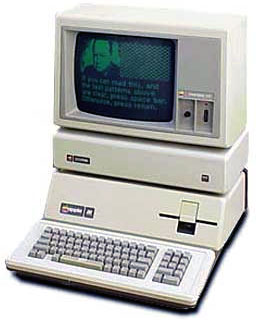
Apple III with 5 MB ProDrive hard drive.
The case design is probably the most noteworthy aspect of the Apple III, not only because it is unusually ugly by Apple’s standards, but because it is deeply flawed from an engineering perspective. The entire American computer industry was waiting for new guidelines on electromagnetic radiation from the Federal Communications Commission. Apple decided that they couldn’t wait for the FCC, so the Apple III’s designer, Jerry Manock, decided to make the III “bulletproof”. Underneath the computer’s beige plastic case lay a cast aluminum chassis that shielded the computer from interference. The chassis, produced by a Toledo-based car parts manufacturer, was so massive that it would pass the most stringent emissions tests in the world.
Unfortunately, this was an expensive and unwieldy solution. Steve Jobs had insisted that the machine have no fan, so the chassis became a heat sink. It didn’t work properly, and the machine often got so hot that chips would pop out of place due to thermal expansion. Apple literally told customers to lift the system several inches above their desks and drop it to reseat the chips.
Other problems included the fact that the machine was quietly sold as compatible with the Apple II, while in reality it was only partially compatible. One member of the design team, Randy Wigginton, puts the machine’s flaws down to a combination of “feature creep” and the fact that “the III was designed by committee. Everybody had ideas about what the III should do . . . and all of them were included.”
Apple attempted to keep the machine alive by beefing up the memory to 256 KB and fixing the case problems to no avail. The machine was discontinued in September 1985.
This article was originally published on 2005.01.05.
Further Reading
- Apple III Chaos: What Happened When Apple Tried to Enter the Business Market, Cortland, 2006.09.01.
- 2 Apple Failures: Apple III and Lisa, Tom Hormby, Orchard, 2005.05.16. Apple’s two not-so-great product lines between the Apple II line and the Macintosh.
- Apple III, OldComputers.Net
- Apple III and III+, Apple History
- Apple III, Apple Museum
- History of Computer Design: Apple III, Apple and the History of Personal Computer Design
- Apple III, Phil Beesley
- Apple III, Marina
- The Apple III Personal Computer System, Washington Apple Pi
- Apple III and III+, Unofficial, Unauthorized, Apple Online Museum
Keyword: #appleiii #6502 #6502cpu #mostech6502
Short link: http://goo.gl/wYL1lj
searchword: appleiii
