The Apple IIGS, Apple's Home Computer for 1986
2005.02.16
Jason Walsh takes a look back at Apple's largely forgotten 16-bit home computing powerhouse, the Apple IIGS.
In the late 1980s and early 1990s, computing made a great leap forward with the advent of 16-bit microcomputers like the Macintosh, Commodore Amiga, and Atari ST.
The Apple II, introduced in 1978, was a phenomenally successful platform, eventually coming to possess a 20% share of the personal computer market in the US. But by 1985 the era of the 8-bit computers was coming to an end.
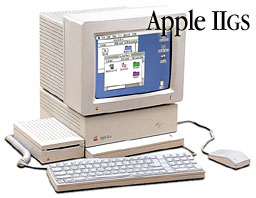
While the Mac was running rings around the IBM PC - in terms of usability if not sales - Apple decided on a different strategy to deal with the 16-bit home computer market. The Apple IIGS, released in 1986, was Apple's answer to Commodore's and Atari's next-generation machines.
 As every Mac-fan knows, the Apple story
started in 1976 when two phone phreakers decided to make a computer.
The pair were both named Steve: Steve Wozniak was the visionary
engineer who designed the machine, soon to be called the Apple I, and
the now infamous Steve Jobs was the man who saw the commercial
potential of computers in the home.
As every Mac-fan knows, the Apple story
started in 1976 when two phone phreakers decided to make a computer.
The pair were both named Steve: Steve Wozniak was the visionary
engineer who designed the machine, soon to be called the Apple I, and
the now infamous Steve Jobs was the man who saw the commercial
potential of computers in the home.
Aside from troubling the phone company, the pair had legitimate engineering jobs: Wozniak was working at Hewlett-Packard, and Jobs at Atari.
It was in Jobs's garage that Wozniak designed the Apple I computer. After offering it to HP, which turned it down, Apple Computer was formed to sell the machine. It was marketed in 1976 at a price of $666. The Apple I was the first single-board computer with a built-in video interface and onboard ROM that told the machine how to load programs from an external source.
Jobs was marketing the Apple I at hobbyists like members of the Homebrew Computer Club, but when he and Woz sat down to design the Apple II, he had grander plans.
In 1977, Apple unveiled the Apple II to the world - the first color-capable microcomputer. The company strongly encouraged third-party software development, and by 1983 there was a library of 16,000 software programs for the machine. The Apple II set the standard in personal computers and was an enormous success. Within three years the company had made a profit of $139 million - 700% growth.
Apple went public in 1980 with an initial offering of $22 per share, and the price went up to $29 on the first day of trading. At the end of the first day, Apple had a value of $1.778 billion, the biggest initial public offering since Ford. Jobs alone was worth $250 million.
 Market Reception
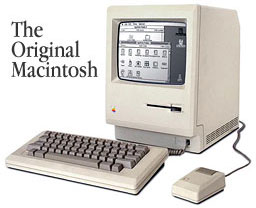
By 1984, Apple's loyal users were hungry for a new machine. Despite having been revised several times, the Apple II was showing its age, while the Mac was too expensive for home use - and while the Mac featured a high-resolution display, it was monochrome.
When you consider that the Apple II was the first computer capable of color graphics, there was no way the Apple II user-base would settle for a mono machine.
 In 1984, Apple had released
the Apple
IIc, but this was still an 8-bit computer. Its main selling point
was that it was portable. It had a tiny form factor, and Apple released
an LCD screen and battery pack for it, making it a very capable
"laptop". And for those on a budget, Apple offered a compact 9"
green-screen display
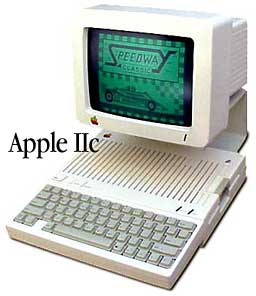
In 1984, Apple had released
the Apple
IIc, but this was still an 8-bit computer. Its main selling point
was that it was portable. It had a tiny form factor, and Apple released
an LCD screen and battery pack for it, making it a very capable
"laptop". And for those on a budget, Apple offered a compact 9"
green-screen display
The IIc sold in very high quantities, but users were hungry for more power. The planned successor was variously code named Cortland, Phoenix, Rambo, Gumby, and Mark Twain.
To the acclaim of its fans, Apple unveiled the IIGS in September 1986. The machine was quite pricey at $999 plus $399 for a 3.5" floppy drive or $299 for a 5.25" drive. A colour monitor cost a further $499 - or $129 for a mono green screen. Despite this, the IIGS initially performed well, outselling the Mac at the time of launch.
This initial success was not to continue. Apple did not seriously market the machine, and it was eventually outsold by the Amiga and the Mac. Outside of North America, the machine made some impact in France, but Apple's sky-high prices in comparison to those of Commodore and Atari hampered the machine in Europe. An Amiga could be had for almost half the price of a IIGS.
Apple IIGS Specifications
| CPU | Western Design Center 65C816 (16 bit) |
| Speed | 2.8 MHz, switchable to 1 MHz |
| RAM | 128 KB expandable to 8 MB |
| ROM | 128 KB expandable to 1 MB |
| Text Modes | 40 or 80 chars x 25 lines |
| Graphic Modes | 320 x 200 / 640 x 200 + Apple II graphic modes |
| Colors | 4096 |
| Sound | Ensoniq 32 with 16 stereo voices (+ 64 KB on chip RAM to store sound data), one voice is reserved for the system beep |
| Keyboard | Detached 80-key full stroke with 10-key numeric pad and mouse connector |
| I/O Ports | 7 slots, RAM card, RS-422c (2), analogue RGB, Apple Desktop Bus (mouse & keyboard), Composite video, joystick, audio, disk port, AppleTalk |
| OS | GS/OS, ProDOS 8 & 16, DOS 3.3, Pascal UCSD, CP/M (with Z80 card) |
| Size | 28.5 (W) x 34.3 (D) x 10.1 (H) cm. |
| Price | $999 when launched. RGB monitor, $499; monochrome monitor $129, 3.5" floppy drive $399, 5.25" floppy drive $299, 256 KB RAM card $129, 20 MB hard drive $1,299, SCSI controller card $129 |
Further Reading
- What Is the Apple IIgs?
- Apple IIgs, Apple History
- Apple IIgs, Old Computer Museum
- Apple IIgs, Old Computers
- Apple IIgs, Apple Museum