
Apple Archive
The Lovable Colour Classic
- 2000.07.10
Ah, yes, the Macintosh Colour Classic. Arguably one of the best computer designs ever, only limited by its slow processor, bus speed, and 10 MB memory limit.
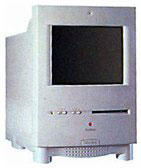 When it appeared in 1993 for US$1,400,
the public immediately fell in love with the design. After drooling
over its beautiful curves and small colour screen, they turned it
on. Of course it chimed like any other Macintosh - but what a slow
computer!
When it appeared in 1993 for US$1,400,
the public immediately fell in love with the design. After drooling
over its beautiful curves and small colour screen, they turned it
on. Of course it chimed like any other Macintosh - but what a slow
computer!
Its logic board design was similar to the Macintosh LC II logic board, which was poorly designed and contributed to its sluggish performance. Why did Apple, with the Quadras and high end 68030 Macs already on the market, use such a compromised logic board? Maybe to save money. Maybe use up leftover LC and LC II parts. Maybe just to prevent the Colour Classic from getting in the way of the sales of the Quadras and higher end '030s.
Whatever the reason, people were still charmed at the small colour screen and simply adorable case (who thought that that word would ever be used to describe a computer).
All Colour Classics came with System 7.1 installed; however, it can run all the way up to Mac OS 7.6.1, which is not recommended. System 7.1 or 7.5 runs very well on the CC. I upgraded to 7.5 the other day, and it has been a very good experience. I have 8 MB of memory and an 80 MB hard drive.
First of all, my Colour Classic feels faster. It may take longer to start up, but it feels faster when in an application.
Second of all, with System 7.1, there is a down time after you choose Shut Down from the Special menu where the screen goes blank for several seconds, but the machine is still on. 7.5 eliminates that.
7.5 also supports Open Transport networking, prettier desktop patterns (I like my computer to look cool - my favourite is the blue cats), menu bar clock (based on SuperClock, remember that one?), and the Macintosh Guide. Those are just some of the improvements with System 7.5.
The Colour Classic came from the factory with 4 MB of RAM onboard and an 80 MB hard disk. The memory can be upgraded with two 4 MB 30-pin SIMMs to a total of 12 MB, but the Colour Classic's logic board can only see 10 MB of that total.
Some upgrades will let you get around that, such as the ThunderCache Pro from MicroMac (also supports the LC, LC II, and Performa 400-430). The ThunderCache Pro lets you upgrade to 26 MB of RAM (10 MB on the motherboard plus up 16 MB on the accelerator), and gives you either a 32 or 50 MHz 68030 with a 32 KB level 2 cache and the option of an equally fast math coprocessor (or FPU). The ThunderCache Pro sells for US$249-299 and provides 120% to 250% more power than the stock CC. (Less expensive accelerators from MicroMac include the Thunder (32 MHz 68030, optional 16 MHz 68881 FPU, 70% performance boost, US$99, CC version currently unavailable), Thunder Cache (32 MHz 68030, optional 32 MHz 68882 FPU, 32 KB cache, 120% boost, US$99-149, CC version currently unavailable), and ThunderPro (32 MHz 68030, optional 32 MHz 68882 FPU, 70% boost, US$199-249).
Sonnet Technologies also offers the Sonnet Presto Plus, which includes 32 MB of RAM (in addition to whatever is on your motherboard), a 33 MHz 68040 or 68LC040 processor, and a 10Base-T ethernet port. It also supports Mac OS 8.1 and provided up to 550% more performance. All this comes at a price, and that price starts at US$349.
You can also replace the original Colour Classic logic board with one from an LC 550 or LC 575. If you want, you can make a Power Colour Classic, like they do overseas. That involves installing a Power Macintosh logic board into a Colour Classic case.
MicroMac will also upgrade the little 10" Sony Trinitron display from 512 x 384 resolution to 640 x 480, the resolution found on most 14" monitors, for US$99.
On the fourth of May in 1994, Apple Computer quietly halted production of the Macintosh Colour Classic. That day sadly marked the end of one of the best-designed computers ever made.
- NOTE: Apple introduced the Colour Classic II in Canada in October 1993, and a bit later in the Asian and European markets. Also known as the Performa 275, this vastly improved 33 MHz version of the Colour Classic was never sold in the U.S. market. ed
Only the iMac, in my opinion, was a computer that was as cute, affordable, and well received as the Colour Classic. (In fact, it was a much bigger hit than the Colour Classic.)
Apple took a big chance when releasing the Colour Classic and the iMac; they wanted to make a low-priced, attractive computer that would be well received. This is hard to do. However I believe they succeeded at it.
Further Reading
About LEM Support Usage Privacy Contact
Follow Low End Mac on Twitter
Join Low End Mac on Facebook
Favorite Sites
MacSurfer
Cult of Mac
Shrine of Apple
MacInTouch
MyAppleMenu
InfoMac
The Mac Observer
Accelerate Your Mac
RetroMacCast
The Vintage Mac Museum
Deal Brothers
DealMac
Mac2Sell
Mac Driver Museum
JAG's House
System 6 Heaven
System 7 Today
the pickle's Low-End Mac FAQ
Affiliates
Amazon.com
The iTunes Store
PC Connection Express
Macgo Blu-ray Player
Parallels Desktop for Mac
eBay