
Apple Archive
The Mac Dilemma: Low Cost and Limited Expansion or High Cost with Great Upgrade Potential?
- 2007.02.20
The topic of upgrading older Macs has come up again recently (see Adding an Intel Mac mini Can Be Cheaper than Upgrading a Power Mac G4!). With Apple's current, more consumer-oriented offerings that lean toward lower prices, the argument for buying new is very strong - especially in light of to the relative un-upgradability of Apple's recent past offerings.
Performa vs. Power Mac
In the mid to late 1990s, Apple had a reasonable hierarchy of models, as complex as the naming of them was. The Performa 5x00 and 6x00 series were consumer multimedia desktops that shipped with bundled software and often bundled hardware (like a TV tuner card, something you can't get built into any current Mac).
The Power Mac 7x00 series were professional desktops designed for a business environment. The 8x00 series were midrange minitowers that allowed for a decent amount of upgradability and were typically used in businesses and offices. And the 9x00 series were the graphics powerhouses; no design firm in the 90s was complete without one.
While the 5200s and 6200s had limited upgradability because they were based on older motherboards designed for pre-PowerPC Macs, the 5300-5500 and 6300-6500 were extremely upgradable with CPU upgrades and PCI cards - just like the Power Mac models. Perhaps the most significant limitation of these models was memory: It could only be upgraded to 136 MB on models that came with 16 MB on the motherboard - and 128 MB on those that had no built-in RAM. These were some of the last desktop Macs to come with RAM onboard.
The Power Mac models were highly sought-after for quite some time due to their ability to accept daughter cards for fast 604e, G3, and G4 processors. With XPostFacto, these machines could be made to run OS X, and with a G3 or G4 upgrade, they generally ran it fairly well.
In 1997, the Power Mac G3 replaced the 7x00, 8x00, and 9x00. It was available in both desktop and a tower configurations that allowed for expandability and upgradability with their PC66 RAM slots, ZIF CPU socket, and three PCI slots. They were also the first top-end Macs to include IDE hard drive support.
Enter the G3
I've owned both a desktop 233 MHz G3 and a minitower 266 MHz G3, and I was impressed at the expansion capabilities of both. The audio Personality Card could be removed and replaced with one that allowed a composite video (as used by a TV) to be connected to the computer.
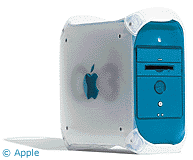 In 1999, the
blue and white G3 (code name:
Yosemite) was released. This is still one of my favourite Macs, if
for no other reason than the design of the case. The side could
fold down like a drawbridge for easy access to all of the
components inside - try finding a PC like that in 1999!
In 1999, the
blue and white G3 (code name:
Yosemite) was released. This is still one of my favourite Macs, if
for no other reason than the design of the case. The side could
fold down like a drawbridge for easy access to all of the
components inside - try finding a PC like that in 1999!
There were four RAM slots that held PC100 RAM and four hard drive bays - plus one for an optional Zip drive (which mine had, although I never used it). The processor used the same easily upgradeable ZIF socket as the beige G3s, and G4 upgrades were readily available. By the time I finished with mine, which ran at 300 MHz, had 320 MB of RAM and a 40 GB hard drive, and was running Mac OS X 10.3. While not particularly fast, it was very solid and reliable.
But it was slow. I could have improved the speed with a 500-800 MHz G4 upgrade, but I'd still have only 320 MB of RAM, a 40 GB hard drive, and ancient ATA/66 hard drive controller (there was a bug with the ATA/100 controller that caused problems with some drives over 20 GB - using that controller for the CD-ROM and the AT/66 controller for the hard drive was the workaround), not to mention the 16 MB video card.
I could have easily put $500 into upgrading it and come out with a machine not much better than a used G4. Given that the computer's original price was $1,600 and that it had lasted five years with relatively few upgrades, it was time for something newer.
Power Mac G5
The dual 1.8 GHz Power Mac G5 that I purchased in the summer of 2005 (see Moving Up from a 350 MHz Power Mac G3 to a Dual 1.8 GHz Power Mac G5) is what I would call a marvel of industrial design. It looks fantastic from any angle - even the rear and the interior. It's solid, heavy, and genuinely feels like it was worth the price I paid. Performance is also what I paid for, and it hasn't disappointed there. It's every bit as fast currently as it was when I purchased it 18 months ago.
Unfortunately, upgradability was not an added bonus.
While the G5 does have a SATA drive controller onboard, it only has two hard drive bays. I currently have two internal hard drives, and I plan on adding a third. Well, I would have planned on adding a third if I could have - instead it looks like I'll have to spend more money in order to replace one of the drives already in the machine (I routinely bring the machine from school in Montreal to the family home in Connecticut, so an external drive isn't a good solution).
RAM is slightly less expandable and a bit less simple than in the G3 and G4 Macs before it. I have to upgrade RAM in pairs, and the machine can hold a maximum of 4 GB. Considering that when I purchased the machine I installed an additional 1 GB beyond the 256 MB that it came with and thus started out with 1.25 GB, 4 GB doesn't seem like a lot.
Then there are the processors. It's stuck as a dual 1.8 GHz G5 forever, especially now that Apple's switched to Intel chips (which, interestingly enough, allow for a lot more upgradability).
Intel Macs More Upgradable
For the roughly $2,000 that I spent for this system and a 19" LCD in 2005, I could now have a very nice Intel Core 2-based 20" iMac - and with the iMac there's the option of a processor upgrade in the future. In fact, you can upgrade the CPU in all Intel-based desktop Macs.
Sadly, these days most consumers don't want a nice, expandable desktop or minitower that they can upgrade a few times before they finally replace it. Ask most people how much RAM or what size hard drive is in their machine, and they'll probably tell you they have no idea and don't really care. If the machine's too slow, they'll buy a new one.
Apple's figured this out and has been doing well with the Mac mini and iMac. Its current offerings are user-friendly, look pleasing, and generally tend to work well, but these consumer Macs don't offer the raw expandability of the 7x00-9x00 models or G3 and G4 Power Macs.
Upgrade or Replace?
If your machine is just running out of hard drive space, a new hard drive is a relatively basic upgrade - and fairly inexpensive, too. RAM upgrades are again easy and a good way to improve system performance. Unfortunately, if you've got a Power Mac G5 or a G4-based laptop, your options for upgrading the processor are almost nonexistent.
If your tasks are relatively basic, a Mac mini is an excellent option if you've already got a display, keyboard, and mouse. For $599, it doesn't really matter if you use it for more than a couple years.
If you don't have existing peripherals (or plan to keep them with an older system), you might consider a refurbished MacBook. The online Apple Store occasionally offers deals on refurb models, and buying a refurb MacBook for under $1,000 gives you not only the keyboard and mouse, but the mobility option. If nothing else, it's an excellent way to gain more space on your desk - just pick up the computer and put it somewhere else.
Sadly, upgrading isn't what it was ten years ago. The options for upgrading Macs are fewer, and the incentives for buying new are too good. But don't throw out your old system - if it works well for you, you don't need to change anything.
Join us on Facebook, follow us on Twitter or Google+, or subscribe to our RSS news feed
Today's Links
- Mac of the Day: PowerBook 500 Series, introduced 1994.05.16. 'Blackbird' includes a 25 to 33 MHz 68040 along with smart batteries and grayscale or color displays.
- Support Low End Mac
Recent Content
About LEM Support Usage Privacy Contact
Follow Low End Mac on Twitter
Join Low End Mac on Facebook
Favorite Sites
MacSurfer
Cult of Mac
Shrine of Apple
MacInTouch
MyAppleMenu
InfoMac
The Mac Observer
Accelerate Your Mac
RetroMacCast
The Vintage Mac Museum
Deal Brothers
DealMac
Mac2Sell
Mac Driver Museum
JAG's House
System 6 Heaven
System 7 Today
the pickle's Low-End Mac FAQ
Affiliates
Amazon.com
The iTunes Store
PC Connection Express
Macgo Blu-ray Player
Parallels Desktop for Mac
eBay